A spectrum of disorders where the normal left-right arrangement of organs in the body is disturbed (“errors of lateralisation”).
Situs inversus is complete mirror image arrangement – there are no health consequences as a result (other than iatrogenic eg delayed diagnosis of appendicitis).
Many genetic causes. Primary cilial dyskinesia (Kartagener syndrome) is one.
Heart – IVC can be interrupted, requiring azygos veins to drain lower body vessels back to heart. Many variations of valves and connections seen. Congenital heart block often seen.
Lipid transfer protein. One of the allergen families. Cross reactions therefore seen with fruit (stoned fruit but also raspberry), nuts, seeds (eg linseed/flaxseed), pulses, even cereals, tomatoes, vegetables (lettuce! Cabbage!). You may also see reactions only to composite foods eg pizza, curry, due to multiple allergens being present, but only producing reaction due to co-factors.
A less common cause of Pollen food syndrome than PR10 allergy. Thought of as a Mediterranean thing but increasing reports from Northern and Western Europe. Plane tree and mugwort have LTP but not thought to be the usual cause for sensitisation (except maybe in China). In N/W Europe, often birch sensitised too but not to be confused with PR10 type PFS!
Important to identify because heat stable (so not affected by heat, processing, digestion etc in the way PR10 allergens are) and potential for severe reactions.
So do component testing if atypical (eg unusually severe) reactions to fruit.
LTP allergy also seems to be more likely to cause reactions of varying severity, compared with primary food allergy, with co-factors perhaps more important. Eating multiple different plant foods at the same time seems to be the most likely cause of co-factor associated severe reactions. Of course, co-factors can co-exist too (alcohol and dancing, for example). So some would advise:
Avoid exercise for 2 hours before (more in same cases) and 4 hours after eating
Danger that with LTP allergy you show sensitisation to multiple foods, and then you end up on a restricted diet without knowing whether there is allergy or not.
Peach allergen Pru p 3 is a good surrogate for LTP allergy, even if peach hasn’t been a problem! If not available, you could test with SPT reagent for peach that is rich in pru p 3 (but might be false positive due to other components being present. London plane and mugwort allergy would also support.
Wheat is a bit tricky – the wheat LTP Tri a 14 is only 45% homologous with Pru p 3 so may get missed. Given the co-factor issue, probably good to do Tri a 19 (omega 5 gliadin, as in exercise induced anaphylaxis) as well.
Where hay fever and atypical reactions to nuts, do the LTPs Ara h 9 (peanut), Cor a 8 (hazelnut), Jug r 3 (walnut). You would do the other components to exclude primary food allergy which can co-exist with LTP sensitisation.
Food challenges have limited use in this situation – if positive, unclear whether LTP is the cause, and if negative, perhaps because of co-factor issue! Exercise challenge?? May just need a bigger dose!
Management
Individualize, to balance risk of reaction against dietary restriction.
Safest fruit/veg appear to be potato, carrot/root vegetables, beans, peas, melon, cashew and pistachio. Avoid pips and skin. Banana is hit and miss.
Good results with Pru p 3 sublingual and oral peach juice immunotherapy in Spain and Portugal.
Julie McCabe died in 2011 as a result of anaphylaxis to Para-Phenylenediamine (PPD) in hair dye. Black henna is known to contain PPD, so may sensitise.
Getting it right is important because otherwise people (child but also the rest of the family) end up anxious and scared of foods, cut out different foods, spend out on expensive alternatives, and risk nutritional/growth problems as well as aversion in the child.
In young infants, avoiding foods unnecessarily makes it more likely that you will become allergic in the future (“iatrogenic food allergy”). This is especially true with atopy and sensitisation – one series of 11 patients sensitized to cow milk found that all developed true cow milk allergy after a median time of avoidance of 2.3 years (with no significant improvement in their atopic dermatitis, which was the initial reason for avoidance). Pronuts study confirmed that multiple nut/sesame allergies was a factor of age – “secondary spread”. Similarly, in the Learning Early About Peanut (LEAP) study, it was precisely the infants sensitized to peanuts who were more likely to benefit from early introduction.
Having unproven food allergies also causes huge problems for schools and nurseries, and may lead to the public becoming sceptical of true allergy, with potentially disastrous consequences.
Getting it right can identify other potential allergies; it can help estimate risk of anaphylaxis; it can help with predicting whether the allergy is going to go away or not.
Allergy focused history
EATERS method –
Exposure – did they actually eat it!? Or was there clear skin contact? Perhaps from surface contamination?
Allergen (suspected) – one of the common ones? Although you can be allergic to pretty much anything, it is really rare to have an isolated rare food allergy.
Timing – type 1 is immediate (within 15 minutes, rarely up to 1hr after) and then settles even without treatment within 24 hours. Rare to fluctuate.
Environment – home (usually during weaning)? Outside home? Co-factors (infection, medicines, exercise, sleep deprivation) come in here.
Reproducible – consistent reactions with exposure? May have had before with type 1 allergy but often on trying for the first time, and won’t have had recently. Milk/egg different, of course…
Symptoms – type 1 vs non type 1. Some overlap of course.
Other issues are age (adolescents with hay fever more likely to develop secondary pollen food syndrome type allergies), alpha-gal allergy can be delayed up to 3 hours; raw vs cooked food sometimes makes a difference; usually you already have eczema and family history of atopy.
Testing
At the end of history taking, you should have be able to assess probability of type 1 allergy. If low, you may wish to proceed straight to challenge (unless reactions sound severe). Otherwise testing may help confirm or refute.
If negative/equivocal on initial skin prick or specific IgE testing, do another test! Skin prick if negative/equivocal IgE, and vice versa.
IgE Component testing may give added information, esp where potential pollen co-sensitisation – best evidence (mostly in US population, however) for Peanut, Hazelnut, Cashew (respectively Ara h 2, Cor a 14, Ana o 3 – other components may give extra information in some cases). Jug r 1 v specific (walnut) but not v sensitive.
Challenge
Challenge will be useful where results still equivocal – viz
Results positive but never eaten or history inconsistent
Results positive but possibly co-sensitivity without allergy
A technical term, not just a fever without obvious source! Essentially presence of confirmed fever for 8 days or more in a child in whom a careful thorough history and physical examination, and preliminary laboratory data fail to reveal a probable cause.
Long list of possible causes, long lists of possible tests – do thorough history and repeated examinations, then follow the clues!
In kids, infection is the commonest cause. But can be connective tissue disorder, or malignancy.
Beware factitious fever – admission sensible.
If possible, stop all drugs. Antipyretics may obscure the pattern of fever, and can occasionally be its cause (drug fever is one cause).
Unless the child is critically ill, try not to give antibiotics. If the diagnosis remains obscure, go back and take the history again, examine the child (fully) again, send the specimens again!
After that, if still doubt then for peanut, hazelnut or cashew, if in doubt do component tests Ara h 2, Cor a 14, Ana o 3 respectively (if available) – otherwise do skin prick or IgE if not done already.
Where peanut or sesame allergy still in doubt, do basophil activation test (BAT – if available – nowhere in Scotland, as far as I know)
“Reassessment of food allergic children, at regular intervals, depending on age, food and patient’s history, is suggested for possible development of spontaneous tolerance”
Ara h 2 (cut off 0.44) has 82% sensitivity and 92% specificity cf 84 and 86% for SPT of 4mm, so equivalent. Cor a 14 (cut off 0.64) has 73 and 95%, so not great sensitivity. Ana o 3 (cut off 0.4) pretty good – 96 and 94%.
If random reactions, then consider hidden allergens: celery, mustard, cochineal, lupin, soy, fenugreek, other legumes such as pea/bean/lentil protein, insects/mealworm, pink peppercorns.
Panel tests
=multiple specific IgE tests done at the same time (the ultimate being the ALEX3 test, where 280+ different antigens are tested simultaneously) – likely reduced sensitivity, compared with individual test, but more importantly, potential for false positives, with attendant harms (including iatrogenic food allergy, if that food then avoided unnecessarily).
Advances of Alex3 over Alex2 include new molecular allergens including alpha-Gal, chicken (Gal d 7), celery (Api g 7, predicts anaphylaxis), wheat (Tri a 36, and Tri a 37), oak pollen, and honeybee venom; inclusion of lentil and pea.
Proteins responsible for a minority of allergic reactions to peanut, hazelnut, sesame among others – hydrophobic, so tend not to be well represented in skin prick and IgE test solutions. May explain false negatives.
Specific IgE tests have been developed, but otherwise you just have to challenge.
Dutch study however didn’t find that specific testing for oleosins helped much.
Once a child starts school/nursery, the risk of reactions (and anxiety about potential reactions) starts to ramp up. Obviously, this is because other people are responsible for sourcing and providing food, often to many different children at once.
In the UK, probably 1 pupil with a food allergy in every classroom.
“Schools are the most common setting for severe allergic reactions, with 18% of all food allergy reactions and 25% of first-time anaphylactic episodes occurring there. Fatal anaphylaxis in children occurs more often in schools than any other setting” [Benedict Blythe Foundation “Keeping the promise” document] – but this data appears to be from old US studies. From my data (19/8/26) I see 4 mentions of anaphylaxis related to school in the last 2 years (about 10% of all anaphylaxis reports) – but half of these were actually related to after school.
Miranda Crilley (CHI Dublin) reported on 521 food allergic children attending school/nursery, and found a 4.5/5% annual rate of reactions in schools. Half of nursery reactions due to milk. 6 of 7 nut reactions in schools with nut bans! 33% of children had not provided copies of their allergy action plans to the school. 22% or the reactions were judged as anaphylaxis, none received adrenaline from school staff. “Promoting milk/egg tolerance in infancy would prevent”.
Scottish government policy on healthcare needs in schools (2017): talks about “coordinated support plans” as well as individual health plans and child plans. Talks about local strategic joint arrangements between NHS boards and educational authority. Inhalers and defibrillators (!) specified. “General awareness raising training of common conditions should be provided… for example, asthma, diabetes, epilepsy, eczema and allergic reactions (including anaphylaxis).”
Specific school arrangements may include:
who in the school accepts responsibility, in principle, for supporting the healthcare needs of children and young people in the school;
who is responsible in school for staff training in regard to supporting healthcare needs and administering medication;
emergency procedures at the school including a main point of contact in the school health team [defined how?];
details of any centrally held inhalers; anaphylaxis auto-injectors; the storage of and access to medication in the school;
who is responsible for ensuring the safety of children and young people’s self-management of their medical conditions;
the arrangements in place to ensure that staff are informed and kept up to date about children and young people’s healthcare needs at school.
First do no harm – parents tend to overestimate risk of anaphylaxis, whereas there are clear consequences to restricting the child’s ability to sit with other children at snack/meal times, or restricting the food choices of other children.
Recommends that an Allergy management policy should be in place (even if incorporated into wider medical conditions policy) even if no currently diagnosed allergic children [quotes 25% undiagnosed reaction rate in school] – cites 2017 Government supporting CYP with healthcare needs document:
Procedure for identifying pupils with allergy and high risk pupils.
Details on developing Individual Healthcare Plans.
Protocol for storage and access to emergency medication – emergency kits.*
Arrangements for staff training.
Policies and arrangements on Preventative Measures.
Details on the administration of medications.
Protocol for the emergency response to anaphylaxis.
The rights, roles and responsibilities of staff, pupil(s) and parent/ carer(s).
Highlights breakfast clubs and after school as under the remit of schools (and school trips, too).
And another about how schools can become more allergy aware – because it’s not just about nuts – https://youtu.be/JHnmcmUP6Cs?si=FgjhoxcOdMoEb7eS. George Raptis has shown how school allergy training (in NW England) can improve allergy awareness, not just confidence in managing an allergic emergency.
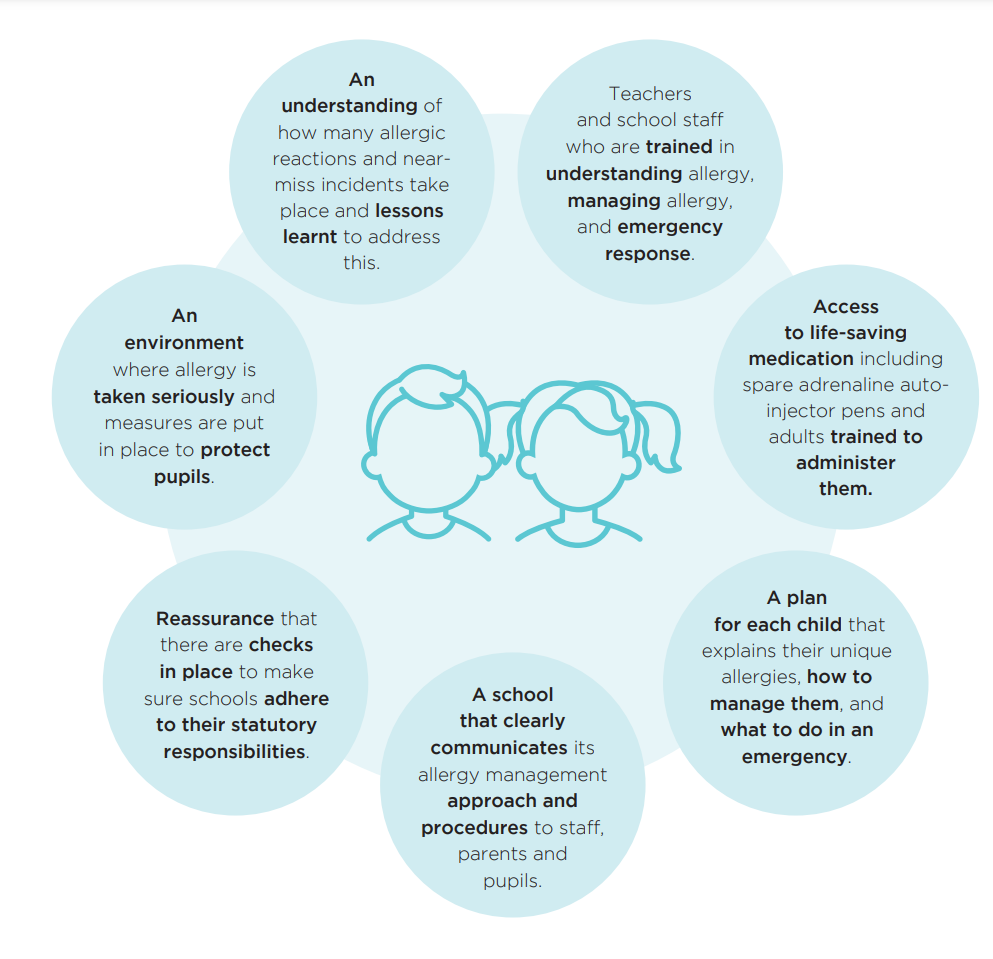
Whole school approach – not just catering/medical – skills (risk reduction, inclusion, first aid); allergy awareness in classroom activities [curriculum?]
Communicate clearly – Allergy and Anaphylaxis Policy (no template!) – (accessible), – and designated allergy lead. IHPs (individual health plans)
Clear governance and risk management – designated lead, other roles/responsibilities. Allergies in every risk assessment
Readiness to respond – 2 in date AAIs for those prescribed them. Hold spare pens in obvious place. Annual risk reduction and ana training. “Ana emergency response plan” [in allergy policy, presumably?], rehearse
Schools allergy code backed by Dept of Education in England.
React report
Data from 2000 English schools, about 10%.
Assessed 4 allergy safe guards: a specific allergy policy, spare pens, allergy training for staff, incident reporting.
69% did not have all recommended safe guards in place. “Pot luck whether your local school has medication, communication and education relating to allergy made available to teachers”. But commented on how well schools are managing despite “seeming lack of guidance, training and funding from government”.
School Allergy Code recommendations
Training
“All schools that are OFSTED monitored AND provide early years education must have at least one member of staff paediatric first aid trained including anaphylaxis treatment”.
First aid training, and even anaphylaxis training, is not the same as allergy awareness, however. 25% of schools don’t train staff on identifying allergy symptoms and anaphylaxis, and what to do in an emergency. Mandatory in New York day care (Elijah’s law), Canadian schools (Sabrina’s law).
Various free and paid for training programmes available. KITT Medical includes training in its package, that includes emergency adrenaline autoinjectors. Natasha Allergy Research Foundation offers Allergy School – includes self assessment for primary schools (also for clubs). Free. Resources for age groups eg 5-7 including going to a party (Armadillo film), assembly plan, top 14 allergen poster.
School Allergy Policy
BSACI Model policy includes (last 9 pages actual template – mostly repetition of initial text):
reference to laws on supporting pupils with medical conditions;
how first aid falls under health and safety policy (designated first aiders)
Anaphylaxis management
SPare pens in schools
Allergy action plans
Staff allergy training (says “all staff”, annually) incl risk reduction (no detail), asthma
Bullying
Storage of medicines, expiry dates
Catering – staff must be able to identify pupils with allergies; menus should be available (with ingredients); may contain; [cross contamination is a heading but nothing further]
Ana UK safer schools programme and allergyWise training;
Working with parents – must keep school updated, provide medicines and allergy plans.
Links to Wiltshire anaphylaxis risk assessment template
Sports (in/out school)
Insect stings (v brief)
Checklist (11 points)
Individual Healthcare Plan
The need for an individual healthcare plan and the medical detail of such a plan should only be assessed by an appropriate designated health practitioner. May include:
details of any diagnosed condition or symptoms;
the impact that the condition or symptoms has to the individual;
details of any medication, dosage, side effects and storage information;
special requirements e.g. dietary needs, pre-activity precautions, access to facilities and other reasonable adjustments etc.;
what to do, and who to contact, in an emergency;
training needs for the support, how often these should be reviewed and who will deliver the training;
consent;
how often and when the plan should be reviewed;
consideration of existing emergency plans, such as Anticipatory Care Plans.