Once a child starts school/nursery, the risk of reactions (and anxiety about potential reactions) starts to ramp up. Obviously, this is because other people are responsible for sourcing and providing food, often to many different children at once.
In the UK, probably 1 pupil with a food allergy in every classroom.
“Schools are the most common setting for severe allergic reactions, with 18% of all food allergy reactions and 25% of first-time anaphylactic episodes occurring there. Fatal anaphylaxis in children occurs more often in schools than any other setting” [Benedict Blythe Foundation “Keeping the promise” document] – but this data appears to be from old US studies. From my data (19/8/26) I see 4 mentions of anaphylaxis related to school in the last 2 years (about 10% of all anaphylaxis reports) – but half of these were actually related to after school.
Miranda Crilley (CHI Dublin) reported on 521 food allergic children attending school/nursery, and found a 4.5/5% annual rate of reactions in schools. Half of nursery reactions due to milk. 6 of 7 nut reactions in schools with nut bans! 33% of children had not provided copies of their allergy action plans to the school. 22% or the reactions were judged as anaphylaxis, none received adrenaline from school staff. “Promoting milk/egg tolerance in infancy would prevent”.
Scottish government policy on healthcare needs in schools (2017): talks about “coordinated support plans” as well as individual health plans and child plans. Talks about local strategic joint arrangements between NHS boards and educational authority. Inhalers and defibrillators (!) specified. “General awareness raising training of common conditions should be provided… for example, asthma, diabetes, epilepsy, eczema and allergic reactions (including anaphylaxis).”
Specific school arrangements may include:
- who in the school accepts responsibility, in principle, for supporting the healthcare needs of children and young people in the school;
- who is responsible in school for staff training in regard to supporting healthcare needs and administering medication;
- emergency procedures at the school including a main point of contact in the school health team [defined how?];
- details of any centrally held inhalers; anaphylaxis auto-injectors; the storage of and access to medication in the school;
- who is responsible for ensuring the safety of children and young people’s self-management of their medical conditions;
- the arrangements in place to ensure that staff are informed and kept up to date about children and young people’s healthcare needs at school.
First do no harm – parents tend to overestimate risk of anaphylaxis, whereas there are clear consequences to restricting the child’s ability to sit with other children at snack/meal times, or restricting the food choices of other children.
School Allergy Care
https://www.rightdecisions.scot.nhs.uk/school-allergy-care/ from George Raptis in Glasgow is a great resource.
Recommends that an Allergy management policy should be in place (even if incorporated into wider medical conditions policy) even if no currently diagnosed allergic children [quotes 25% undiagnosed reaction rate in school] – cites 2017 Government supporting CYP with healthcare needs document:
- Procedure for identifying pupils with allergy and high risk pupils.
- Details on developing Individual Healthcare Plans.
- Protocol for storage and access to emergency medication – emergency kits.*
- Arrangements for staff training.
- Policies and arrangements on Preventative Measures.
- Details on the administration of medications.
- Protocol for the emergency response to anaphylaxis.
- The rights, roles and responsibilities of staff, pupil(s) and parent/ carer(s).
Highlights breakfast clubs and after school as under the remit of schools (and school trips, too).
Refers to EAACI/DOH guidelines:
- Allergy lessons as part of curriculum
- Education for all school staff in preventing cross contamination of allergens during handling, preparation and serving of food.
- Emergency medication stored in school for pupils with allergies.
- Distribution of menus to parents/carers and pupils with the 14 allergens listed
- (a full ingredients list should be made available upon request)
- Supervision during meal times.
- Allergen free areas, where there may be a high risk of allergen exposure, e.g. canteen or cooking classes.
- Clear allergen labelling of all meals, drinks and snacks in the canteen.
- Labelling individual cups/ bottles/ containers with children’s names.
- No food sharing policy.
- No eating utensil sharing policy.
- Routine Cleaning (with warm soapy water and disinfectant) of tables, floors and food preparation areas, especially after meal times.
- Encourage hand-washing after meals/ snacks.
- Discuss with parents/carers and obtain their permission before giving food treats to pupils with allergies (e.g. birthday parties or special events).
- Risk assessments completed for school trips, exchanges and excursions.
- No eating policy on school buses.
“Things to consider:” specific food bans as not equitable; potential for stigma and restricted opportunities (“can’t guarantee”).
Discusses indemnity/insurance incl private schools. Getting insurance will usually require training and allergy plans as a condition!
Food also becomes an issue at special school events (festivals, shows, fundraisers), in art classes, as rewards/treats…
Nut bans
Probably better to increase allergy awareness (which varies widely) than rely on classroom or school-wide bans [Dave Stukus editorial]. Here is a podcast video I did with Anaphylaxis UK about nut bans in schools – https://youtu.be/1TcMqMe3Q_4?si=1rQ5AgA5QguO_F0I
And another about how schools can become more allergy aware – because it’s not just about nuts – https://youtu.be/JHnmcmUP6Cs?si=FgjhoxcOdMoEb7eS. George Raptis has shown how school allergy training (in NW England) can improve allergy awareness, not just confidence in managing an allergic emergency.
Benedict Blythe – School allergy code
https://theallergyteam.com/schools-allergy-code/ from the Allergy Team plus Benedict Blythe foundation.
Checklist, register, trust mark!
2 pages (plus separate checklist). 4 points –
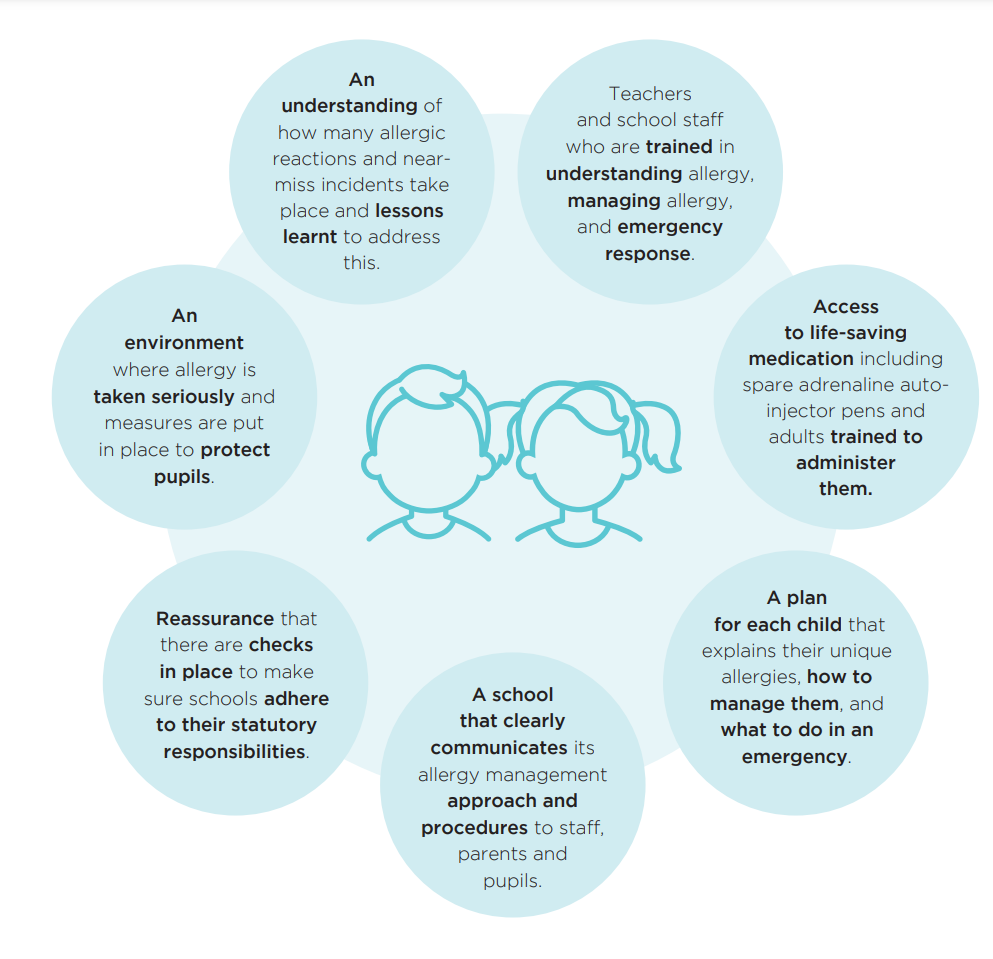
- Whole school approach – not just catering/medical – skills (risk reduction, inclusion, first aid); allergy awareness in classroom activities [curriculum?]
- Communicate clearly – Allergy and Anaphylaxis Policy (no template!) – (accessible), – and designated allergy lead. IHPs (individual health plans)
- Clear governance and risk management – designated lead, other roles/responsibilities. Allergies in every risk assessment
- Readiness to respond – 2 in date AAIs for those prescribed them. Hold spare pens in obvious place. Annual risk reduction and ana training. “Ana emergency response plan” [in allergy policy, presumably?], rehearse
Schools allergy code backed by Dept of Education in England.
React report
Data from 2000 English schools, about 10%.
Assessed 4 allergy safe guards: a specific allergy policy, spare pens, allergy training for staff, incident reporting.
69% did not have all recommended safe guards in place. “Pot luck whether your local school has medication, communication and education relating to allergy made available to teachers”. But commented on how well schools are managing despite “seeming lack of guidance, training and funding from government”.
Training
“All schools that are OFSTED monitored AND provide early years education must have at least one member of staff paediatric first aid trained including anaphylaxis treatment”.
First aid training, and even anaphylaxis training, is not the same as allergy awareness, however. 25% of schools don’t train staff on identifying allergy symptoms and anaphylaxis, and what to do in an emergency. Mandatory in New York day care (Elijah’s law), Canadian schools (Sabrina’s law).
Various free and paid for training programmes available. KITT Medical includes training in its package, that includes emergency adrenaline autoinjectors. Natasha Allergy Research Foundation offers Allergy School – includes self assessment for primary schools (also for clubs). Free. Resources for age groups eg 5-7 including going to a party (Armadillo film), assembly plan, top 14 allergen poster.
School Allergy Policy
BSACI Model policy includes (last 9 pages actual template – mostly repetition of initial text):
- reference to laws on supporting pupils with medical conditions;
- how first aid falls under health and safety policy (designated first aiders)
- Anaphylaxis management
- SPare pens in schools
- Allergy action plans
- Staff allergy training (says “all staff”, annually) incl risk reduction (no detail), asthma
- Bullying
- Storage of medicines, expiry dates
- Catering – staff must be able to identify pupils with allergies; menus should be available (with ingredients); may contain; [cross contamination is a heading but nothing further]
- Ana UK safer schools programme and allergyWise training;
- Working with parents – must keep school updated, provide medicines and allergy plans.
- Links to Wiltshire anaphylaxis risk assessment template
- Sports (in/out school)
- Insect stings (v brief)
- Checklist (11 points)
Individual Healthcare Plan
The need for an individual healthcare plan and the medical detail of such a plan should only be assessed by an appropriate designated health practitioner. May include:
- details of any diagnosed condition or symptoms;
- the impact that the condition or symptoms has to the individual;
- details of any medication, dosage, side effects and storage information;
- special requirements e.g. dietary needs, pre-activity precautions, access to facilities and other reasonable adjustments etc.;
- what to do, and who to contact, in an emergency;
- training needs for the support, how often these should be reviewed and who will deliver the training;
- consent;
- how often and when the plan should be reviewed;
- consideration of existing emergency plans, such as Anticipatory Care Plans.