Use of peanut oil in eczema creams had OR 8 for peanut allergy but retrospective.
Filaggrin deficiency has OR 5 for food allergy, only 3 for eczema!
So could skin protection (particularly in babies with eczema) before early weaning prevent food allergy? Preliminary studies suggest 35- 50% response. Evidence that peanut consumption of household predicts peanut allergy in baby – presumably by skin sensitization.
Jewish children in the UK have a prevalence of peanut allergy that is 10-fold higher than that of Jewish children in Israel. This difference is not accounted for by differences in atopy, social class, genetic background, or peanut allergenicity. Israeli infants consume peanut in high quantities in the first year of life, Bamba (peanut snack, like a Wotsit) often used for weaning, so most infants have been exposed by age 12 months. [Du Toit J Allergy Clin Immunol. 2008 Nov;122(5):984-9]
Gideon Lack at Evangelina hospital in London did LEAP study (Learning about Peanut Allergy), randomized infants with severe eczema and/or egg allergy to receive either no peanut until age 3yr, else an age-appropriate peanut snack (Bamba or smooth peanut butter, 6g) three times a week. Among the 530 infants in the intention-to-treat population who initially had negative results on the skin-prick test, the prevalence of peanut allergy at 60 months of age was 13.7% in the avoidance group and 1.9% in the consumption group (86% reduction, P<0.001). 98 participants had baseline positive SPT results, only 12% had a positive challenge so most continued the protocol. Another 10% with SPT>4mm were excluded from the start.
Adherence to the diet was excellent. Dust samples were taken from some participants’ beds, peanut levels were significantly higher for kids in consumption group. There was a higher rate of urticaria in the consumption group.
IgE greater than 10 in peanut avoiding group had 100% PPV for allergy. Peanut-specific IgG4 antibody seems to be linked to tolerance – it went up more in the consumption group, and IgG4:IgE ratio was generally lower in allergic group (most had IgG4 under 1000). [NEJM 2015; DOI: 10.1056/NEJMoa1414850] See also LEAP-On study, which is the follow up at 72 months, still significant difference.
Michael Perkins’ EAT study of early introduction of 6 common allergens in non-high risk babies showed if strict adherence to protocol eg 2g weekly of peanut, then every case of peanut allergy could be prevented.
Risk of peanut allergy in high risk babies estimated to be about 14%. Cost benefit analysis suggests better to go for early introduction WITHOUT initial testing, as high rate of false positives. Yet in the US at least, lots of early screening happening (median number of foods tested =10!), rarely followed by oral challenge. If you tested every high risk baby in the US with IgE, it would cost $900m…
These are extra bits of information sometimes provided on labels, in addition to the actual ingredients. Phrases like “May contain…”, “Made in a factory where…”. These precautionary allergy labels are not legally required, but manufacturers are encouraged to use them to warn their customers of a risk of accidental contamination during the production process. The Food Standards Agency (FSA) (2006) encourages manufacturers to be as precise as possible eg which specific nut, or else peanut or “tree nuts” rather than just “nuts” but in reality different companies do different things eg Kelloggs does not differentiate between peanut and tree nuts when they put a warning label on about nuts.
Is there a real risk or not?
Contamination of chocolate is a particular problem, particularly with nuts, and with milk in the case of dark chocolate. In some studies, half of all the chocolate tested was contaminated.
But most foods carrying such a label will not contain any of the allergen mentioned, indeed it is sometimes hard to imagine how it possibly could! In an Irish study looking at foods labelled marked “may contain peanut/nut”, 5% had detectable peanut or nut, which is a significant proportion but actually the peanut or nut was present at such low levels they would be unlikely to cause a reaction in the majority of allergic people.
Aren’t they just a way of avoiding legal liability?
The FSA clearly state that these labels should only be used where there is a real and unavoidable risk. And in any case, it’s not clear it changes the company’s legal responsibilities – if there is evidence that a manufacturer has been producing food in an unsafe manner, they would be liable regardless of whether there was a warning or not.
When is a trace not a trace?
The idea of threshold is important – how much of the allergen is actually present, and is it even enough to cause a reaction? Not everyone reacts at the same threshold, and the differences between individuals can be a factor of ten or even a hundred.
In big study of peanut challenges in kids, those who got through to last stage were 13x more likely to have anaphylaxis (related to total amount of peanut consumed, presumably). Higher thresholds found in older kids, perhaps because they would have presented earlier if they had lower threshold? [PAI 2018 vol 29:754-761]
Australia and New Zealand ask manufacturers to look at actual levels of contamination before putting a warning on their products.
In the UK and Europe, the risk associated with the processes is what matters, rather than the actual levels of contamination. It’s not clear which is actually more useful.
So what should you do about traces?
Many people tend to ignore these warnings, particularly when it is something they have eaten many times before, or when it is a big brand name, and when the wording is ambiguous rather than direct. Yet there is no good evidence that any of these things actually makes a difference to the real risk.
What is definitely true is that people have unexpected reactions and this can be after eating things marked with these warnings, but equally after eating things without these warnings.
What is also true is that allowing yourself to eat things marked with these warnings makes life much simpler!
Some patient organizations eg Anaphylaxis Campaign recommend avoiding anything marked with precautionary allergy labels, if only because this puts the control in your hands rather than leaving you at the mercy of the manufacturers.
Doctors often recommend avoiding anything with an allergy warning, because it “seems” safer and they don’t appreciate how difficult it is in day to day life.
So I think you have to make your own choice. If you have a nut allergy, and it’s chocolate or something else that often does contain nuts eg a muesli bar, then to me the risk seems too much. It it’s something that wouldn’t usually contain nuts, and you’ve had it before, and you’re at home with your family, then maybe the risk is acceptable to you. But if you are away on holiday, and you’ve forgotten to bring your allergy medicines, and your asthma is playing up, and it’s late at night, then that’s probably the worst time to take a chance.
Children reported to have taken antibiotics during infancy (0-2yrs) were more likely to have asthma at 7.5yrs, with a dose response pattern. No association between antibiotic use and atop on skin prick testing however! Hoskin-Parr, Ped All Imm 2013;24:762 (Avon longitudinal study)
At 18/12 of age, babies born by SVD and whose parents suck their dummy are 2.5x less likely to have eczema than those born by LSCS whose parents do not suck their dummies. Germany/Sweden, Peds 2013;131:e1829
Children born outside of US much less likely to have allergic disorder (OR 0.48), although those who have lived in US for 10+yrs have higher odds of eczema and hay fever cf those who have lived in US under 2 years. But not clear whether children moved from developing or developed country. Ped 2013;167:554
Inverse dose response effect between food diversity in infancy and asthma (OR 0.74). 26% reduction in asthma for every additional item of food added in the first year of life. Increased risk of food allergy by age 6yr (OR0.7), but no longer statistically significant after excluding children with food allergy in the first year of life. European cohort, JACI 2014;133:1056
The UK still currently follows the European Food Information For Consumers Regulation (FIR) that took effect from December 2014.
This applies to unpackaged food eg restaurants, takeaway’s deli’s, bakeries etc. It now also applies to food prepacked for direct sale (PPDS) such as a sandwich made on the premises of a cafe but wrapped (Natasha’s law).
Allergy advice boxes are no longer permitted, although “may contain” advisory labels are. The allergen should be emphasised in the ingredients panel through typeset eg font, style, colour. The specific type of cereal or nut must also be stated.
The 14 allergens that must be highlighted under UK/European law are: cereals containing gluten (wheat, barley, rye etc), crustaceans (eg shrimp, prawn), molluscs (eg mussel, oyster), eggs, fish, peanuts, nuts, soybeans, milk, celery, mustard, sesame, lupin and sulphur dioxide at levels above 10mg/kg, or 10 mg/litre, expressed as SO2. Lupin and Molluscs added later.
There are some exceptions, where the food is so highly processed that they are no longer capable of triggering an adverse reaction eg fish gelatine in beer/wine, soya in vegetable oil.
If your allergy is not one of those listed, eg lentil, there is no legal duty for the manufacturer to highlight the presence of that ingredient, or for the restaurant to provide a full list of ingredients. So you need to read the full list of ingredients carefully, and plead with the restaurant for details relevant to your allergy. In the past, some manufacturers highlighted allergens in a separate box, but this is no longer permitted.
The rules list nuts as:
almond,
hazelnut,
walnut,
cashew nut,
pecan nut,
Brazil nut,
pistachio nut,
macadamia nut or Queensland nut
and products made from these nuts.
Other types of nuts, and other foods which are not nuts (even though they are called nuts i.e. chestnuts, pine nuts and coconut), are not named in the rules, even though they are known to cause allergy in some people.
Note that by law, “cereals containing gluten” includes oats! Spelt and Kamut should be declared as containing wheat. Oats contain avenin, rather than gliadin, but related. Products containing oats that have not been contaminated by wheat can be declared “gluten free” by law, so effectively the law considers oats as both containing but not containing gluten…
(food.gov technical guidance on new labelling law)
There is no legal duty to highlight changes in recipes on packaging. The same product with the same packaging can sometimes have different ingredients, depending on where it is produced.
The Food Standards Agency (FSA) has ordered councils to encourage restaurant owners to check their ingredients.
Note that non-EU countries will have their own rules eg US has only 10 ingredients that must be highlighted (not molluscs, mustard, celery, or lupin).
Immunoglobulin A deficiency is the most common primary immunodeficiency.
1 in 700 healthy Western blood donors, but much rarer in some ethnic groups. FH only in a quarter.
Defined as a serum IgA concentration of < 0.06g/L in patients over 4 years of age, with normal levels of IgG and IgM, which is not secondary to other causes e.g. myeloma.
IgA subclass (IgA1 and IgA2) deficiencies described. IgA deficiency may be found in ataxia-telangiectasia, and IgG subclass deficiencies, drugs (phenytoin, sulfasalazine), chromosomal abnormalities (esp chromosome 18), coeliac disease.
Sometimes seen in families as recessive trait, else dominant with variable penetrance.
Issues:
Infection – Most individuals with IgA deficiency are clinically asymptomatic. Otherwise, higher than usual frequency of respiratory (incl sinus) infections, and GI infections esp giardiasis. Recurrent infections more often seen when accompanying IgG subclass deficiency (so consider IVIG, although contains small amount IgA, so might produce antibodies).
Associated conditions – Long term follow up has found higher rate of gut and lymphoid malignancies. Increased frequency of coeliac disease, autoimmune disorders and allergy/atopy.
Blood transfusion – IgA deficient patients can develop anti-IgA antibodies to blood products (20-40%). But these antibodies also seen not uncommonly in normal population and do not help predict transfusion reactions, so testing controversial. Severe reactions are v rare (1 in >20,000 transfusions).
Enhanced surveillance for transfusion reactions recommended, and pre-medication with hydrocortisone/chlorphenamine should be considered.
If a patient has previously had a reaction, then plasma reduced products or IgA def donor products (best) recommended. However, danger of delaying transfusion must be weighed against potential risk.
Transfusion labs should be informed of patients with the diagnosis.
Pathogenesis of IgA deficiency is presumably abnormalities in Ig class switching. T-cell function normal in most. Possibly part of CVID spectrum?
More than 10 years ago, shown to be effective in children – 2014 Andrew Clark Lancet STOP II study – 39 children 7-16yrs, peanut flour orally. 2 weekly up dosing, starting with 2 mg, increasing to 800 mg of peanut protein (5 peanuts) then maintained for total of 26 weeks. Tolerance then assessed with challenge.
91% achieved final daily dose (although only 62% actually had negative challenge, which was to 1400mg, nearly double – and previous evidence has suggested that most people at this level can tolerate substantially more with only mild symptoms).
Side effects mainly oral itching (6% of doses), nausea, vomiting. 1 patient needed IM adrenaline (twice) for wheeze. Even minor reactions are annoying especially GI, or if daily! And not always predictable. Tend to get less over time, of course. Paul Turner feels adverse event reporting “massaged” somewhat (no international consensus on reporting) – the word anaphylaxis not used except to thank the Anaphylaxis campaign, yet 22% of patients had wheeze at some point, even though reported rate of wheeze is 0.4% of doses. Still, anaphylaxis in hospital when potential reaction expected not the same as unexpected reaction in community.
Peanut IgE significantly reduced but not SPT! So works as long as you keep taking your daily dose, definitely side effects incl anaphylaxis, but not a cure.
No data yet on rates of reactions after treatment. But using anxiety model, OIT helps with “perception of severity” (as lots of minor reactions), “perceived ability to cope” (as managed already) and “rescue factors” (as more used to carry medicines). Note how experience of using AAI seen as positive (and kids often laugh at anticlimax of it!). 1/3 of benefit of OIT seen after initial confirmation challenge, particularly where anaphylaxis occurred (and in patients as well as parents)! [Sarah Burrell, ADC 2021]
Roughly 10-20% don’t desensitize at all. A further 10-20% don’t achieve full dose. And another 10-20% fail to achieve pass full dose challenge. Benefit likely to be highest for those most at risk of anaphylaxis, yet tendency will be to cherry pick lowest risk cases…
AR101 Oral Immunotherapy trial (PALISADE) – multiple authors including Jonathan Hourihane and George du Toit. US/Europe, N=496 aged 4-17yrs. Dose escalation then 24/52 maintenance (so about 12 months total) with peanut derived product, 67% passed 600mg peanut protein challenge (equivalent to 5-6 peanuts). [Some adult patients included initially but unsuccessful in all of them!]
Frequent mild/moderate events, but also in placebo group! 4.3% had severe events cf 0.8% of placebo group. About 10% withdrew due to adverse events , mostly GI- interestingly another 10% were lost due to parents withdrawing consent, I wonder what their reasons were.
Michael Perkins NEJM editorial – possible risk of eosinophilic oesophagitis? Only 1 case confirmed.
Second trial, just in Europe (ARTEMIS), n=227, up dosing every 2 weeks, just 12 weeks maintenance (300mg), so about 9 months treatment total. 58% tolerated 1000mg peanut (about 8-10 peanuts). Again, lots of mild/moderate adverse events but in the controls too! 1% rate of severe in treatment group (1 patient). 10% withdrew due to adverse effects. No eosinophilic oesophagitis reported. “Clinically important” improvements seen at the time of final food challenge in QOL scores related to “Allergen avoidance and diet restrictions” and “Risk of accidental exposure”, and in FAIM domains relating to perceived likelihood and chance of dying (both self and parent/carer reported) in the future.
Follow up study of self selected group of those who successfully completed 1yr PALISADE programme, who then opted to continue treatment for total of 18 vs 24 months – 48% of former still able to tolerate 2000mg, cf 80.8% of latter. Less adverse events over time of treatment, improved quality of life scores (“clinically meaningful”). Still peanut SPT positive (IgE a bit less for the 24 month group)! There were more accidental peanut exposures in this study than in the original trial, suggesting less vigilance, but the severity of these reactions and need for adrenaline was low, which might confirm an immunomodulatory effect.
Another follow up study (ARC004, Vickery) looked at daily vs non-daily dosing (6 months twice weekly 300mg) after PALISADE. Non-daily dosers had 40% more adverse events, although 80% mild-moderate. Daily dosers had best evidence of desensitization – more than 70% passed 1000mg challenge with NO symptoms (better than PALISADE), and 69% of the cohort (“3A”) who did 2yrs plus could do 2000mg with no symptoms. Evidence of “ongoing immunomodulation” with extended dosing – IgE reduced, SPT did not.
Does not discuss whether non-daily dosing might be appropriate for subgroup who have best immune response to treatment.
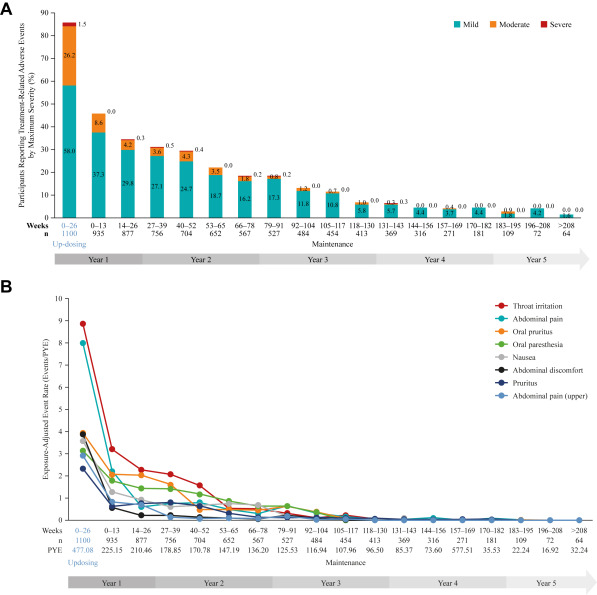
ARC0008 study still to report (closed 2023), but provisional data reported show the trend towards decreased adverse events (AEs) at years 1 and 2 is maintained up to 5 years, with 94% of patients experiencing mild or moderate AEs and only 13% discontinuing PTAH use because of AEs overall.
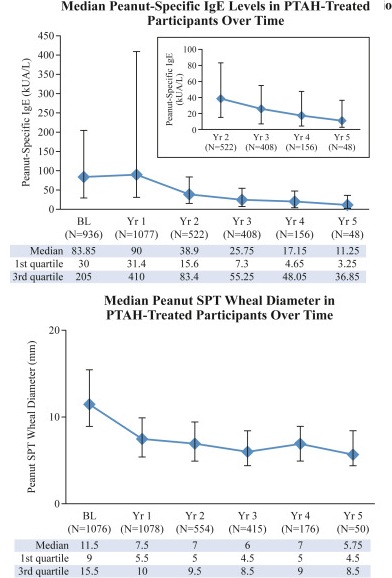
Gastrointestinal symptoms were the most commonly reported treatment-related AEs. A downward trend in systemic allergic reactions was also reported. PTAH treatment resulted in reduced levels of peanut-specific IgE after the first year and increased levels of peanut-specific IgG4, with a lowered peanut-specific IgE:IgG4 ratio. A reduction in median peanut skin prick test wheal diameter was observed (11.50 mm at baseline vs 5.75 mm at year 5). Unpublished draft is available here.
Severe and uncontrolled asthma was an exclusion criterium, obviously. Similarly chronic/recurrent abdominal pain.
AR101 (Palforzia) has now received NICE approval for use in NHS England, which has set targets for patient numbers. In Scotland, SMC did not find sufficient evidence of economic benefit, which fits with ICER report (US economic review) 2019 which showed that peanut immunotherapy led to more systemic reactions and more adrenaline use with no cost benefit. But hard to quantify benefit of reduced anxiety and increased quality of life. Natasha trial currently looking at immunotherapy using commercial peanut flour across several UK sites.
Various forums about immunotherapy. One young person’s blog is Ask About My Peanut Allergy (stopped regular peanut!!! But doing well).
Future may be to combine different routes eg sublingual/patch.
Under-recognized, particularly when chronic blockage (without itch/sneezing) rather than sneeze/discharge. Late phase reactions involving Eosinphil induction by T cells tends to produce chronic swelling and non-specific irritability eg cold air. Nose problems impact with everything connected eg eyes, sinuses, middle ear, lungs. Differential is wide eg CF/PCD, deviated septum, polyps.
Considered trivial, and indeed work and school attendance not much affected but quality of work much more so – proven sleep problems, tiredness, impaired cognitive function. In a study of UK 15-17yr olds , students who dropped a grade between prelims and finals were significantly more likely to have had allergic rhinitis symptoms, to have taken antihistamines, and in particular, Piriton (OR=1.7). 43% increased odds of dropping an exam grade, goes up to 71% if using a sedating antihistamine [Samantha Walker, JACI 2007: 120; 381-387]
In asthma, prevalence of rhinitis increases over time to very high levels. If significant symptoms then OR=4 for poor asthma control (equivalent to poor inhaler technique!), plus combination of acute rhinitis and URTI gives OR=20 for asthma exacerbation.
Persistent defined as more than 4/7 per week, for more than 4/52. Mod/severe defined as any impairment of sleep or activity, else “troublesome symptoms” (BSACI includes seasonal or not, where you might be considering immunotherapy).
On examination (with auroscope), blue boggy wet mucosa, ?nasal crease.
SPT is pretty good at finding causes – depends how many you screen for, of course! In a US study, 65% of patients (mixed adults/children) had a positive: house dust mite (HDM) most commonly, else trees, weeds, moulds. Aspergillus and Penicillium are indoor moulds, Alternaria is outdoors. Cat allergens are commonly found in homes without cats! Nasal challenge can be done if neg SPT/IgE (Rondon, Curr Op Allerg Clin Imm 2010).
Children/adults same, just watch for doses/side effects.
Intranasal steroids most effective. Antihistamines, both intranasal and oral, are effective. Consider also leukotriene receptor antagonist (LRTA) eg montelukast (esp if co-existing asthma). Oral decongestants and steroids are also used short term sometimes.
For intermittent symptoms or mild persistent, no preferred treatment option – intranasal antihistamine, oral antihistamine, decongestant, LTRA, or combination. Nasal saline douches eg Sterimar have some evidence for efficacy, also nasal filters (not caught on yet!).
If co-existing conjunctivitis, prob best to go straight to nasal steroid, else add oral/topical antihistamine, or topical cromone, or saline.
Oral decongestant should only be used for max 10/7, can be useful diagnostically. Similarly oral steroids, if poor response or where diagnosis still unsure.
Cromoglycate (Rynacrom) has a role in young children but prob less effective than topical steroid or anthistamine, and at 4-6x a day, certainly less convenient.
Nasal ipratroprium recommended for rhinorrhoea.
Azelastine spray (Rhinolast) has been discontinued, so only nasal antihistamine is now the combination product Dymista (with flutic, from age 12). Not as good as steroid, doesn’t seem to have much effect on congestion (prob non-type 1 mechanism). Bad taste, irritation.
Montelukast licensed for rhinitis in asthmatics where resistant to other treatments, from age 15! ARIA recommend for over 6.
Intranasal steroids superior to top/systemic antihistamine, LRTA (even combinations). They also help eye symptoms, whereas nasal antihistamines don’t. Beclometasone (from age 6yr) and budesonide have relatively high bioavailability so better to use fluticasone (from age 4, furoate or propionate) or mometasone (from age 6), esp if other steroid use eg for asthma/eczema.Technique is often an issue – most gets sprayed or sniffed into back of throat!
Nasal spray Technique – (see video) Shake, head slightly forward, aim at ceiling (better to use opposite hand?), don’t sniff. Gargle and spit if taste unpleasant. Keep with toothbrush or other marker of habitual routine.
See also immunotherapy – some evidence that immunotherapy for rhinitis reduces risk of asthma!
Non–IgE-mediated severe gastrointestinal food hypersensitivity, typically presents in early infancy with repeated vomiting, dehydration, lethargy, metabolic acidosis (even mimicking sepsis). Watery diarrhoea (sometimes with blood and/or mucus) can develop in some cases. The severity is really what makes it worthy of a distinct name, debatable if it is actually distinct from other non-IgE mediated food allergy.
Probably underdiagnosed.
A few unusual features cf type 1 allergy.
The most common offending foods are cow’s milk and soy in young infants; in older infants, there are a range of food triggers including some foods usually not considered allergenic eg rice, oat, chicken, sweet potato! Egg an unusual cause in some countries! Cases in breastfed infants have been reported, even severe hypotension requiring intensive care.
Acute symptoms occur 1 to 5 hours after ingesting the offending food. Lasts up to 24 hours. Not always consistent, which might suggest co-factors important.
In Europe, rare to get multiple food FPIES but in UK/US/Australia about 25% (English speaking!?).
Diagnosis
Diagnosis is based, predictably for a non-IgE condition, on clinical history and food challenges. Leucocytosis and methaemoglobinaemia are associated but low specificity/sensitivity.
2017 Consensus out of date but diagnostic criteria still used –
Major – vomiting at 1-4 hours in absence of type 1 skin/resp symptoms.
Minor – at least 3 minor criteria eg second episode of repetitive vomiting after same food; extreme lethargy; hypotension; need for hospital care or IV fluids; etc
Probably mild, mod and severe! Proposed BIO-FPIES criteria includes abdominal pain, nausea, increase in neutrophil count (but 3 points for second episode of repetitive vomiting after same food).
Phenotype switching
Egg and nut FPIES often go on to develop IgE sensitisation (about 20%), less for others. Of those, about 30% of milk FPIES will switch to type 1 phenotype, 15% for egg, less for other foods. But overall, unlikely to make much of a difference to care (and doesn’t help predict resolution).
For introducing weaning foods, when known FPIES to one food, start with low risk foods, supervise common triggers eg rice/egg.
Challenge
Challenge is necessary to decide whether things are getting better or not. Consensus is that 12-18 months after last reaction is a good balance between chances of things being better, and risk of causing severe reaction.
50% milk/soya resolve by age 3-4, more like 4-5 years for other foods.
Traditional protocol is 0.3g/kg protein, divided into 3 doses over 30 mins. But unrealistic for low protein foods eg fruit. And doesn’t really make sense to split dose when you don’t expect a reaction for hours (but risk of switch to type 1 allergy for egg/nuts).
2 day protocol (25% portion then whole portion next day) had less severe reactions.
25-30% of age appropriate portion triggers reaction in most children. [Baked???] Over 50% react after at least 2 hours.
Or “hives” – itchy plaques or papules (weals), with surrounding flare, typical of histamine reaction in skin. Urticaria can also be accompanied by angioedema – although angioedema on its own may point to hereditary angioedema (else drugs eg NSAID, ACE inhibitors, oestrogens, statins), and absence of angioedema may suggest urticarial vasculitis, Schnitzler syndrome, cryopyrin associated periodic syndromes.
Not always allergy, although it is the classic rash of type 1 (histamine and IgE mediated) allergy. Can be inducible or spontaneous. Can be transient, intermittent or chronic (6 weeks minimum).
Burden on quality of life and health services can be substantial.
Inducible
Various kinds of physical stimuli can trigger urticaria, including:
Dermatographism – within 10 minutes of pressure
cf Delayed pressure type – tight clothing, sitting
Heat (including exercise and emotion)
Cold – can be secondary to autoimmune conditions or infection. Anaphylaxis risk from swimming!?
Sunshine (solar)
Water (aquagenic) – cold, hot, even rain…
Vibratory angioedema
Cholinergic urticaria
Contact urticaria
Can be mixed! Some tests have been suggested eg ice cube test (ice cube in a sealed plastic bag over the forearm for up to 10 min – wait for skin to rewarm), flannel test for aquagenic (wet towel for a few minutes on area of skin most affected).
Can be hormonal in girls, therefore cyclical (catamenial).
Differential
These things are considered to have different mechanisms:
Oestrogen, progesterone and pregnancy related dermatoses
And if everything else excluded, that leaves Chronic idiopathic urticaria.
Urticaria Activity Score available – wheals and itch over course of day, score 0-3. Moderate wheals are 20-50. Do for 7 sequential days and add up to give UAS7 score.
Diagnosis
Basophil histamine release assay and autologous serum skin tests suggested, 25% of all chronic urticaria patients are positive for one and/or other, but 50% are negative for both – so struggling for a diagnostic standard.
Essential:
FBC, CRP, ESR – CRP raised and eosinophils low in type IIb (mast cell-directed autoantibodies)
Total IgE – reduced in type IIb
Anti TPO antibody – high in type IIb (high ratio to total IgE)
After that, as indicated, eg:
ASOT
Immunoglobulin electrophoresis done in adults to look for paraprotein
H pylori – some have suggested eradication helps but BSACI come down against routine screening
TFTs, Functional autoantibodies eg Thyroid, ANA
Pseudoallergen (additives, flavourings, colourings) free diet for 3 weeks? BSACI not v keen
Tryptase – systemic mastocytosis? Not in BSACI guideline!
C3/4 – if suspected urticarial vasculitis, and if reduced, measurement of anti-C1q antibodies [BSACI urticaria guideline]. C4 low in HAE.
Cryoglobulins for cold induced
Biopsy – but for mastocytosis, bone marrow aspirate most sensitive!
Specific tests: ice cube, flannel, dermatographism, hot bath, exercise.
Incidence of underlying cause varies regionally. And some of these things may simply be aggravating underlying spontaneous urticaria, rather than a cause as such!
Assess for co-morbidity – mental health, autoimmune disease, allergy.
For acute, non-sedating antihistamines (H1 blockers), else steroids. Evidence for H2 blockers eg ranitidine very weak.
For chronic, continuous non-sedating AH effective in <50% of patients. No evidence that one antihistamine is better than any other. Guidelines recommend up to 4x updosing (studies support for cetirizine, fexofenadine, otherwise desloratadine, levocetirizine, rupatadine!).
No evidence that using different H1 blockers at the same time has any advantage (moderate consensus only, however…)
Weak evidence for steroids! Suggests maximum 10 days. Similarly montelukast.
Omalizumab is second line for both spontaneous and inducible – monthly SC injections 300mg (not dependent on IgE, as is asthma dosing) every 4 weeks (safety data now from age 1). Increase dose or shorten interval if necessary (up to 600mg every 2 weeks). After that, ciclosporin.
Other treatments with limited evidence include doxepin, ranitidine, methotrexate, dapsone etc.
Tranexamic acid for angioedema?
No evidence for thyroxine treatment if autoantibodies, if euthyroid.
Plasmapheresis and IVIG have been used…
Tolerance to triggers can be induced (rapidly in some cases, eg within days), but not usually v pleasant, and temporary only…
Note the high rate of anxiety, depression, somatising disorders (50%).
C3 is the major complement component. Associated with bacterial infections esp gram neg eg Meningococcus, Enterobacter, Haemophilus, E coli. Gram pos infections also seen. Some increase in autoimmune eg SLE but this is more well recognized with C1q, C2 and C4 def.
Secondary C3 def seen with nephritis (complement activation products in kidney), but also with hereditary factor I and H deficiency (cofactors in C3 product cleavage).