Getting it right is important because otherwise people (child but also the rest of the family) end up anxious and scared of foods, cut out different foods, spend out on expensive alternatives, and risk nutritional/growth problems as well as aversion in the child.
In young infants, avoiding foods unnecessarily makes it more likely that you will become allergic in the future (“iatrogenic food allergy”). This is especially true with atopy and sensitisation – one series of 11 patients sensitized to cow milk found that all developed true cow milk allergy after a median time of avoidance of 2.3 years (with no significant improvement in their atopic dermatitis, which was the initial reason for avoidance). Pronuts study confirmed that multiple nut/sesame allergies was a factor of age – “secondary spread”. Similarly, in the Learning Early About Peanut (LEAP) study, it was precisely the infants sensitized to peanuts who were more likely to benefit from early introduction.
Having unproven food allergies also causes huge problems for schools and nurseries, and may lead to the public becoming sceptical of true allergy, with potentially disastrous consequences.
Getting it right can identify other potential allergies; it can help estimate risk of anaphylaxis; it can help with predicting whether the allergy is going to go away or not.
Allergy focused history
EATERS method –
Exposure – did they actually eat it!? Or was there clear skin contact? Perhaps from surface contamination?
Allergen (suspected) – one of the common ones? Although you can be allergic to pretty much anything, it is really rare to have an isolated rare food allergy.
Timing – type 1 is immediate (within 15 minutes, rarely up to 1hr after) and then settles even without treatment within 24 hours. Rare to fluctuate.
Environment – home (usually during weaning)? Outside home? Co-factors (infection, medicines, exercise, sleep deprivation) come in here.
Reproducible – consistent reactions with exposure? May have had before with type 1 allergy but often on trying for the first time, and won’t have had recently. Milk/egg different, of course…
Symptoms – type 1 vs non type 1. Some overlap of course.
Other issues are age (adolescents with hay fever more likely to develop secondary pollen food syndrome type allergies), alpha-gal allergy can be delayed up to 3 hours; raw vs cooked food sometimes makes a difference; usually you already have eczema and family history of atopy.
Testing
At the end of history taking, you should have be able to assess probability of type 1 allergy. If low, you may wish to proceed straight to challenge (unless reactions sound severe). Otherwise testing may help confirm or refute.
If negative/equivocal on initial skin prick or specific IgE testing, do another test! Skin prick if negative/equivocal IgE, and vice versa.
IgE Component testing may give added information, esp where potential pollen co-sensitisation – best evidence (mostly in US population, however) for Peanut, Hazelnut, Cashew (respectively Ara h 2, Cor a 14, Ana o 3 – other components may give extra information in some cases). Jug r 1 v specific (walnut) but not v sensitive.
Challenge
Challenge will be useful where results still equivocal – viz
Results positive but never eaten or history inconsistent
Results positive but possibly co-sensitivity without allergy
After that, if still doubt then for peanut, hazelnut or cashew, if in doubt do component tests Ara h 2, Cor a 14, Ana o 3 respectively (if available) – otherwise do skin prick or IgE if not done already.
Where peanut or sesame allergy still in doubt, do basophil activation test (BAT – if available – nowhere in Scotland, as far as I know)
“Reassessment of food allergic children, at regular intervals, depending on age, food and patient’s history, is suggested for possible development of spontaneous tolerance”
Ara h 2 (cut off 0.44) has 82% sensitivity and 92% specificity cf 84 and 86% for SPT of 4mm, so equivalent. Cor a 14 (cut off 0.64) has 73 and 95%, so not great sensitivity. Ana o 3 (cut off 0.4) pretty good – 96 and 94%.
If random reactions, then consider hidden allergens: celery, mustard, cochineal, lupin, soy, fenugreek, other legumes such as pea/bean/lentil protein, insects/mealworm, pink peppercorns.
Panel tests
=multiple specific IgE tests done at the same time (the ultimate being the ALEX3 test, where 280+ different antigens are tested simultaneously) – likely reduced sensitivity, compared with individual test, but more importantly, potential for false positives, with attendant harms (including iatrogenic food allergy, if that food then avoided unnecessarily).
Advances of Alex3 over Alex2 include new molecular allergens including alpha-Gal, chicken (Gal d 7), celery (Api g 7, predicts anaphylaxis), wheat (Tri a 36, and Tri a 37), oak pollen, and honeybee venom; inclusion of lentil and pea.
Proteins responsible for a minority of allergic reactions to peanut, hazelnut, sesame among others – hydrophobic, so tend not to be well represented in skin prick and IgE test solutions. May explain false negatives.
Specific IgE tests have been developed, but otherwise you just have to challenge.
Dutch study however didn’t find that specific testing for oleosins helped much.
Once a child starts school/nursery, the risk of reactions (and anxiety about potential reactions) starts to ramp up. Obviously, this is because other people are responsible for sourcing and providing food, often to many different children at once.
In the UK, probably 1 pupil with a food allergy in every classroom.
“Schools are the most common setting for severe allergic reactions, with 18% of all food allergy reactions and 25% of first-time anaphylactic episodes occurring there. Fatal anaphylaxis in children occurs more often in schools than any other setting” [Benedict Blythe Foundation “Keeping the promise” document] – but this data appears to be from old US studies. From my data (19/8/26) I see 4 mentions of anaphylaxis related to school in the last 2 years (about 10% of all anaphylaxis reports) – but half of these were actually related to after school.
Miranda Crilley (CHI Dublin) reported on 521 food allergic children attending school/nursery, and found a 4.5/5% annual rate of reactions in schools. Half of nursery reactions due to milk. 6 of 7 nut reactions in schools with nut bans! 33% of children had not provided copies of their allergy action plans to the school. 22% or the reactions were judged as anaphylaxis, none received adrenaline from school staff. “Promoting milk/egg tolerance in infancy would prevent”.
Scottish government policy on healthcare needs in schools (2017): talks about “coordinated support plans” as well as individual health plans and child plans. Talks about local strategic joint arrangements between NHS boards and educational authority. Inhalers and defibrillators (!) specified. “General awareness raising training of common conditions should be provided… for example, asthma, diabetes, epilepsy, eczema and allergic reactions (including anaphylaxis).”
Specific school arrangements may include:
who in the school accepts responsibility, in principle, for supporting the healthcare needs of children and young people in the school;
who is responsible in school for staff training in regard to supporting healthcare needs and administering medication;
emergency procedures at the school including a main point of contact in the school health team [defined how?];
details of any centrally held inhalers; anaphylaxis auto-injectors; the storage of and access to medication in the school;
who is responsible for ensuring the safety of children and young people’s self-management of their medical conditions;
the arrangements in place to ensure that staff are informed and kept up to date about children and young people’s healthcare needs at school.
First do no harm – parents tend to overestimate risk of anaphylaxis, whereas there are clear consequences to restricting the child’s ability to sit with other children at snack/meal times, or restricting the food choices of other children.
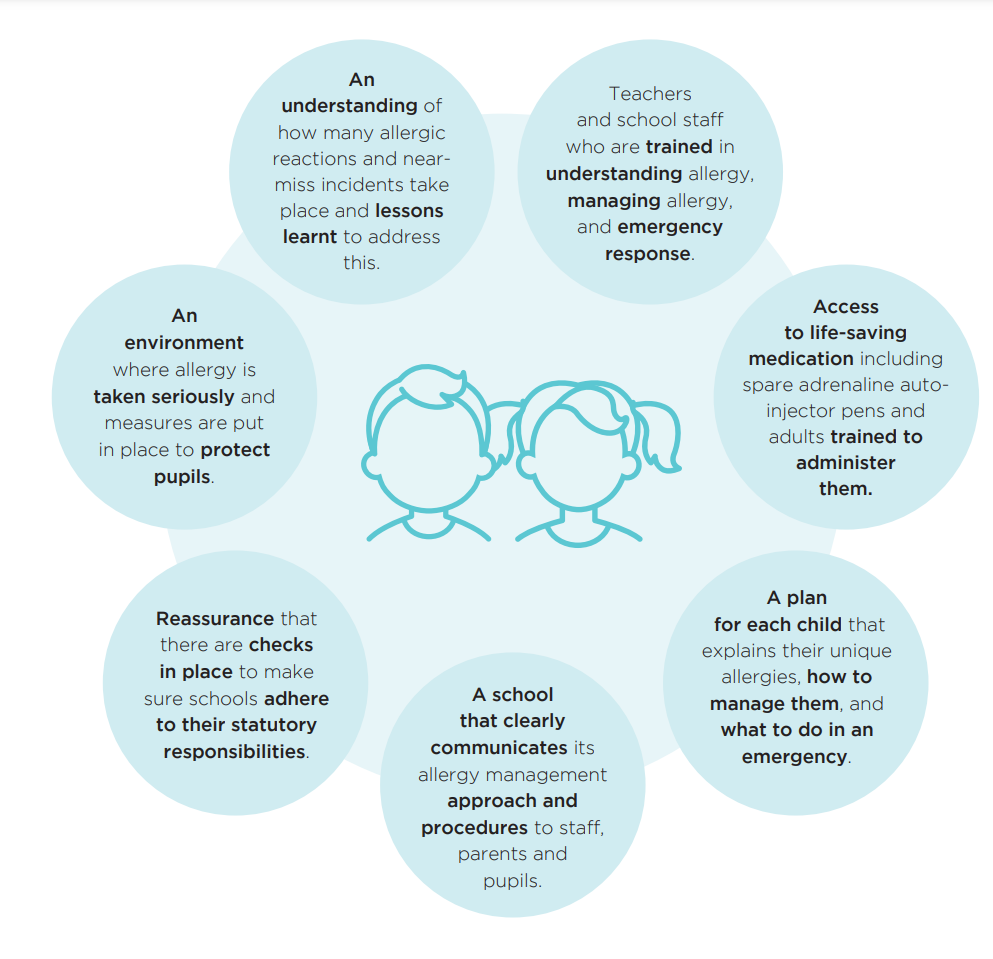
Recommends that an Allergy management policy should be in place (even if incorporated into wider medical conditions policy) even if no currently diagnosed allergic children [quotes 25% undiagnosed reaction rate in school] – cites 2017 Government supporting CYP with healthcare needs document:
Procedure for identifying pupils with allergy and high risk pupils.
Details on developing Individual Healthcare Plans.
Protocol for storage and access to emergency medication – emergency kits.*
Arrangements for staff training.
Policies and arrangements on Preventative Measures.
Details on the administration of medications.
Protocol for the emergency response to anaphylaxis.
The rights, roles and responsibilities of staff, pupil(s) and parent/ carer(s).
Highlights breakfast clubs and after school as under the remit of schools (and school trips, too).
And another about how schools can become more allergy aware – because it’s not just about nuts – https://youtu.be/JHnmcmUP6Cs?si=FgjhoxcOdMoEb7eS. George Raptis has shown how school allergy training (in NW England) can improve allergy awareness, not just confidence in managing an allergic emergency.
Whole school approach – not just catering/medical – skills (risk reduction, inclusion, first aid); allergy awareness in classroom activities [curriculum?]
Communicate clearly – Allergy and Anaphylaxis Policy (no template!) – (accessible), – and designated allergy lead. IHPs (individual health plans)
Clear governance and risk management – designated lead, other roles/responsibilities. Allergies in every risk assessment
Readiness to respond – 2 in date AAIs for those prescribed them. Hold spare pens in obvious place. Annual risk reduction and ana training. “Ana emergency response plan” [in allergy policy, presumably?], rehearse
Schools allergy code backed by Dept of Education in England.
React report
Data from 2000 English schools, about 10%.
Assessed 4 allergy safe guards: a specific allergy policy, spare pens, allergy training for staff, incident reporting.
69% did not have all recommended safe guards in place. “Pot luck whether your local school has medication, communication and education relating to allergy made available to teachers”. But commented on how well schools are managing despite “seeming lack of guidance, training and funding from government”.
School Allergy Code recommendations
Training
“All schools that are OFSTED monitored AND provide early years education must have at least one member of staff paediatric first aid trained including anaphylaxis treatment”.
First aid training, and even anaphylaxis training, is not the same as allergy awareness, however. 25% of schools don’t train staff on identifying allergy symptoms and anaphylaxis, and what to do in an emergency. Mandatory in New York day care (Elijah’s law), Canadian schools (Sabrina’s law).
Various free and paid for training programmes available. KITT Medical includes training in its package, that includes emergency adrenaline autoinjectors. Natasha Allergy Research Foundation offers Allergy School – includes self assessment for primary schools (also for clubs). Free. Resources for age groups eg 5-7 including going to a party (Armadillo film), assembly plan, top 14 allergen poster.
School Allergy Policy
BSACI Model policy includes (last 9 pages actual template – mostly repetition of initial text):
reference to laws on supporting pupils with medical conditions;
how first aid falls under health and safety policy (designated first aiders)
Anaphylaxis management
SPare pens in schools
Allergy action plans
Staff allergy training (says “all staff”, annually) incl risk reduction (no detail), asthma
Bullying
Storage of medicines, expiry dates
Catering – staff must be able to identify pupils with allergies; menus should be available (with ingredients); may contain; [cross contamination is a heading but nothing further]
Ana UK safer schools programme and allergyWise training;
Working with parents – must keep school updated, provide medicines and allergy plans.
Links to Wiltshire anaphylaxis risk assessment template
Sports (in/out school)
Insect stings (v brief)
Checklist (11 points)
Individual Healthcare Plan
The need for an individual healthcare plan and the medical detail of such a plan should only be assessed by an appropriate designated health practitioner. May include:
details of any diagnosed condition or symptoms;
the impact that the condition or symptoms has to the individual;
details of any medication, dosage, side effects and storage information;
special requirements e.g. dietary needs, pre-activity precautions, access to facilities and other reasonable adjustments etc.;
what to do, and who to contact, in an emergency;
training needs for the support, how often these should be reviewed and who will deliver the training;
consent;
how often and when the plan should be reviewed;
consideration of existing emergency plans, such as Anticipatory Care Plans.
Alliums, as are leeks, shallots and chives. Part of same bigger family as asparagus but probably not co-sensitivity.
The main issue with onion is the chemicals released from cut surfaces, which can trigger eye/nose reactions and potentially asthma. But there’s actually some evidence that onion has an anti-allergy action.
With garlic, there is a well recognised contact dermatitis relating to chopping it.
As with that syndrome, the problem for the allergic person is that not only is it not one of the 14 UK recognised allergens for food labelling and restaurants, but it can be included under “spices” if less than 2% of the overall product, without further detail.
Mixed up with “intolerance” and “sensitivity” – intolerance is a vague term for any kind of reaction, agnostic to cause (most commonly used for gastrointestinal symptoms); “sensitisation” has a specific meaning (see allergy diagnosis) so not to be confused. Allergy is where there is an immune mediated problem (based ideally on history and testing) – but sometimes hard to know the mechanism.
2 basic types of food allergy, you can have both at the same time – type 1 (IgE mediated), and non-type 1 (non-IgE mediated – possibly type 4 hypersensitivity).
Most commonly (in Scotland – but varies across UK, especially with different ethnic groups), and varies widely across the world):
Milk
Egg
Peanut
Tree nuts
Legumes/Pulses
Sesame
Wheat
Crustaceans/molluscs
Various fruits
Birch pollen sensitization in Northern Europe changes the kinds of allergies you get – cross sensitivity with fruit and nuts (pollen food syndrome) – whereas in the rest of Western Europe you get more fruit and seed allergies based on LPS.
Allergy has increased over recent decades – “hygiene hypothesis” has now been developed further to address entire “exposome“. Eczema increases the risk of food allergies 6-fold, via genetic and environmental factors (esp filaggrin mutations, and IL-4 receptor alpha chain polymorphisms).
Hospital admissions for food allergy in the UK have increased 3 fold over the last 30 years, with the biggest increase in children [BMJ 2021; 372: n251]. In big English study of primary care records, estimated incidence of probable food allergy doubled between 2008 and 2018; prevalence highest in children under 5 years (4·0%). Rate in children aged 5–9 years 2·4%, 15-19 years 1·7%. In those with previous food anaphylaxis, only 64∙0% of children and young people had at least one prescription for adrenaline autoinjector, and only 50.3% had them on repeat. Adrenaline autoinjectors prescription was less common in those resident in more deprived areas. 93.3% of first health care encounters for children regarding allergy were in primary care, with 2.2% in emergency departments. Only 7.4% of children had been seen for allergy in a hospital clinic. 92.2% of children had only ever been seen for food allergy in primary care (and looking at those prescribed AAIs, 93.5% only ever seen in primary care!).[Lancet Public Health 2024, Paul Turner]
If you ask people about their children’s allergies, up to 28% of infants will report allergies! Lifetime and point prevalence of self-reported food allergy 20% and 13%, respectively – point prevalence of sensitization as assessed by sIgE stands at 17%, skin prick test 6%, and food challenge positivity 1%. Based on clinical history or positive food challenge, food allergies have increased from 2.6% in 2000–2012 to 3.5% in 2012–2021. Point prevalence for under 16s for self reported but physician diagnosed food allergy is 3.75%. Patterns vary across European regions but not in a consistent way. [Spolidoro and Venter 2022]
Having a child with a food allergy has a significant effect on the quality of life for the whole family. One study suggested that having a peanut allergic child had a worse effect on a family than having a child with diabetes, even though with diabetes you also have restrictions on eating and the potential for serious adverse events. A similar study found the same comparing food allergic families with families where a child had a rheumatological diagnosis. The main domains affected were social. Patient/parent feedback pretty consistent across the world however (although most studies done in Europe and English speaking countries), and across time:
Parents lived in fear after the first reaction, often perceiving it as traumatic, and often feeling guilt too
They tried to live an ordinary family life and had to learn how to be one-step ahead and understand early signs.
The family’s social life was also influenced.
Parents asked for support and information from health professionals
More knowledge and skills increased parents’ confidence (and by implication quality of life – Knibb 2015)
Mothers tend to report greater impact on the child’s quality of life and experience more anxiety and stress than fathers. Mothers tend to shelter the child, whereas fathers more often express a desire to expand their child’s life, and these differences are often greater where parents are separated.
The concern for the child’s safety affected eating outside the home, with birthday parties and visits to peers’ homes particularly threatening. School and nursery are a major source of concern and often led to more parental work, preparing safe lunches.
Parents often felt they had to teach themselves about allergies, due to the lack of early information provided by health care, and then ended up having to teach family, friends and educational institutions too.
Adolescence is a particularly stressful time, as parents recognize the need for the child to become more independent, at the same time that the adolescent can see the parents as excessively controlling (at least with respect to peanut allergy). Supportive friends particularly important for adolescents.
Initial studies did not show any relationship between moulds/damp and health, as there was major confounding with socioeconomic status, and because it is hard to quantify mould exposure (with many different mould species).
Then there is the effect of climate, and the built environment – heating, ventilation, insulation, materials etc.
More recently systemic reviews have made it clear there is a link particularly with development of asthma, particularly in older children, and where there is already a family history of atopy.
Coroner ruled death of 2yr old Awaab Ishak in 2020 from granulomatous tracheobronchitis was due to environmental mould exposure from poor housing.
Longitudinal studies have suggested that there may be protective effects but data is limited.
Similarly there is evidence that higher exposure to moulds leads to more asthma exacerbations.
There are genetic polymorphisms that affect ability to break down the fungal protein chitin, and these have been linked to urgent medical care visits, which suggests a non-immune mechanism may be important.
Dampness is linked to mould growth but also to house dust mite, microbial volatile compounds, mycotoxins and endotoxin.
The most studied mould species are Aspergillus, Penicillium, Alternaria and Cladosporium.
Limited evidence that interventions to reduce mould make any difference.
Hundreds of different allergens have been identified, and can be classified by similarities in structure/genetics, usually based on the plants being related to each other in evolutionary terms.
This is useful because cross reactivity is more common, the more closely different proteins are related. Not all are allergenic however, and not all cross react.
Looking at specific allergenic proteins (“components”) can also improve diagnostic specificity. For example, Peanut Ara h2 has higher sensitivity than whole peanut IgE at the same level of specificity –
Ara h2 at 0.35 kUA /L cutoff has 83.3% [95% CI 75.6, 88.9] sensitivity, and 83.6% [95% CI 77.4, 88.4] specificity. [PAI 2020]
At the same cut off, Ara h1 and Ara h3 had comparable specificity but significantly lower sensitivity.
You can also predict how heat stable these proteins are by how cross linked their structure is. Linear proteins are more easily disrupted by heat, so the allergy is likely to only be an issue with raw food, and the risk of anaphylaxis much lower.
Most allergens belong to one of a small number of groups:
PR-10 eg Bet v 1, Ara h 8, Cor a 1, Pru p 1, Mal d 1. Heat labile, homologous. Most pollen food syndrome cases (birch pollen).
Profilin eg Bet v 2, Cor a 2. About 20% of pollen food syndrome cases. More common in Southern Europe – birch and oak too, but also olive tree, London plane, grasses (eg Phl p12), ragweed. Citrus, raw tomato, banana, melon/watermelon, pineapple, courgette (but different from latex-fruit syndrome). Unstable with heat, as PR-10, so considered low risk, but reports of severe food reactions in Spain, apparently related to high grass pollen intensity (not citrus so much but the others), and some reports of severe reactions with co-factors.
Prolamin – includes nonspecific lipid transfer proteins (nsLTP) which are heat stable but very cross reactive, and are found in fruit, vegetables, nuts, legumes, seeds and cereals. Best known is Pru p 3, which is a good surrogate marker for any nsLTP sensitisation, even if peach (prunuspersica) isn’t a known issue. Ara h 9, Cor a 8, Jug r3, Mal d 3. Mugwort related pollen food syndrome is usually due to an LTP (Art v 4 with Api g 4 of celery and Dau c 4 of carrot, else Foe v 5 (fennel), Sin a 3/4 of mustard). Severe reactions possible.
Cupin – includes legumins. Heat stable. Ara h 1 and 3, lentil, cor a 9/11 (hazelnut), some soya.
Thaumatin – named after W African shrub! Various fruit including apple, kiwi, plus cedar pollen.
2S albumin eg Ara h 6.
Glasgow lab offers only hz, peanut, peach/cherry, egg (Gal d 1), alpha galactose and bee/wasp. Dundee offers those plus milk and cashew.
Sesame often used in bakery products, also in Far Eastern (gomashio, furikake are sprinkled over Japanese food) and Middle eastern food. Typical white seeds are obvious (and stick to everything, which makes cross contamination a big problem) but black sesame seeds found in Japanese cooking, and tahini (sesame paste, used in hummus and dressings), are not recognisably sesame seeds at all.
Sesame oil is generally unrefined, which is to say that it is likely to contain significant amounts of sesame protein and therefore trigger reactions. With many other kinds of oil, this isn’t the case because they are refined and lack proteins.
Evidence exists that ingested whole seeds can pass through digestive tract of allergic person without causing a reaction – which can confuse diagnosis and/or suggest tolerance when it isn’t. Or delayed rupture of seed case may cause delayed but severe reactions (90 mins plus after ingestion)
Some sesame allergic appear to be sensitized to oleosins, which are not water soluble so are not found in standard skin prick and IgE test solutions, potentially giving a false negative result. In 2020 study from Israel, SPT only 33% sensitive, cf 86% (although specificity also drops to 50%). So recommended that you test with both commercial solution and shop bought tahini – if never eaten/reacted, they recommend avoiding, especially if eczema and/or other food allergies.
Children growing up on farms are less likely to develop allergies and asthma. Farming has been part of human culture for probably 7000 years.
It is widely accepted now that a symbiotic relationship with a diverse population of microbes in the environment, on the skin, in the gut and in the lung is necessary for a healthy immune system (“microbiome“). These microbes influence the balance between inflammation and immune tolerance. That relationship needs to be developed in early life, and nutrition is a major part.
Big European cross sectional studies – PARSIFAL and GABRIEL. Amish and Hutterites in US are genetically similar but Hutterites use industrial rather than traditional farming techniques (and have 4-6x the rate of hay fever and atopic sensitization).
Prenatal maternal exposure to farm animals is protective against eczema in the first 2 years of life, and against asthma symptoms pre-school.
Farm milk consumption in the first year of life is protective against respiratory allergies. Not clear what it is about it – more whey? Higher levels of cytokines or polyunsaturated fatty acids?
In children, exposure to cows and hay was protective against asthma. Some evidence for pigs, but risk seems to go up for sheep.
Mediators thought to potentially be N-gylcolylneuraminic acid (animals/pets) and arabinogalactan (plants).
Lipopolysaccharide (endotoxin) is widespread in the farm environment. Levels in mattresses inversely associated with hay fever, atopic sensitisation and asthma.
Lack of gut microbial diversity in first month of life predicts school age asthma.
Dietary diversity in first 2 years of life protects against asthma and allergic rhinitis. The link between gut microbes and lung health is thought to be short chain fatty acids, such as acetate and butyrate.
In a study of 589 children, 1-year microbiota maturation (based on metagenomics – genetic material of a community of micro-organisms – and metabolomics – metabolites in environment) closely related to eczema, asthma, food allergy and allergic rhinitis at age 5 years. Found a core set of “functional and metabolic imbalances” characterized by compromised mucous integrity, elevated oxidative activity, decreased secondary fermentation, and elevated trace amines. [Hoskinson, BC, Canada – Nature communications . 14(1):4785, 2023 08 29.]