Category Archives: Common

UTI diagnosis

See NICE 224 (2022).

Classic symptoms – dysuria, frequency, new wetting, dark or cloudy or smelly urine.  Frank haematuria, loin pain.  Fever, shivering (rigors), history of UTI. 

Clean catch ideally, pad (commercial, not cotton wool balls or gauze) if clean catch unsuccessful. Else catheter.  Suprapubic aspiration is an option but needs ultrasound to confirm bladder full.

See Sofia method of urine collection.


Testing

Under 3 months – send for culture and microscopy. Urgent?

Microscopy interpretation is simply on basis of pyuria pos/neg, bacteria pos/neg.

Over 3/12, dipstick is standard. A positive dipstick urinalysis for BOTH leucocyte esterase (LE) and nitrite is specific, negative both is a good negative predictor. If dipstick positive for just one, not reliable either way. Metanalysis, Huicho Luis, PIDJ 2002;21:1-11. Previous metanalysis by Gorelick and Shaw (Peds 1999) concluded nitrite/LE tests superior to microscopy!

If nitrites and leucocytes positive, assume infection. Culture only if high risk for serious infection or recurrent UTI.

Nitrites only positive, treat but send culture.

Leucocytes only positive, send culture, treat if classic UTI symptoms or under 3yrs, else await result before treating.

Culture if high risk of serious illness, upper tract signs, poor response to treatment, recurrent UTI.

Most studies show that clean catch is equivalent to suprapubic aspiration (SPA); limited data on pad, nappy or bag specimens.

Uricol (Euron, Newcastle) urine pads. Check at 10 min intervals (discard after 30mins). Cost 18p each. Agrees with clean catch for gluc/ket/blood/nitrite (within 1 block ) but in study only 2 cases with leucocytes so ?reliable.

Health Technology Assessment (Winchester, England). 10(36):iii-iv, xi-xiii, 1-154, 2006 Oct.

Urinary Tract Infection

See also:

A common, potentially serious, infection in children.  More common in girls over the age of 3 months, more common in boys below that.

Generally occurs by ascending infection from urethra.  Most common organisms are E coli, Klebsiella, Enterococcus faecalis, Proteus.  Infection appears to develop clinically when bacteria in the urine manage to adhere, hence depends on presence of fimbriae on bacterium, and ability of urothelium to resist adhesion (genetic factors).

Classic symptoms are of cystitis:

  • Urinary urgency and frequency (although amounts may be very small)
  • Dysuria
  • Haematuria
  • Suprapubic pain

There may be systemic features, eg fever, nausea/vomiting, lethargy.  However these are more common if the infection progresses to pyelonephritis:

  • unilateral loin pain
  • features of sepsis

Besides the inconvenience, particularly or recurrent cystitis, there is also the risk of long term kidney damage (chronic pyelonephritis, with renal scarring).

Risk factors

  • Constipation
  • Poor fluid intake
  • Withholding of urine for prolonged periods
  • Indwelling catheter

Immunodeficiencies rarely increase risk of UTI, neutrophil disorders are perhaps the exception.

Complications

Besides septicaemia, the major complication of concern is renal scarring, with potential for long term chronic pyelonephritis and premature renal failure.

Risk factors are: (n=1280)

  • temperature >=39degC,
  • a bug other than Escherichia coli,
  • abnormal ultrasound
  • neutrophil count >60%, CRP>40 mg/L,
  • Vesico-ureteric Reflux (VUR)

Having 2 or more of the first 3 puts you in a high risk group with double the overall risk of scarring (30 vs 15% in this study).  Covers 21% of the total sample.  Sensitivity is so-so: catches 44.9% of all scarring.

Adding in bloods and/or a micturating cystourethrogram (MCUG) only increases the predictive value by 3-5%. [JAMA Pediatrics. 168(10):893-900, 2014 Oct.  PMID: 25089634]

There are many studies showing that scars can develop without reflux, and that many children with reflux (but without infections) do not develop scars. Scars are associated also with delayed treatment.  Cochrane review did not come out strongly in favour of identifying VUR – nine reimplantations would be required to prevent just one febrile UTI, with no reduction at all in the number of children developing any UTI or renal damage. Archives, 2003

What is the risk of long term damage? Low, given that UTI is common, the occurrence of CRF is rare, and acute pyelonephritis with severe long term complications is also rare. The only large population-based study (n= 1221) found a low risk of hypertension after 16-26 years: only 9% of children with scarred kidneys became hypertensive cf 6% for unscarred. Glomerular filtration rate in later life was normal in both those with and without scarring. Archives of Disease in Childhood 2007;92:357-361

Follow up investigations

Apart from addressing risk factors, you need to consider looking for underlying VUR or else evidence of renal scarring.  See NICE CG54 guidelines.  For Scotland, see SPRUN guidelines.

Bruising

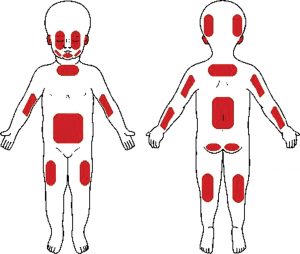
Typical areas of accidental bruising:

Pattern of accidental bruising
Maguire, 2010

Typical pattern of abusive bruising:

Pattern of abusive bruising
Maguire, ADC Ed & Pract 2010

From prospective longitudinal study of children (<6 years):

  • 6.7% of premobile children had at least one bruise (2.2% of babies who could not roll over and 9.8% in those who could)
  • Most common site affected in all groups was below the knees, followed by ‘facial T’ and head in premobile and early mobile.
  • The ears, neck, buttocks, genitalia and hands were rarely bruised (<1%).
  • Gender, season or the level of social deprivation not associated with bruising patterns, although having a sibling increased the mean number of bruises.
  • There was considerable variation in the number of bruises recorded between different children, which increased with developmental stage, and was greater than the variation between numbers of bruises in collections from the same child over time – so some kids do just bruise more than others?

[Arch Dis Child 2014]

Differential

Are you sure it isn’t a Mongolian blue spot? Or capillary haemangioma? Or erythema nodosum?

Cupping in Chinese culture! Dermatitis artefacta?

  • Thrombocytopenia. Note film can show clues – inclusion granules in Chediak-Higashi.
  • Factor deficiency – bleeding from umbilical stump classic for XIII deficiency. Girls can have bleeding problems even if carriers rather than completely factor deficient.
  • Glanzmann’s thrombasthenia – platelet count normal! But severe eg fingertip bruising and bleeding from vaccination sites. Other platelet defects similarly.

History

Haematomas after Vit K at birth or immunisations? Bleeding from umbilical stump or Guthrie test? Dental treatment? Joint swelling or pseudoparalysis that might suggest a haemarthrosis?

Family history? 30% of haemophilias de novo mutations.

Skin/joint hypermobility/elasticity? See Ehlers-Danlos.

Parenting and constipation

Parental child-rearing attitudes (as assessed by the Amsterdam version of the Parental Attitude Research Instrument, A-PARI), are associated with constipation in children in Dutch study.

More specifically, both higher and lower scores on the autonomy attitude scale were associated with decreased defecation frequency and increased faecal incontinence. High scores on the overprotection and self-pity attitude scales were associated with increased faecal incontinence.

“Autonomy” reflects emphasis on encouraging independence.  “Overprotection” refers to concern about child with respect to prevention of disappointment and problems for the child, and need to know what’s going on inside child.  “Self pity” refers to irritability and frustration with respect to upbringing, which implies rejection.

More and stronger associations were found for children aged ≥6 years than for younger children.

Authors recommend addressing parenting issues during treatment and even referral to mental health services when parenting difficulties hinder treatment or when the parent–child relationship is at risk.  [Arch Dis Child 2015;100:329-333 doi:10.1136/archdischild-2014-305941]]


Functional abdominal pain

Rome III classification (now Rome IV?) of functional GI disorders – has child section.  Colic, rumination, cyclical vomiting, diarrhoea, dyspepsia, abdo migraine, IBS, abdominal pain, constipation.

Functional abdominal pain (FAP) must include all of the following:

  • Episodic or continuous abdominal pain

  • Insufficient criteria for other functional GI disorders

  • No evidence of an inflammatory, anatomic, metabolic, or neoplastic process that explains the subject’s symptoms

Criteria fulfilled at least once per week for at least 2 months before diagnosis

Childhood Functional Abdominal Pain Syndrome

Must include childhood functional abdominal pain, and at least 25% of the time have 1 or more of the following:

  • Some loss of daily functioning

  • Additional somatic symptoms such as headache, limb pain, or difficulty sleeping

Criteria fulfilled at least once per week for at least 2 months before diagnosis

That loss of daily function is an optional criterion is because it would exclude motivated children who continued activity despite the pain and children whose parents insisted that they continue activities. However, it is recognized that there is a subgroup of children in whom loss of daily functioning and/or accompanying somatic symptoms form an important component of their symptom complex. This group is now referred to as having FAPS.

Anti-emetics

Oral Ondansetron use for gastroenteritis has become v popular in many emergency departments.  In 1 study of 18 EDs, where it was a standard in nearly half all cases, there was no overall improvement in rates of either intravenous rehydration (remained around 18%) or hospital admission. There was a small decrease in re-attendance rates.

There was also a wide variation between institutions: perhaps the problem is not using Ondansetron it correctly eg not giving it soon enough, or rushing into IV fluids before allowing the drug time to work

Same group looked at Ondansetron in diabetic children with vomiting, again, usage increased from 0 to 67%. Admission rates dropped from 62% to 49% between these eras, as did use of IV fluids, but Ondansetron had no independent benefit.

From Archimedes Blog.  (Freedman S et al. JAMA Pediatr 2014;168:321–29, see also Editorial)( (Leung J et al. J Pediatr 2014. doi.org/10.1016/j.jpeds.2014.10.020). )

Febrile Convulsions

Typical febrile convulsions are:

  • age 6 months to 6 years
  • Normal neurodevelopment
  • generalized, tonic-clonic

Most important differential is CNS infection eg encephalitis, meningitis.  These tend to present with posturing, impaired conscious level, or focal seizures. 15% of patients presenting with status epilepticus with fever have meningitis (observational study) – although low rate of LP so underestimate? I suspect there would have been other features to suggest meningitis beforehand.  Stiff neck? Fear of doing LP due to RICP from fit and/or meningitis, so do CT first if in ICU or abnormal neurology else as soon as no contraindication. If in doubt, treat empirically for meningitis (+/- herpes encephalitis, although risk unknown) with antibiotics and steroids. [Chin RFM, Arch Dis Child 2005;90:66-9.(Ed by Kneen)]

About 30-35% of febrile convulsions in the absence of CNS infection however have one or more complex features:

  • focal onset,
  • duration >10 minutes,
  • or multiple seizures during the illness episode

Febrile status epilepticus, a subgroup of complex febrile convulsions with seizures lasting more than 30 minutes, occur in about 5% of cases.  [BMJ 2015; 351 doi: http://dx.doi.org/10.1136/bmj.h4240 ]

Recurrence

One third of children with febrile convulsions will experience further seizures; age is the single, strongest, and most consistent risk factor. Most recurrences will occur during the first year and over 90% recur within two years (so unlikely to happen later). Other risk factors for recurrence are –

  • family history of febrile convulsions (but not epilepsy) in a first degree relative,
  • children whose initial seizure occurred with a relatively low fever,
  • multiple initial seizures occurring during the same febrile episode.

Surprisingly, status in an otherwise normal child does not appear to significantly increase the risk for further febrile seizures or the development of epilepsy.

Information for Families

From European Journal of Pediatrics 2021:

Wheeze

US and elsewhere use “bronchiolitis” to mean wheezing illness!  So beware definitions in studies.

Early aeroallergen sensitization predictive of ongoing symptoms and loss of lung function at school age, but does not predict response to treatment with inhaled corticosteroids (ICS)!

European Resp society task force diferentiate Episodic Viral Wheeze (EVW) from Multiple trigger wheeze (MTW) viz exercise, smoke, allergens.  Children may change categories over time.  Guides treatment.  But note that few RCTs have used this classification, and tend to conflate.

MTW is associated with more airflow obstruction, and the pathology (eosiniphilic inlfammation and remodelling) similar to asthma.  Eosiniophilic inflammation not seen in EVW.

Several clinical indices which attempt to predict future asthma – PPV generally under 50%.  Kids with EVW only have no increased risk of respiratory symptoms once they reach age 14.

No evidence that early ICS (intermittent or continuous) affects progression of disease.  [N Engl J Med 2006;354:1985-97 PMID 16687711]

Parental smoking linked to wheeze, asthma, bronchitis and nocturnal cough, with mean odds ratios all around 1.15, with independent effects of prenatal and postnatal exposures for most associations (PATY study (Pollution And The Young), n=53 879 children from 12 cross‐sectional studies).   “Not in front of the children” does not protect from effects [Jenny Pool, Cambridge – Thorax 2012;67:926]: 88% of children from families where parents only smoke outside still have detectable urine cotinine.  Nicotine levels in household dust and on surfaces is at least 3x higher in homes where parents smoke indoors, but still 5-7x higher in homes where parents smoke outside cf non-smoking houses [Tob Control 2004;13:29-37 doi:10.1136/tc.2003.003889].  Air pollution increases vulnerability to preschool wheeze, but no specific advice on individual exposure.

PREEMPT study of intermittent montelukast (1 week with onset of URTI) for EVW vs placebo reduced unscheduled consultations for asthma, days away from sc hool/nursery, parental time off work.  [Australia, Am J Respir Crit Care Med. 2007 Feb 15;175(4):323-9.] Similar findings from a US study, but not supported by much larger WAIT study, 3 way study of intermittent vs continuous montelukast vs placebo [Nwokoro, Lancet Respir Med. 2014 Oct;2(10):796-803. doi: 10.1016/S2213-2600(14)70186-9].  But “5/5 ALOX5 promoter genotype might identify a montelukast-responsive subgroup”? Discontinue when child is better, not after specified number of days!

Cochrane supports intermittent ICS for wheeze, but only due to small studies with unlicensed doses eg fluctic 750mcg BD!  No studies of combined ICS/montelukast.

No evidence for prophylactic continuous ICS, but studies looked at mild rather than severely affected children.   Could be tried if repeated hospital admission, in case interval symptoms underappreciated!  Beware growth suppression, review and wean/stop if able.

Hospital study of pred vs placebo (n=687) found no benefit!  SImilar study in primary care.  SO should not be automatic, esp when anticipated duration of admission less than 24 hours.

No evidence for treatment plans for preschool wheezers!

BMJ 2014;348:g15 Andrew Bush

Plantar warts

2/3 resolve within 2 years.  In young children, higher spontaneous clearance.  In systematic review, only salicylic acid and aggressive cryotherapy seem to be effective.  Both are user dependent.  In RCT between the 2 and conservative management, no difference detectable after 13 weeks.  So watch and wait, unless causing a lot of pain.

Perianal warts can be transmitted vertically from mother at birth, or potentially from carers changing nappies.

Warticon cream is podophyllotoxin. Else Condyline paint.