Category Archives: Common

Henoch Schonlein Purpura

or HSP. Usually preschool but any age! Boys more than girls. Vasculitis, leucocytoclastic with IgA predominance. EULAR criteria 2010.

Features:

  • Urticarial rash becoming purpuric but still raised (pathognomic), predominantly on lower limbs, especially extensor surfaces incl buttocks, but sometimes trunk, rarely face (infant).  Accompanying soft tissue swelling, as seen in photo in feet.
  • Arthralgia (not migratory, cf acute rheumatic fever)
  • Abdo pain, diffuse, colicky, often severe – possible intussusception, melaena
  • Proteinuria (30+ mmol/mg albumin:creatinine ratio), 2+ red cells on dip or 5+ on microscopy (or casts) indicating glomerulonephritis, usually asymptomatic cf streptococcal, but a few develop diffuse proliferative lesions with irreversible renal damage.
  • Scrotal rash/bruising common, rarely torsion
  • Rarely encephalitis, seizures, pulmonary haemorrhage

Pathology

Leukocytoclastic vasculitis with glomerular mesangial IgA deposits.  Biopsy of patients with IgA nephropathy identical, and indeed both groups have defective IgA1 glycosylation, which may explain why they may aggregate and precipitate IgA in small vessel walls as well as in the glomerular mesangium.

Complications

Complications and relapse associated with age esp over 6yr. 50% relapse, usually within 6 weeks but can be up to a year later; 50% of those will relapse more than once. Treat with NSAIDs (unless renal involvement!) for joint pain, analgesics for abdo pain. Small study from Turkey found that Ranitidine reduced symptoms.

Steroids (prednisolone 1-2 mg/kg/day for 1-2 weeks) are suggested (grade 2 recommendation) within 3 days of onset of severe abdominal pain (defined as pain requiring hospital admission) or acute GI bleeding – after exclusion of intussusception, of course.

Steroids are also suggested for orchitis, after excluding torsion.

Reviewing 101 children with abdo involvement those who did not receive steroids had an average of 5 days of abdominal pain, whereas all those treated recovered within 24 to 48 hours of starting steroids (letter, J Pediatr Gastroenterol Nutr. 31(3):323-4, 2000).

Abdominal pain is a predictor of renal involvement, so maybe that’s the best reason for giving steroids… (Kidney Int 1998; 53:1755-9).

Renal disease

20 to 90% risk of renal disease, but generally mild (mostly just mild proteinuria and/or haematuria)! Normal urinalysis at day 7 has 97% negative predictive value for chronic renal disease [PLoS One 2012;7:e29512].

About 56% of those children with renal disease develop signs and symptoms of renal disease a week or more after presentation, although generally in first month.  Can be up to 6 months later.  Incidence of renal failure in HSP nephritis is just 2 to 5%.  Risk factors are severe abdominal pain (OR=2.1), age >8yrs (OR=2.7), and relapsed HSP (OR=3).[Arch Dis Child. 2010 Nov;95(11):877-82. doi: 10.1136/adc.2009.182394]

A normal urinalysisNB Children who appear to recover may have significant renal disease many years later. (Lancet. 339:280282, 1992).

If more than 50% crescents on biopsy, then poor prognosis.  Only 1% get that far.

Archimedes in 2012 found 3 RCTs of steroids, treatment courses 2-4 weeks, seemed to shorten duration of abdominal pain, with most obvious effect when used early.

Dudley trial of early steroids (day 7) failed to find any benefit at 12 months (n=352).  Quite a high proportion of drop outs unfortunately, but prob not enough to influence results.  Doesn’t answer question of what to do if severe disease at onset eg nephrotic range.  [Arch Dis Child. 2013 Oct;98(10):756-63.]

Non-randomized prospective clinical trial of 223 kids showed that steroids were effective in reducing the severity of abdominal and joint pain and in treating renal disease – steroids did not prevent the development of nephritis [Archives of disease in childhood. 2010;95:877–82, doi: 10.1136/adc.2009.182394 ].  Previous systematic review suggested that steroid treatment at diagnosis did not reduce the median time to resolution of abdominal pain but did significantly reduce the mean resolution time, and increased the odds of resolution within 24 hours.

There is no proven benefit of corticosteroids in the treatment of established HSP nephritis (2009 Zaffanello systematic review, evidence is poor), but used anyway.

The major risks of corticosteroid treatment in children with HSP are masking an acute abdomen or intussuception, and GI bleeding.

Follow up

UK Kidney association guideline 2022 – for uncomplicated presentation, do frequent dipstick checks, for example weekly for first 4-6 weeks then monthly. BP check at presentation and then if evidence of nephritis. No need for parents to check at home otherwise. 6 months minimum (audit criteria, rather than recommendation).

If hypertensive or urinalysis pos, then do proper urine protein:creatinine ratio, U&Es, MC&S. Isolated haematuria is benign. As soon as urinalysis becomes normal, child can have routine follow up.

Scottish guideline was that persisting proteinuria of + or more needs more frequent follow up eg 2 weekly, 2 monthly then 3 monthly with the second line investigations.

Refer urgently for confirmed hypertension, or nephrotic range proteinuria (P:CR over 200mg/mmol).

Refer for biopsy if persisting severe proteinuria (UP: UC >250 mg/mmol for up to 4
weeks), persisting moderate proteinuria (UP: UC 100–250 mg/mmol for 3 months),
AKI stage 1 or greater (creatinine >1.5 × previous baseline or >1.5 × upper limit of normal for age). Treatment depends on histology and severity of clinical features.

ACE inhibitor is suggested (grade 2 recommendation) for persisting mild/moderate proteinuria.

A systematic review found no risk of long-term renal impairment in children with Henoch-Schonlein purpura with normal or minimal urinary findings without nephritic or nephrotic syndrome or renal failure (Arch Dis Child 2005;90:916-20). If urine analysis is normal at presentation, then test for 6 months after the last symptoms. If there is renal disease at presentation, then the risk for progression seems to be more associated with rising proteinuria during follow-up rather than presentation features. (Am J Kidney Dis 2006;47:993-1003)

Constipation

Consider constipation if:

  • episodes of faecal incontinence (stains or smears in pants, potentially larger accidents),
  • retentive posturing (standing or sitting with their legs straight and stiff or crossed legs, some will sit on their own heel),
  • occasional massive but soft stools that virtually obstruct toilet.

Not just hard painful infrequent stools! Beware also dyschezia, where baby appears to strain at stool but not actually hard/large.

In a population-based prospective birth cohort, where dietary types were extracted from questionnaire, adherence to a ‘Western-like’ dietary pattern was associated with a higher prevalence of constipation up to 48 months [aOR 1.39; 1.02-1.87], which was not mediated by overweight or sedentary behaviour. Adherence to a ‘Health Conscious’ dietary pattern was only associated at short term, with a lower prevalence of constipation at 24 months (aOR; 0.65; 0.44-0.96). This suggests that specific dietary patterns in early childhood could be associated with higher or lower risks for constipation, but these effects are time-dependent. [Maternal & Child Nutrition. 9(4):511-23, 2013 PMID: 22288911]

Straining is not a criteria, in NICE, interestingly, although it is in Rome III criteria!

Red flags:

  • multiple anal fissures,
  • gross abdo distension,
  • tenderness with guarding,
  • abnormal lumbosacral or lower limb findings,
  • failure to thrive
  • ribbon like stools (?anal stenosis)
  • etc

“Do not use dietary interventions alone as first-line treatment for idiopathic constipation” – because no evidence that it helps! But yes, adequate hydration and fibre important (whole grains, fruit/veg, pulses).

NICE recommends Movicol/Laxido (macrogol) as first line, combining with a stimulant (picosulfate, biscodyl, senna) as second line. If macrogol not tolerated, use stimulant +/- softener (lactulose, docusate).

Warn that pain and soiling gets worse before getting better!

Review of adherence and dose important.

Toilet training eg diary, reward system, regular post prandial sitting 5 mins +/- feet on hard surface eg stool.

Poo should be as soft as toothpaste and should come out like a snake” (Snakes and ladders booklet, Kidney Kids Scotland). Tell your teacher if no toilet paper/soap or broken seat/locks etc.

Soiling

Typically, episodes of soiling (large and small) are due to overflow of liquid stool past a large impacted stool in the rectum.  The child is unable to control, due to the distortion of the rectum.

However, children often try to deny being aware of soiling, despite the obvious smell or discomfort – this is simply a coping method, and normal sensation is usually easy to demonstrate.

The diagnosis is easier in the presence of a large suprapubic mass, or a rectal mass on digital examination.  Some children however soil for attention, without any bowel or rectal disorder.

The presence or implication of a large rectal mass requires disimpaction – an escalating regimen of a paediatric formulation of macrogol (Laxido or Cosmocol are cheaper than Movicol) as per NICE guideline 99 (doses and licensing may differ from product literature):

  • Child under 1 year: ½-1 sachet daily (non-BNFC recommended dose)
  • Child 1-5 years: 2 sachets on 1st day, then 4 sachets daily for 2 days, then 6 sachets daily for 2 days, then 8 sachets daily (non-BNFC recommended dose)
  • Child 5-12 years: 4 sachets on 1st day, then increased in steps of 2 sachets daily to maximum of 12 sachets daily (non-BNFC recommended dose)
  • If macrogol not tolerated, use stimulant laxative eg picosulfate +/- lactulose

If no progress after 2 weeks add stimulant laxative eg senna, picosulfate, bisacodyl, docusate.

Enemas eg citrate can prevent megarectum where prolonged medical treatment fails.

Polyethylene glycol licensed for distal intestinal obstruction!?

Maintenance

I suggest half disimpaction dose for maintenance.

Preferred treatment is paediatric formulation of macrogol (Laxido or Cosmocol are cheaper than Movicol) as per NICE guideline 99 (doses and licensing may differ from product literature).

  • Child under 1 year: ½–1 sachet daily (non-BNFC recommended dose)
  • Child 1–6 years: 1 sachet daily; adjust dose to produce regular soft stools (maximum 4 sachets daily) (for children under 2, non-BNFC recommended dose)
  • Child 6–12 years: 2 sachets daily; adjust dose to produce regular soft stools (maximum 4 sachets daily)
  • If macrogol not tolerated, use a stimulant laxative eg sodium picosulfate (5mg/5ml, NICE recommended doses):
    • Child 1 month to 4 years: 2.5–10 mg once a day
    • Child/young person 4–18 years: 2.5–20 mg once a day
    • Add lactulose or docusate if stools hard

For babies, Senna and lactulose from age 1/12.

At least 3/12 of maintenance before weaning if disimpaction required initially.

I always highlight that laxative use does not induce dependency, rather, that chronic constipation is unlikely to improve without adequate treatment.

Review regularly – symptoms, toileting, taking medication.

Continue maintenance treatment until regular bowel habit established for at least a few weeks or until toilet trained. Do not stop dose abruptly.

General advice re balanced diet including fruit, vegetables, high-fibre bread/breakfast cereals, baked beans, regular toileting, exercise, sufficient fluid intake (1000-1400ml age 4-8yrs, 1200–2100ml age 9–13yrs).

Involve Health Visitor in pre-school group.

Consider trial of milk exclusion (to rule out cow’s milk protein allergy if intractable (ESPGHAN 2023).   Coeliac disease, hypothyroidism, cystic fibrosis, Hirschsprung’s disease and hypercalcaemia also come into the differential.

Surgery

Rectal biopsy indicated if delayed meconium at birth (ie >48hrs), Downs, enterocolitic episodes.

Anal fissures have high spontaneous healing rate with medical treatment.

Manual evacuation under GA may be required if resistant. No benefit on RCT for anal dilatation. Small RCT found botox as good as internal sphincter myectomy for refractory constipation.

Appendicostomy or caecostomy antegrade colonic enema (where bowel irrigated using catheter) has a role in refractory cases after age 6yrs. QOL, continence improve but appreciable morbidity.

Relapses more common in boys, under age 4, background of psychosocial or behavioural probs, encopresis. 1/3 of post pubertal children continue to have severe problems.  See also parenting and constipation.

Parent information

ERIC website – www.eric.org.uk

[NICE clinical guideline 99 – constipation in children and young people (Published 2010)]

[BMJ 2012]

National Review of asthma deaths

2014 Report (adults and kids) finds that routine asthma care, management of previous and final attacks is generally poor, but particularly for children cf adults.

Almost half did not seek medical help before death. 10% deaths within 1 month of discharge from hospital for asthma. Many being treated for mild/mod asthma, but review suggested prob poorly controlled severe asthma. Widespread over reliance on reliever inhalers and underuse of preventers. Overall 39% had used more than 12 blue inhalers in the year before death. 80% of deaths did not get 12 preventer inhalers in the previous year. Nearly half had not had an asthma review in previous year.

Poor follow up of previous severe attacks (but only about 20% had been in A&E in the previous year).

Delays in primary and secondary care in about a 1/3 of final attacks.

In 93% children and young people, one or more avoidable factors relating to patients, their families and their environment: eg exposed to smoke or smoked,  allergy,
Poor recognition of risk of adverse outcome from asthma.

Recommendations

Any patient prescribed more than 12 relievers in a year should have urgent review. Follow up should be made after every ED attendance for asthma. Every hospital discharge should have hospital outpatient follow up.

Should have personal asthma action plan (PAAP).

Better education on when to use asthma medication, recognise poor control, how/when to seek emergency advice.

For parents/patients

Triple A online test!

See GP within 48hrs of discharge.

Associations with depression and anxiety. Obesity mentioned.

Gilbert’s syndrome

Gilbert’s syndrome is an hereditary, chronic/episodic, mild unconjugated hyperbilirubinemia.  Due to impaired hepatic bilirubin clearance (glucuronyltransferase deficiency).  Otherwise liver function is normal.

It does not cause chronic liver disease. Non pruritic.  Jaundice may be provoked by fasting, surgery, dehydration, alcohol ingestion, infectious illnesses, heavy physical exertion, and lack of sleep.  Symptoms eg tiredness are due to exacerbating condition, not high bilirubin!

Common, 2–10% of the general population, many undiagnosed. At least 30% of people with Gilbert’s syndrome never develop symptoms.

Gilbert’s syndrome can be diagnosed when the person has:

  • Unconjugated hyperbilirubinemia (on at least 2 occasions, and not progressing).  Conj bilirubin may be sl high but always less than 20% of total.
  • Bilirubin is less than 3x upper limit of normal (approx 60).
  • No evidence of haemolysis (normal full blood count, reticulocyte count, blood film, Coombs’ test, haptoglobin level, and lactate dehydrogenase level).
  • Normal liver enzyme levels.
  • No clinical evidence of liver disease.
  • Commonly homozygous for allele 7.

Differential is Crigler Najjar type 2 – can cause persistent jaundice in childhood (cf type 1 = severe jaundice in first few days of life).

No treatment is required.

Some drugs should be used with caution in people with Gilbert’s syndrome:

  • Atazanavir and indinavir.
  • Gemfibrozil.
  • Irinotecan.
  • Statins when combined with gemfibrozil.

[NICE clinical knowledge summary]

Parent/family information at https://childliverdisease.org/liver-information/childhood-liver-conditions/gilberts-syndrome/

Enuresis

  • Primary or secondary – have they ever been dry? Only considered secondary if consistently dry for at least 6 months
  • Neurology – dribbling, ankle jerks, anal tone
  • Daytime or night time

Nocturnal wetting is considered normal up to the age of 7.  Quantify daytime wetting – pants only, patch on clothes, or puddle.

Diagnoses to consider: (not mutually exclusive)

  • Spinal lesion
  • Excessive urine production – diabetes, lack of mature pattern of ADH production at night
  • Excessive bladder tone/poor bladder volume – urgency, posturing
  • Abnormal voiding – straining, intermittent or poor stream. Could be a bladder neck problem, or else incomplete emptying.
  • Inadequate nocturnal awareness

Diaries of input/output, wetting/waking and measuring overnight urine output may be helpful. The expected bladder capacity is (Age + 1)x 30, max 390ml. If night time urine output is substantially greater than this eg 130% of expected, then suggests nocturnal polyuria. Similarly, day time voiding of consistently less than 65% of expected capacity suggests a small bladder. Going 8x a day or more (with a normal fluid intake) is another clue.

Recommended fluid intake (NICE):

  • 4-8 yrs: 1000–1400 ml
  • 9–13 years: 1200–2100 ml (boys sl more!?)

Incomplete bladder emptying can be defined as post void residual urine volume of greater than 20 ml, on more than one ultrasound, without excessive bladder distension before hand.

For bladder problems, exclude UTI/diabetes by urine dipstick testing.

For bladder or bowel problems, look for any signs of constipation, not just hard/painful stools.

Daytime wetting or urinary urgency/frequency

Ensure adequate fluid intake.  Aim for at least 6-8 cups of appropriately sized water-based drinks spread throughout the day (e.g. 200ml for a 7 year old, about a teacup full;  250ml for an 11 year old, about a mug full).  Start with 8 small drinks every day and increase the amount gradually so the bladder gets used to being stretched.

Try avoiding fizzy drinks, blackcurrant, orange, and drinks containing artificial colourings, flavourings and sweeteners, tea/coffee/hot chocolate for a few weeks, then introduce them one at a time to see what effect they have on the bladder.

Aim for 4-7 voids per day.  If child tends to hang on for prolonged periods, ensure adequate fluid intake as above, then consider an alarm to remind them to go (vibrating watch available, £40+).  Do not encourage excessively frequent voiding – bladder will then become less able to contain normal volume.

Check child is properly relaxed going to the toilet.  Feet should be supported if sitting, use child toilet seat if tending to slip through.  Boys should try sitting for some pees each day, as well as standing.  “Don’t push your pee out.  When you think you’re finished, count to 10 and start again.  Tell your teacher if no toilet paper/soap or broken seat/locks etc.” (Snakes and ladders booklet, Kidney Kids Scotland).

Oxybutinin for small bladder (Desmopressin may work but less rational). Tolerterodine, Solifenacin are alternatives but still antimuscarinic, so same side effects.

Night time wetting

Deal with daytime wetting or urgency/frequency first.

Ensure adequate fluid intake through the day, spread evenly through the morning and afternoon/early evening.  Stop drinking an hour before bed time.

Fully empty bladder before bed time.  Try going twice!

Make toilet easily accessible in night – lower bunk, night light, bucket etc

Do not encourage regular or random lifting/waking – there is no evidence that this promotes long term dryness!  Should only be used as temporary short term measure.  Where night time wetting has not responded to management, a young person may find it useful to set an alarm for themselves.

Establish reward system for drinking well through day and helping to change bedding/pyjamas (rather than for staying dry, which is beyond their control).  Choose appropriate goals, choose appropriate reward (choices/time, not necessarily monetary/dietary), choose appropriate format. Dot to dot picture rather than calendar?

Think positively – say  “I can wake up and go to the toilet if I need to in the night!” before going to sleep. Try without nappies/pull-ups from time to time.

Get bed pads or waterproof mattress protector

Consider bed wetting alarm – bedpad or pant sensor? Buzzer or beeper? Alarms from ERIC cost £50-150!  NICE says avoid alarms if doesn’t suit household, emotional stress esp parental blaming, or if infrequent wetting. Will disrupt sleep, of course!  Parents may need to help child wake to alarm, need to do consistently and chart progress.

Offer trial of desmopressin if child over 7yrs, especially if rapid short-term improvement a priority, or if alarm not suitable.  Consider from age 5yrs.  Response rate low for those without obvious polyuria.

Refer to ERIC website (www.eric.org.uk) or helpline  (0845 370 8008) for further support/information

Although primary nocturnal enuresis is still reasonably common up to the age of 7yrs, addressing the issues above should nonetheless be considered in children younger.

Refer to Secondary Care:

  • Bladder dysfunction: straining to pass urine, intermittent or poor stream
  • Abnormal neurology or lumbosacral spine (naevus, hairy patch, pits, asymmetry)
  • Social/emotional factors that are affecting likelihood of improvement
  • Bedwetting not responding to alarm or trial of desmopressin
  • History of recurrent urinary tract infection
  • Day time wetting not improving with first line advice as above

See ERIC (Childhood continence) website for parent information. Hjalmas, J Urol 2004 International evidence based strategy for nocturnal enuresis. International Children’s Continence Society.  NICE guideline 111 nocturnal enuresis

Fever

See also antipyretic treatment.

Fascinating how fever affects parents!  Fever phobia first described in the literature in 1980 by Schmidtt. Found in many different cultures and countries, not related simply to child mortality rates or education.  And does not appear to be declining over time.  Also commonly found in health care professionals esp nurses. 

Interesting cultural variation eg Hispanic Americans vs white, Bedouin vs Jewish Israelis.

The main fears for parents are seizures, brain damage, dehydration, whereas the issue for health care is the potential for underlying, serious illness, typically bacterial eg meningitis, pneumonia, septicaemia etc.  

Hyperthermia, ie unregulated rise in temperature (think dogs in cars) is dangerous, causes brain damage.  Hyperpyrexia on the other hand, where body “thermostat” reset, is not dangerous.  It can precipitate febrile convulsions, but only really in children with a genetic susceptibility or at least an underlying predisposition to seizures.  

In a qualitative study of Dutch parents, it was clear that when parents did not feel recognised in their concern or felt criticised, anxiety increased as well as the threshold to seek healthcare for future illnesses.  The authors recommend that health care professionals recognise parental intuition and provide clear information on alarming signs and potential diagnoses to empower parents [BMJ Open 2018;8:e021697].

Measuring/Detecting

Touch is sensitive (90%) but not specific (50%) for fever – so don’t dismiss parental reporting entirely. [J Trop Pediatr. 2008 Feb;54(1):70-3 PMID 18039678]

NICE recommends digital thermometer in axilla, else tympanic thermometer or chemical dot thermometer in axilla (still not great cf rectal, particularly when parents doing it with over the counter devices cf nurses with hospital equipment [BMC Fam Pract. 2005; 6: 3]). 

Over the counter devices sadly provide little useful practical information to parents – in fact most do not even give correct criteria for pyrexia and few give useful advice on managing fever [Br J Gen Pract. 2015 Jun; 65(635): e366–e371.]

Assessment

The height of fever is associated with bacterial, rather than viral infection, but only over 40 degrees: in hyperpyrexia (> 41.1.degC) still only 20% will have serious bacterial infection so really not v helpful.  Chronic underlying illness, prematurity or diarrhoea increase the risk of a bacterial cause, rhinorrhoea or other viral symptom decreases it. Age, maximum temperature, and total white blood cell count were surprisingly not predictive of either bacterial or viral illness! (n=103). (Pediatrics. 118(1):34-40, 2006 PMID 16818546)

Red flags:

  • Cold limbs – sepsis
  • Leg pains, thirst – sepsis esp meningococcal
  • Short history – meningococcal
  • Disproportionate heart rate – sepsis
  • Foreign travel
  • Unimmunised – Pneumococcal, Hib
  • Prematurity, chronic disease

History of fever at home, compared with actual fever on admission, is  lower risk (RR 0.68) but not enough to ignore [Journal of Pediatrics. 204:191-195, 2019 01.PMID 30291019].

Fever without source causes concern, although generally it will either become more obvious where the source is or else it will sort itself out.  Only when fever has been persistent for more than 7 days in a child in whom a careful thorough history and physical examination, and preliminary laboratory data fail to reveal a probable cause for the fever, can you reasonably start talking about a pyrexia of unknown origin (PUO)!.

The risk of invasive bacterial disease in young children with unexplained fever presenting to hospital has certainly declined with modern immunisation schedules so difficult to compare with historical data.  

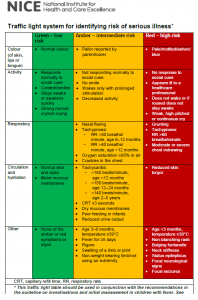
NICE published a Traffic Light system for detecting serious illness in febrile under 5s. A bit unwieldy, seems to cover the main issues, retrospectively sensitivity is only about 85%, and specificity only 29% for serious bacterial infection.Traffic lights NICE fever

Red symptoms/signs are ones that clearly indicate serious illness eg

  • weak, high pitched or continuous cry (meningitis)
  • grunting
  • tachypnoea >60
  • reduced skin turgor

The Amber group includes the vast majority of children coming to hospital with fever. In particular:

  • creps
  • tachypnoea >50 (under 1) or >40 over 1
  • tachycardia >160 (under 1), >150 (1-2), >140 (over 2)
  • rigors (not probably much more predictive than high fever – ?higher risk of urinary sepsis?)

And anyway, we know signs and symptoms other than classic neck stiffness etc fail to predict outcome; best predictor is still “something is wrong” or “appears unwell”.  In Jonathan Craig’s big Australian study looking at more than 25 clinical indicators for bacteraemia, UTI and pneumonia, “appearing generally unwell” was the strongest diagnostic marker for all 3 groups.  Raised temperature, no fluid intake in the previous 24 hours, increased capillary refill time, and chronic disease also predictive. [BMJ 2010;340:c1594]

Hence most important primary care action is prompt clinical assessment by experienced clinician. [BrJGP 2007;57:538, pmid 17727746]

Compared with other scoring systems, NICE traffic lights work pretty well but note how none of these systems work as well as they were supposed to, and performance varies across different datasets.

Adding urinalysis improved sensitivity to 92%, since most of the missed infections were UTI. (De et al, BMJ 346: f866 ).  Thus, prize winning haiku:

Improve the NICE guide
for under 5s with fever
Urinalysis

[Brian Attock]

See also antipyretic treatment.


UTI Treatment

See NICE CG224 (refers then to CG111 (pyelonephritis) and CG109 (lower tract UTI)): Under 3 months get IV treatment. Else 3 days oral treatment if lower tract, 7-10 days oral for upper tract. IV for vomiting, unable to take oral or severe illness (but also says underlying known anomalies should influence choice) 2-4 days IV then oral for total of 10 days (!). No preference between cefuroxime, ceftriaxone and gentamicin. Upper tract defined as fever else loin pain/tenderness

Cochrane review concluded that 2-4 day course of oral antibiotic is as effective as a 7-14 day course in the treatment of lower-tract UTIs in children. PMID 12535494 The majority of febrile infants with UTI have nuclear scan evidence of pyelonephritis, suggesting that infants should not receive short course treatment.

Also concluded that for pyelonephritis oral antibiotics are as effective as the combination of parenteral followed by oral antibiotics. Based on:

  • Hoberman’s RCT children under 2 with fever and UTI (n=300) – oral cefixime for 2 weeks as good as IV: no difference in defervescence, reinfection, scarring at 6 months (and much cheaper!). Severely ill excluded (eg CRT>3sec) – only 3! Funny group though, mean age of 8 months, 90% female, and a low scarring rate (15%). Pediatrics 99 Vol. 104: 79, Hoberman A.
  • Montini Multicentre RCT non-inferiority (n=502, 1/12 to 7yrs). Oral co-amoxiclav for 10 days equivalent to ceftriaxone for three days followed by oral in terms of DMSA scars, time to defervescence. BMJ 2007; 335:386-8

Crucial that oral antibiotics are not vomited, of course.

Gauthier et al treated infants and toddlers with febrile UTIs as outpatients using a single daily dose of intravenous gentamicin until the children were afebrile for at least 24 hours, after which oral amoxicillin (!) was given until the urinary culture report was available. Successful in three quarters. Current Opinion in Pediatrics. 18(2):134-8, 2006

1/3 of UTI E coli resistant to trimethoprim, 2/3 if underlying renal abnormality. 61% of women with UTIs and resistant organisms do not reconsult! So should we use community surveillance to guide prescribing rather than individual culture and sensitivity?

UTI prophylaxis did not reduce recurrent infection (n=611). But lower rate (12%) reported than might be expected. Higher resistance rates are seen in recurrent infections, which could be anticipated (JAMA 2007;298;179)

UTI Follow up investigations – GGC guideline 2020

Same definitions of upper, lower and atypical. UTI definitions

  • Under 6/12, USS for all, within 6 weeks. Urgent if recurrent or atypical features (other than funny bugs).

UTI imaging under 6 months

  • Provided things settle within 48 hours of treatment, no further investigations are required unless atypical or recurrent, in which case everyone gets DMSA (6 months after infection) and MCUG.
  • 6/12 to 3yrs: USS only if doesn’t settle within 48 hours of treatment. If atypical or recurrent then USS and DMSA (USS urgent if atypical features, other than funny bugs), else within 6 weeks.

UTI imaging 6/12-3yrs

  • Consider MCUG if dilatation on US, or family history of VUR, or atypical bugs, or poor flow. (MAG3 if continent)
  • Over 3yrs: same, except no DMSA even if atypical features, and no mention of MCUG at all.

UTI imaging 3yrs+

If USS abnormal, refer for consideration of further imaging.

But:

  • USS – not much evidence for benefit, esp if normal antenatal scan, rarely changes management even if something minor found, but harmless. If dilatation seen, do MCUG urgently.
  • MCUG – like GORD, maybe you see reflux, maybe you don’t, so can you rely on it? NB Cost, radiation, discomfort…
  • DMSA – acutely, diagnoses pyelonephritis. Then remain positive for up to 6 months after an infection. Late scan diagnoses scars. But if negative during first UTI episode, rarely (NPV 88%) have VUR and never high-grade VUR. [J Pediatrics Volume 150, 1 , January 2007, 96-99]
  • Antibiotic prophylaxis – not routinely.  If considered on the basis of risk/benefit discussion, then use trimethoprim.  If trimethoprim resistance, consider strategy of early empirical treatment rather than use a broad spectrum antibiotic such as co-amoxiclav or cefalexin (else risk of highly resistant bugs). [Hoberman A, NEJM 2003] Review every 3-6 months.
  • Cycling of antibiotic for prophylaxis may be more rational eg every 2-4 weeks

Studies do not address whether placebo or nothing is worse than prophylaxis (Cochrane: suggests about 36% reduction in infection, but all 3 studies biased, and most other work has prophylaxis vs surgery). Eg Sweden, only screen if additional risk factor, and v low prevalence of scars. Garin study (Paeds 2006) non placebo controlled, found no protection from recurrent infection with antibiotic prophylaxis (the rate for those with reflux was close to significance but seemed to be cystitis rather than pyelo) – plus the bugs were resistant. The rate of scarring was actually higher in the prophylaxis group…

[(Roberts, Kenneth) PIDJ 23(12); 2004:1163-1164 ]

UTI Follow up investigations – NICE CG54

  • Under 6/12, OPD USS sufficient if good response to treatment within 48 hours.
  • Under 6/12 and atypical (see below) or recurrent (see below), then urgent USS to look for obstruction or severe reflux, or if simply non-E.coli then within 6 weeks.  PLUS later OPD DMSA (ie 4-6 months post infection), MCUG.
  • 6/12 to 3 yrs: nothing if good response to treatment within 48 hours. If atypical or recurrent, as above but no MCUG unless:
    • family history,
    • poor flow,
    • dilated tract on US,
    • non-E coli.
  • Over 3yrs: nothing if good response to treatment within 48 hours. If atypical, only needs urgent USS (OPD USS within 6 weeks if simply non-E.coli). If recurrent, do OPD USS and later DMSA.

Atypical defined as seriously ill, poor urine flow, abdominal/bladder mass, raised creatinine, septicaemia, failure to respond to appropriate antibiotics within 48 hrs, non-E. coli infection

Recurrent defined as 3 lower tract UTIs, else 1 upper tract plus any other

If another UTI occurs before the DMSA is done, don’t defer DMSA in case scarring already established.

Prophylactic antibiotics for MCUG (1 day before to 1 day after).