Category Archives: General paediatrics

Hay fever

=allergic rhinoconjunctivitis due to seasonal triggers, typically grass and/or tree pollen, can also be weeds/moulds. First described by John Bostock in 1819, so a new disease!?

More likely if born in early months of year!?

So itchy, swollen, watery eyes, runny and/or blocked nose, sneezing. Often itchy throat and ears too. Cobble stone appearance can be seen at the back of throat.

Not dangerous, but can seriously affect quality of life: poor sleep, poor concentration (exams usually at worst time of year), embarrassment about snot. One study in England showed that children with hay fever requiring anti-histamines are significantly more likely (43%) not to achieve predicted exam grades, especially when using first generation sedating antihistamines such as Piriton (chlorphenamine)  [Samantha Walker, JACI 2007: 120; 381-387].

Associated with other atopic conditions, such as food allergy and asthma. Moderate to severe hay fever also associated with worse, uncontrolled asthma. London study found hospital admissions for asthma 50% higher 3 days after high grass pollen levels (inconclusive for tree pollen). [Int J Biometeorol. 2017] Brussels study found similar, compounded by air pollution. Treatment of hay fever with intranasal steroids or class 2 antihistamines reduced admissions by up to 80%. [asthma res and pract 2015]

Pollen is too large to trigger the lower airways directly, rather, pollen exposure in the upper airways trigger inflammation that travels down (probably over a period of weeks) to the lower airways. An exception is when pollen grains are fragmented, as seen in thunder storm asthma where one night in Melbourne, 2016, several thousand acute respiratory presentations came to ED (up over 600%), asthma admissions up over 900%, hospitals ran out of inhalers. 10 deaths implicated. [Australia, Clin Exp Allergy. 2018;48:1421‐1428]. Complex though, rain/moisture probably contribute to pollen grain rupture, and atmospherics bring surges of pollen down to ground level.

There are many different species of grass, but if allergic to one you tend to be allergic to all of them. Trees on the other hand vary, you tend to be allergic to specific groups of trees. In Europe the most important are birch (northern Europe) and olive (Southern Europe). Birch pollen cross reacts with alder, hazel, hornbeam, beech, oak, chestnut.  Olive is related to ash and lilac, cross reacts to a degree with birch.  Cedar and cypress are related, pine (spruce/fir etc) are different but latter pollens are heavier and thought not to be as relevant to symptoms. Weeds belong to various unrelated families.

Hazel trees can start producing pollen in January! Peak is Feb/March. Alder is next earliest (see chart below). Pine is quite late, similar to grass. Weeds such as nettle can continue producing pollen through September! Cypress blooms in winter! 

Average start of grass season in Scotland is mid-May (dark green on chart below), high counts generally start 1st week of June (blue), peak (purple) is mid-June to mid-July. (Light green is earliest/latest appearance, low risk).

Average start of birch season in Scotland is last week in March, highest counts end April, early May.
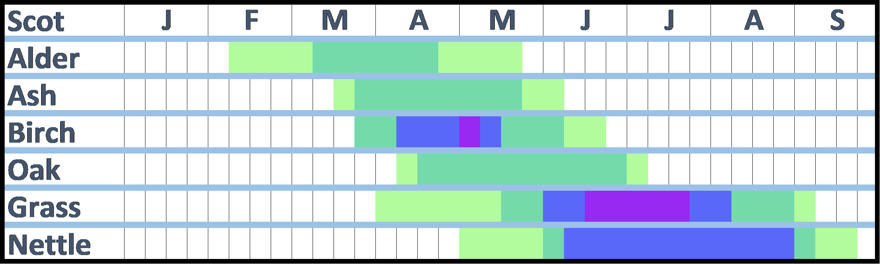
Pollen seasons in Scotland – University of Worcester Pollen Lab

Met office gives 5 day forecast by region. Kleenex site gives more detail (postcode level! Individual trees/grasses!).

It’s not just pollen count – the amount of allergen carried by the pollen (“pollen potency“) varies too. Correlates pretty closely but varies by time and place, 4-5 fold difference geographically (especially grass). France has the highest yearly average grass pollen potency, 7-fold higher than Portugal. Olive pollen from two locations 400km apart varied 4-fold in their allergen potency – in Portugal there are times when pollen from Spain probably more of a problem for triggering hay fever than pollen from “local” trees! [Health Impacts of Airborne Allergen Information Network (HIALINE project)]

Moulds seem more associated with asthma than hay fever.

Management

Watch the pollen count, and choose activities inside or outside accordingly. There are apps that can help with this. But note that the time of day is important too – for grass pollen, the risk is greatest in the first half of the morning and again from about 4pm in the afternoon, until late evening. But can persist into the early hours if temperatures remain high, this effect is particularly noticeable in the cities of the south of England. For tree pollen, the risk is usually during daylight hours only.

Closing windows, or at least not sitting near windows should help. Wash your hair more regularly. Don’t dry clothes outside. Pollen barrier balms available (evidence?). Big, wrap around sunglasses?

Air purifiers with a HEPA filter should help but doors and windows will need to be closed. Unfortunately the best ones tend to be big, expensive and noisy, and price does not mean good quality. Plus you have to remember to replace the filters. The cheapest Which? recommended one (the Electriq EAP500HC) costs over £200.

Choose when and where you are going on holiday carefully, so you get away during the worst period. North of Scotland and the islands have a short, late grass season (late June, early July). Coastal areas likely to be best (although often there are fields just back from the coast, so it may depend on the wind direction!). For tree pollen, season is earlier for most (see above), and there are parts of Scotland (Orkney, Lewis, Caithness, Sutherland) with very few trees. For holidays abroad, see World pollen data.

Medicines

Antihistamines – oral, nasal or eye drops. Various, some people find one works better than another Sedating antihistamines eg Chlorphenamine should be avoided except at night.

Cromoglycate eye drops are available, they work in a different way from antihistamines so may give additional benefit. But need to be given 4 times daily, which is inconvenient.

Nasal steroids useful if used correctly. Fluticasone is licensed from age 4 – Betnesol nasal drops from age 2 (but systemic absorption an issue). Combination steroid/antihistamine spray available from age 12.

Leukotriene receptor antagonist licensed for hay fever in children with asthma.

Short courses of oral steroids might be justified for special occasions.

Immunotherapy available. Grazax is sublingual grass product; Pollinex Grass and rye is subcutaneous. age not important cf ability to hold in mouth for 2 minutes! Metanalysis by Dhami S et al of grass desensitization in children, using either subcutaneous or sublingual therapy, found overall standardized mean difference (SMD) of -0.53 (95% CI -0.63, -0.42) in symptoms scores (roughly equal numbers of SCIT and SLIT studies, roughly equivalent scores)  [Allergy 2017]. Deaths reported in asthmatics with poor control.

Itulazax is NICE approved (2025) birch pollen daily sublingual (need to start 16 weeks ahead of season, so last week in November; £80 on NHS). European license is 5yrs+. Itulazax submitted to Scottish medicines consortium (SMC) – decision due October 2026.

Pollinex is subcutaneous (£450 for a course of Grass on NHS – Quattro version more expensive again, theoretical benefit).

Licensed but none approved by SMC (Grazax rejected in 2008 and not re-submitted, Pollinex not submitted) for Scotland. Combined grass and house dust mite products?

[Sian Ludman, St Mary’s]

For symptoms all year round (perennial), triggers such as house dust mite and pets are more likely.

Omalizumab – monoclonal anti-IgE – single injection of 300 mg omalizumab two weeks before start of the pollen season achieves better overall control of symptoms and QoL [adults, China 2022]. Evidence of benefit in allergic rhinitis with difficult asthma [adults, 3 years worth of monthly treatment, Italy 2020].

Tree nut allergy

Group of nuts that includes hazelnut, almond, brazil nut, cashew, pecan, pistachio, walnut and macadamia. Definition of nut is actually a bit complicated, to do with whether the shell comes off spontaneously or not, but I stick to those defined by food labelling law.

Does not include peanut (a legume), coconut, pine nut, chestnut or tiger nut. You can be allergic to these as well, of course.

You can be allergic to just one, a couple or the whole lot. Risk of allergy to peanut is higher than if you weren’t allergic to anything.

Hazelnut and cashew allergies are common. Almond rare.

Hazelnut allergy goes along with fruit allergy and oral allergy syndrome.

Cashew allergy goes with pistachio allergy (OR for being allergic to both 575). Cashew allergy is particularly associated with anaphylaxis, even more so than peanut (but less common as allergy and allergen so less well known). 3 components – Ana o1/2 are seed storage proteins. Ana o3 is a prolamin, and the component most likely to be associated with anaphylaxis, plus probably more useful for diagnosis than cashew IgE.

Pecan allergy goes with walnut allergy (OR 150).

Hazelnut goes with macadamia (OR 56.2) supposedly, although that’s not my experience.

Cross reactivity table
Correlation coefficients – Brough, JACI 2020

Diagnosis and management as per Gary Stiefel BSACI guideline.

[Helen Brough, JACI 2020]

Hazelnut allergy

One of the tree nuts. One of the most common food allergens in the UK. Adults seem to get less severe reactions than children. Anaphylaxis rare compared with peanut and other tree nuts.

Hazel tree is related to birch, and indeed hazelnut allergy can be associated with tree pollen allergy (hay fever and pollen food syndrome), as well as fruit allergies.

Cor a 1 is the least likely to cause systemic reactions, and then only with raw cf roast.  But pretty much everyone tests positive for it, so not v helpful unless it is the only thing that is positive. You are usually also positive for rBet v 1/2, the birch pollen antigens.

Cor a 8/9/14 associated with systemic. Cor a 8 is LTP so likely fruit allergy too.

Cor a 9 and 14 (11s globulin and 2s albumin respectively, ie heat stable seed storage proteins) seem most useful  for defining kids at risk of systemic reactions – >1kU/l and/or >5 respectively give specificity of >90% and sensitivity of 83% in kids for “allergy with objective symptoms” viz more than just a tingle/itch, so more likely to have severe reactions. That translates to a negative predictive value of about 93% (PPV not given). [Dutch study, JACI 2013;132(2):393]

German study found  Cor a 14 had best AUC (0.89, cf 0.71 for whole hz).  Level of 0.35 gave 85% sensitivity with 81% specificity.  PPV doesn’t hit 90% until 47.8 though…

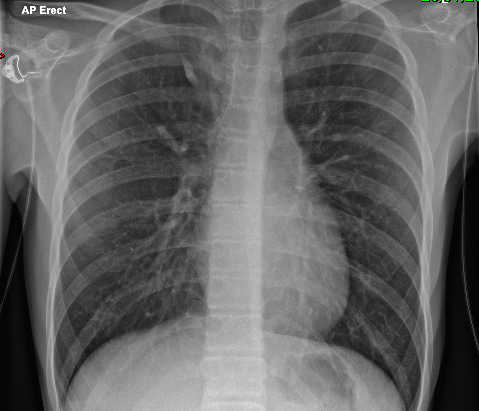
Chest X-ray

Interpretation

  • Start outside, work in – soft tissues, then bones, then lungs/heart, finally neck/infradiaphragmatic.
  • Safety check – position of lines/tunes, check apices for pneumothorax, any foreign bodies?

Adequacy

  • Rotation – look at symmetry of clavicles and anterior rib ends.
  • If clavicles high, then lordotic film. May obscure apices.
  • Penetration – should just be able to make out intravertebral spaces, without lung fields being too dark.
  • Inspiration – hila become artificially prominent if underinflated.

Thymus

Pesky thing! Can look like pneumonia. Latter more likely if air bronchograms, volume loss (displaced fissure/trachea/mediastinum), effusion. Classically:

  • indentations where ribs overlie.
  • Pointy outside edge (“sail sign”).
  • No mass effect
  • Lowish density – should still be able to see vascular markings of lung behind

Spinnaker sign is where pneumomediastinum around thymus creates long curving line.

Other normal things

Azygos lobe – normal variant where RUL has near vertical line curving up and out, from thick point (anomalous azygous vein) – giving impression of mediastinal mass.

Azygos love on chest x-ray
Azygos lobe at upper right

Mach effect – a line parallel to heart border, looks like pneumocardium but actually optical illusion where your eye “detects” border where there isn’t one…

One diaphragm usually higher than other – both ok, as long as no more than 2cm (one rib space).

Other

Hilum – rings or tram lines suggest bronchitis. Round opacity adjacent to and larger than ring suggests vascular prominence due to left to right shunt.

Silhouette sign – where heart border and/or diaphragm obscured in lower zone due to consolidation in lower lobe (left or right).

Effusion – vertical line at costophrenic angle.

Round pneumonia – will have air bronchograms, compare mass.

Collapse vs consolidation – sharp lower border is the fissure so if deviated then collapse.

Pneumothorax – lucency without clear edge may suggest lung hyperinflation eg bronchial atresia.

If edge projects below diaphragm then likely to be skin fold!

Foreign body – get expiratory film, which will enhance air trapping.

Cobalamin related metabolic disorders

Amino acid homocysteine is converted to methionine (“remethylated”) – cobalamin is involved in some of these processes, folate metabolism also important.

Various disorders.

Variety of presentations, at different ages:

  • Neurological (central and peripheral)
    • Feeding difficulties, apnoea in babies
    • Seizures
    • Subacute combined degeneration of spinal cord (peripheral neuropathy, ataxia, incontinence)
    • Acute and/or chronic encephalopathy – hypotonia, regression
    • Neuropsychiatric problems
  • vascular problems (stroke/embolism)
  • bone marrow (megaloblastic anaemia, cytopenia) – folate related
  • Atypical HUS
  • Glomerulopathy

Investigations

  • High homocysteine, usually
  • Vitamin B12 and folate, for differential
  • Methylmalonic acid (in urine)
  • Acylcarnitine
  • Methionine (usually goes low)

Treatment

Start intramuscular B12 (hydroxocobalamin) as soon as samples collected, to prevent end organ damage.

Betaine should be started if high homocysteine with low methionine found, helps push conversion to methionine.

Homocystinuria

Autosomal recessive condition of high homocysteine in blood and urine, causing similar neurological problems, thrombosis, Marfanoid appearance, downward subluxing lenses.

Needs low methionine diet. Betaine supplements help.

GIRFEC

Getting it right for every child. A framework for dealing with children and young people, looking at a range of values (SHANARRI).

Children and Young People (Scotland) Act 2014 made provision for Named Person and Child’s plan, but after review in 2019, amid privacy concerns (brought by Christian Institute, among others), government decided not to pursue legislation. Supreme court found that “duty to share information”, although well intentioned, was potentially at odds with article 8 of European convention on Human rights (“Privacy and family life”).

[https://www.gov.scot/publications/getting-right-child-practice-development-panel-report/]

Diet and mental health

Longitudinal research shows association between progressively higher glycaemic index diet and incidence of depressive symptoms. Experimental exposure to diets with high glycaemic load increases depressive symptoms in healthy volunteers, with moderately large effect.

Mechanism could be repeated and rapid changes in blood glucose, triggering counter regulatory hormones such as cortisol, adrenaline, growth hormone, glucagon.

Appears to be an inflammatory response to high glycaemic index foods too. Adherence to Mediterranean diet reduces markers. Mood disorders have been linked to heightened inflammation, although only in a minority. Observational studies show people with depression score higher for “dietary inflammation” viz trans fats, refined carbohydrates, lower intake of omega 3 fats. Mediated through polyphenols, polyunsaturated fatty acids?

Diet also affects microbiome, which interacts with the brain in bidirectional ways using neural, inflammatory and hormonal signalling pathways. High fibre, polyphenol, unsaturated fats promotes microbial taxa that generate anti-inflammatory metabolites such as short chain fatty acids.

Study of probiotics in healthy volunteers found altered response to a task that requires emotional attention, and may even reduce symptoms of depression.

But no benefit in large trial of Medierranean diet with subclinical depressive symptoms, only small trials of current depression showed benefit. Note context of people’s expectations regarding food/diet, which will likely have a marked effect on wellbeing.

Danger too of stigmatisation if trying to change an individual’s dietary choices.

[Joseph Firth, BMJ 2020;369:m2382]]

Mesial temporal sclerosis

= scarring in hippocampal area of temporal lobe. Commonly found on MRI in focal epilepsy (although focal EEG changes not always indicative of MRI abnormality, and other MRI lesions can account for temporal lobe epilepsy).

Often a history of febrile convulsions but unclear which comes first. Brain injury in early years from viral encephalitis or other cause often explains it.

Adjacent to language areas (assuming same side as language areas, which are usually on the left side in people who are right handed, but can be either side in people who are left handed) so seizures may affect speech. Also close to memory area so may not remember afterwards.

In people with drug resistant temporal lobe epilepsy, surgery can be useful.

COVID19 treatment

Death from COVID19 usually from cytokine storm and multi-organ failure (often resulting in secondary haemophagocytic lymphohistiocytosis).

NICE has risk factors for young people 12-16yrs:

  • Complex life limiting neurodisability

Otherwise you need 2 of the following to justify treatment in ill (hospitalised) patient:

  • Primary immunodeficiency:
  • Secondary immunodeficiency viz:
    • HIV with CD4 count less than 200 cells per mm3
    • solid organ transplant
    • stem cell transplant (HSCT) within 12 months, or with graft versus host disease (GVHD)
    • CAR-T cell therapy in last 24 months
    • induction chemotherapy for ALL etc
  • Immunosuppressive treatment:
    • chemotherapy within the last 3 months
    • cyclophosphamide within the last 3 months
    • corticosteroids greater than 2 mg per kg per day for 28 days in last 4 weeks
    • B-cell depleting treatment in the last 12 months
  • Other conditions:
    • high body mass index (BMI; greater than 95th centile)
    • severe respiratory disease (for example, cystic fibrosis or bronchiectasis with FEV1 less than 60%)
    • tracheostomy or long-term ventilation
    • severe asthma (paediatric intensive care unit [PICU] admission in 12 months)
    • neurodisability and/or neurodevelopmental disorders
    • severe cardiac/chronic kidney/liver disease
    • sickle cell disease or other severe haemoglobinopathy
    • trisomy 21
    • complex or chromosomal genetic or metabolic conditions associated with significant comorbidity, multiple congenital anomalies associated with significant comorbidity
    • bronchopulmonary dysplasia – decisions should be made taking into account degree of prematurity at birth and chronological age
    • infants less than 1 year with cyanotic CHD, or haemodynamically significant acyanotic CHD with history of prematurity, or those due for corrective surgery (to avoid complications or delay)

Steroids

WHO recommends dexamethasone 150mcg/kg once daily for 10 days for severe/critical COVID19 disease, on basis of REACT metanalysis.

Severe defined as any of:

  • Sats <90%
  • Tachypnoea (>30 in over 5s, >40 over 2 etc)
  • Severe respiratory distress

Critical defined as ARDS, septic shock or anything else that would require critical care.

Remdesivir

For Patients at ‘high risk’ of complications (as above, in particular immunocompromise) plus:

  • >4 weeks of age and at least 3kg 
  • Within 10 days of symptoms onset

NOT for patients requiring ventilatory support unless high risk, and not for ALT > 5x upper limit of normal .

5mg/kg loading dose on day 1, followed by 2.5mg/kg once a day for 4 days. May be extended to 10 days in immunocompromised.

Toculizimab is an option for pneumonitis.

Prophylaxis for high risk patients is available:

  • Remdesivir 3 days once daily infusions
  • Paxlovid (Nirmatrelvir +Ritonavir) 300/150mg BD for 5 days

Neutralising antibodies have also been tried but not in guidance.

Sotrovimab [NO LONGER AVAILABLE] – for 12-16yrs, pre-hospitalisation, PCR positive and onset of symptoms within previous 5 days. Not if new oxygen requirement or weight under 40kg. 1% vs 7% placebo hospitalisation or death (85% reduction).