Evidence that having a peanut allergy has worse quality of life for a family than having diabetes… Mostly due to fear of unexpected severe reaction, and restrictions on social activities particularly eating out, parties and holidays.
Allergic patients can feel embarrassed or even ridiculed for declaring their allergy. Allergy is often mocked in the media (Cobra Kai, the Box Trolls, Peter Rabbit), asthma in particular.
School and nursery are a particular area of concern, whether the right foods will be served, whether teachers or other children might bring allergens into school (food is sometimes used in classes, for example making bird seed balls), whether reactions will be managed appropriately, school trips. Children have died in school (Nasar Ahmed, Mohammed Ismaeel Ashraf).
APPEAL study 2022 – UK & Ireland, peanut allergy – 87% of parents/care-givers (not clear if mums or dads) felt moderately or severely restricted eating out, choosing where to eat (82%), special occasions (76%) and when buying food from a shop (71%). 52% of survey participants reported being bullied because of their allergy. But variable – some feel allergy has minimal impact on their health-related quality of life.
Mums tend to be more concerned by limitations in the child’s own social life, dads seem to care more about limitations in the whole family’s social life. [Stensgaard, Clin Exp Allergy 2017]. Mums are the ones most studied. There probably are significant differences between mums and dads. In some studies, parents overrate their child’s quality of life, but in others (particularly with teenagers) parents can be seen as over anxious. Teenagers tend to take on the perspective of the parent of the same sex.
How bad previous reactions have been, interestingly, does not in itself contribute significantly to quality of life – in some cases, not having ever had a reaction can make families more anxious, because they don’t know what to expect! In one study, having multiple allergies and having an adrenaline pen was associated with worse quality of life. [Protudger, Clin Transl Allergy 2016]
Parents can feel guilty if their child has a reaction, a failure of their duty to protect. Mums can feel guilty about having “caused” their child’s allergy, either through their own medical history or what they ate or didn’t eat in pregnancy (even there is no good evidence for this being a factor).
Better quality of life is seen in allergic families with greater self efficacy for food allergy management, and lower perceived likelihood of a severe reaction [Knibb, Pediatric Allergy & Immunology. 27(5):459-464, August 2016].
APPEAL-1 study
8 European countries, questionnaire study of adults and children with peanut allergy.
Only a minority remembered getting any training in future
emergencies or use of medication, after their initial reaction. There was a low
rate of satisfaction with AAI training!
43% reported bullying, and a third of these described it as
severe.
65% confident in ability to recognize a reaction, but only
45% confident about knowing when to use an AAI and 59% how. 62% say the carry AAI all the time.
25-30% said it was not easy (or rarely easy) to talk to
friends or family about their allergy, although most felt confident talking to
new people about their allergy. Friends and family were generally seen as “believing
there is too much concern over allergy” even though overall they were seen as
having a good awareness and understanding of allergy (cf other people, where
this was seen as the opposite).
Dutch respondents had lowest rates of uncertainty and stress
around activities, and for feeling anxious.
At same time, they had the highest rates of confidence around knowing
when and how to use AAI. France had
highest rate of being made to feel different in a negative way, and feelings of
isolation.
NB – likely to be the most affected families who
participated.
Raised CRP, ESR, ferritin (esp over 1000 – also haemophagocytic syndromes, haemochromatosis, liver disorders, malignancy)
Poor response to IVIG (cf Kawasakis)
Leucocytosis (neutrophilia, can be leukaemoid)
Thrombocytosis
Arthritis
Hepatosplenomegaly
Generalised lymphadenopathy
Pericarditis
Can be systemically very unwell and potentially life threatening complications may occur early in the disease course (eg pericarditis, macrophage activation syndrome or HLH, sepsis). See the Big Sick film from Netflix. Start high dose corticosteroids after careful exclusion of other diagnoses, especially infection, Kawasaki disease, and malignancy – difficult when arthritis is absent! But maybe you have to look harder…
Systemic features may predate the arthritis by several weeks and occasionally longer. Typically involves small joints of the hands and wrists, ankles, hips, knees, and cervical spine – about 30% ultimately develop severe polyarthritis.
There are no pathognomic tests or agreed diagnostic criteria for SOJIA! Classic features:
quotidian (=daily) evening spiking temperature, that returns to or falls below baseline by the morning.
Rash is faint, salmon pink maculopapular, most obvious during pyrexia. Usually not on the face so easily missed – typically on the trunk, inner thigh and axillae, especially on areas of trauma or pressure (Koebner phenomenon).
Treat with IV methylprednisolone pulses (30mg/kg over 4 hours, max 1g, once daily for 3 days) and ibuprofen (seems better than piroxicam for SOJIA!). Oral prednisolone may then be used while methotrexate is introduced.
Seven subtypes – only diagnose when symptoms for at least 3 months:
Oligo (persistent or extended) – Arthritis affecting up to four joints during the first six months of disease. If subsequently more than four joints are affected the term extended oligoarthritis is used, otherwise the term persistent oligoarthritis is used. This is the most common pattern (50% of all JIA) and usually involves large joints of the lower limbs, especially knees. These children have the best prognosis but are at high risk of asymptomatic uveitis (30%, and risk highest in monoarthritis!) and therefore must be screened regularly. In aggressive disease, can develop within 3 months of presentation. Girls mostly ankles, knees or wrists, 50% will be ANA positive and particularly associated with chronic (even subclinical) uveitis. Boys tend to get sacroiliitis and are HLA B27 positive, which is associated with acute uveitis…
Polyarthritis (rheumatoid factor -ve) – 5+ joints affected during first 6 months. Tends not to be hips! 17% of all JIA. Severity is very variable.
Polyarthritis (RF +ve) – 7% of all JIA. Symmetrical polyarthritis, nodules, and Rheumatoid factor IgM +ve at least twice, 3 months apart. Typically adolescent girls of 10yrs+. Prognosis is guarded as early joint damage often occurs.
Systemic onset – SOJIA, 11% of all JIA. Can occur at any age, often pre-school but rarely in infancy. Males and females affected equally.
Enthesitis related arthritis – inflammation of tendon insertions eg sternum, around knee (at 2,6 and 10 o’clock positions), tibial tubercle, achilles/plantar, tibialis anterior, flexor digitorum insertion in foot. Often dactylitis. Asymmetric, distal lower limbs large joints commonly affected, high risk of developing ankylosing spondylitis in early adulthood – spine rarely affected early on. BASMI score consists of 5 measurements of spinal mobility. The group also includes arthritis or enthesitis with at least two of:
tenderness of the sacroiliac joint and/ or inflammatory spinal pain
HLA B27 positive (10% of normal population)
family history in a first or second degree relative of HLA B27 related disease (ie arthritis, IBD, Reiter’s, uveitis)
anterior uveitis (usually symptomatic with redness, pain and blurred vision)
arthritis after 8 years of age in a boy (esp large lower limb joints).
Psoriatic arthritis – esp umbilicus, behind ear, scalp. The arthritis is usually asymmetrical, mixed large/small joints. Often NOT psoriasis, at least initially, but includes children with arthritis and at least two of:
dactylitis (fat, sore fingers!)
pitting or onycholysis of nails
psoriasis in a first degree relative
Other arthritis – This group is for children with idiopathic arthritis that does not fit the other groups (or into more than one! eg Crohns & UC associated arthritis, features overlap). Downs syndrome children can get a resistant polyarthritis.
Presentation
Clinically, history of pain, swelling, stiffness. Pain is usually not severe, and often avoided completely by adapting movement; can occur at night, and occurs in the joint line. Degree of pain does NOT predict severity of synovitis. Swelling may be due to effusion or bony overgrowth. Stiffness not so severe as to cause gelling ie sitting still leads to freezing (cf myasthenia gravis, hypermobility). Bony overgrowth, discrepant leg length (longer with inflammation! Leads to postural scoliosis), wasting show chronicity.
Differentials:
Benign hypermobility – typically get pain related to exertion, short lasting although may occur at night.
SLE (high ESR with normal CRP, low WCC/platelets, autoantibodies) or dermatomyositis (stiffness, rather than true arthritis – proximal muscle weakness, high CK)
Investigations:
Mono JIA usually CRP <7 – else beware infection
Micro of joint fluid nonspecific
XR – to exclude tumour etc. Lucency in metaphysis may be marrow infiltration in leukaemia, Brodie’s abscess or Langerhans’ histiocytosis. Moth eaten appearance and onion skin periosteal reaction suggests tumour or infection.
RF v non specific, like autoantibodies, only significant in discriminating teenage girls with adult type Rheumatoid Arthritis.
US is good but operator dependent. MRI probably better, predicts extension in mono, 4-11/12 before clinical signs.
Treatment
NSAIDs and intra-articular steroids work quickly. Ibuprofen can be given at high dose (10mg/kg qds), else Diclofenac 3-5mg/kg in 3-4 divided doses, max 150mg. Piroxicam is once daily, which is convenient but it probably has more GI/cutaneous side effects. No longer considered appropriate for acute pain.
Routine NSAIDs are probably pointless; if you need regular anti-inflammatories, you should probably be on a disease modifying agent eg methotrexate.
Joint injections are given under general anaesthetic in young children or with entonox in older children. Lederspan (triamcinolone) 1mg/kg max 40mg used for big joint, 0.5mg/kg for wrist, TMJ. Knuckles will only take 0.1-0.2ml before they start to leak (which leads to subcut atrophy). Injecting multiple (eg >6) sites can result in Cushings for 3-6/12. Better to pulse methylpred? (Kennilog is another formulation, but seems to give more Cushings). Most patients tolerate injections well and have no loss of function immediately after; physio is usually started after 24hr. How often? Balance of steroid effects and uncontrolled joint disease…
Methotrexate Side effects: GI (nause, ulceration, diarrhoea), hepatotoxicity (reversible elevations of serum liver enzymes eg 3x upper limit normal common), Pulmonary (oedema, pleuritic pain, pulmonary fibrosis, interstitial pneumonitis), mood changes, Renal (haematuria, dysuria, renal failure) – plus usual chemo stuff ie bone marrow suppression.
BNFc
Methotrexate is the disease modifying drug of choice – early use helps to reduce joint damage and minimise the exposure to, and side effects of, corticosteroids. Well tolerated in most children but often causes nausea the day after administration (so usually given on Friday to avoid affecting school). Avoid alcohol, as potentiates risk of cirrhosis. Takes 6-8 weeks to become effective so cover interval with intravenous methylprednisolone. The theoretical risk of malignancy and infertility has not so far been borne out in long term outcome studies. Folic acid improves tolerability but not clear what regimen to use – BNF suggests 5mg once weekly or 1mg daily, theoretically it should not be given within 24 hours of the MTX [so once weekly sounds easier]. Methotrexate is given once a week at 10-25mg/m2 – can be oral but subcut route improves bioavailability at doses beyond 10mg/m2. Metojet has better shelf life (10 months). Regular blood tests to monitor inflammatory markers and side effects eg monthly for 6 months then 3 monthly thereafter. Not great for axial disease ie HLA B27.
Steroids are useful for treating acute flares. Methylprednisolone can be given once daily for 3/7 to control severe exacerbations, then once weekly thereafter (30mg/kg, max 1g). Don’t work well for axial disease though ie HLA B27 (although may be good for peripheral joints) – TNF blockade (ie etanercept or infliximab) effective.
Patients who are refractory to high dose parenteral methotrexate are considered for monoclonal antibodies such as Etanercept/infliximab (TNF antibody), autologous stem cell transplantation, or very high dose immunosuppression.
Etanercept (Embrel) used to be twice weekly subcut injection but most now do once weekly 0.8mg/kg. £10 000pa.
Infliximab is an infusion, given at 0, 2, 6 weeks then 8 weekly thereafter. Children usually start at 5mg/kg. If control not achieved, a higher dose could be used else the interval reduced. Patients should get a CXR and Mantoux before starting in view of the particular risk of mycobacterial disease.
IV immunoglobulin has been used eg 2 doses on consecutive days monthly. Very expensive.
Mycophenolate – related to azathioprine. Used for connective tissue disease. SE gastrointestinal, liver, bone marrow. 600mg/m2 BD
Calcium and vitamin D supplements are often given for bone health.
Patients on immunosuppressants should avoid live vaccines and beware of infection. If unwell enough to need antibiotics they should probably stop treatment temporarily. Varicella is a particular concern – if contact with chickenpox and non-immune, consider VZIG or oral aciclovir for prophylaxis, and early IV aciclovir treatment. See Greenbook.
Not clear when to wean… Many patients do well for a year or so before their condition begins to worsen, swapping to another agent often works, and swapping back is also a useful option.
Outcome
JIA is a not a benign disease and outcome is variable. At least a third of patients have ongoing active disease into adulthood and many have sequelae eg:
joint damage requiring joint replacement
short stature from chronic disease compounded by steroid toxicity
localised growth problems (micrognathia or leg length inequality)
visual loss from uveitis
osteoporosis: one off DEXA scan not predictive of # (maybe better if serial scans?) so clinical. Minimize steroids; optimize exercise, nutrition, growth/puberty, calc/vitD/bisphosph
Bisphosphonates seem to be effective for increasing bone mass in JIA. Flu-like symptoms with first IV dose can be treated with paracetamol and tend not to recur.
The Uvea is the term for the whole eye (uvea=peeled grape). Whereas conjunctivitis looks like a red eye, it’s only really the surface that is inflamed. With uveitis, all the different tissues of the eye are inflamed. Acutely, might not look that different to conjunctivitis but painful, whereas latter usually just itchy. Anterior chamber starts to fill up with inflammatory cells so vision starts to deteriorate. An irregular pupil due to synechiae can eventually be seen, with hypopyon. Cataracts and scarring can follow.
Chronic on the other hand can be subclinical but potential for visual loss so screening important in associated conditions.
Usually idiopathic, otherwise:
Juvenile idiopathic arthritis – about 10% of patients with non-oligoarthritis, and 30% of ANA positive oligo so pretty common
HLA-B27 – with or without other B27 conditions such as Ankylosing spondylitis
Talking here about type 1 IgE mediated wheat allergy. Not coeliac disease, which is an autoimmune process triggered by gluten.
Only 10% persists to adulthood, equivalent to milk/egg. Max IgE over 20 has median resolution age of 7, rises to 16 if max over 50. Unusually, IgE often remains positive even when tolerance has developed! But trend still useful for individual patient.
Wheat allergens – most commonly LMW glutenin, alpha and gamma gliadins, NOT omega. Technically gluten is found only in wheat, and is a complex of gliadin and other proteins, similar prolamins in other cereals have different names eg zein (rye), avenin (oat), hordein (barley)!
Level of omega 5 antibodies correlates with clinical severity of exercise induced anaphylaxis! Not specific though – Omega 5 antibodies are present in 80% with anaphylaxis to wheat (non-exercise induced) and 20-30% of wheat allergic with eczema. Useful for predicting anaphylaxis??
Note that those with grass pollen allergy often have non clinically significant IgE to wheat.
Lots of different names for wheat versions/products – Bulgar wheat, couscous, durum wheat, freekeh, einkorn, emmer, farola, kamut, malted wheat, semolina, spelt, triticale, wheat bran, wheat germ.
Presence of wheat starch in gluten free products (can be useful for producer) means the low level permitted for coeliac disease may still cause reactions if sufficient amount eaten, so avoid wheat based gluten free products if type 1 allergy.
But glutens present in non-wheat grains are not usually a problem for type 1 wheat allergy, so excessively restrictive to follow gluten free labels on things not made with wheat, eg oats!
Testing often suggests cross reactivity between different cereals but when you actually challenge, majority only react to one, and non wheat allergies pretty rare. Oat, rye, barley, maize allergy uncommon.
And strange how aeroallergy (to the pollen) so rarely translates to food allergy and vice versa.
[J ALLERGY CLIN IMMUNOL 1995;96:341-51]
So I would say no need to avoid or test unless symptomatic.
Cross contamination (as in coeliac) a big issue – crumbly! Toasters, butter, surfaces etc.
Hydrolysed vegetable protein sometimes comes from wheat, has to be declared as allergen but little evidence that it is still allergenic.
There are reports of allergy to deamidated wheat (“wheat protein isolate”), where tolerant to normal wheat. Found in cosmetics too.
Reintroduction
Typical ladders suggest starting with 1/2 teaspoon of Weetabix, toast, biscuit or pasta, doubling every 3 days if non type 1, more slowly if type 1.
Immunotherapy
There has been some work in the field of wheat immunotherapy.
2018 US multicentre RCT with “high protein vital wheat gluten flour” (n=46, median age 8.7 years) – initial escalation dosing first day from 0.1mg irradiated wheat powder (0.07mg protein; much more than wheat flour, which is only 7-16% protein) up to 12mg (8.5mg protein), escalation every 2 weeks to 1445 mg wheat protein (about half a slice?). Median threshold at start was 43mg protein.
Vial/capsule initially. Placebo subjects crossed-over to a high-dose-OIT, maximum 2748 mg wheat protein daily dose. Both regimes induced desensitization to 4443mg in the majority after 1 year of therapy – 52.2% (low dose OIT), 57.1% (high dose OIT). At 2 years, only 13% had sustained unresponsiveness (stopped wheat OIT for 8 –10 weeks). Adverse reactions were “comparable” with oral immunotherapy to other foods; 24% of the subjects discontinued the trial, predominantly due to gastrointestinal symptoms.
2020 Thai 3 step protocol found threshold dose of 20 mg of wheat protein. Starting dose of 1mg of wheat flour (0.1 mg of wheat protein) and increment every 30 minutes – starting OIT dose was then dose below threshold. Carrying medium used was cow or soy milk. Systemic reactions seen on 13 occasions in 26 patients; adrenaline used 6 times.
2021 Review here, and almost identical one here. Only one RCT!? Some studies used rush introduction, others clinic or even home updosing. Vital wheat probably more concentrated than regular wheat – so easier to hide in things?
Orzo pasta as more practical than flour!? 1 grain=5.2mg protein. Finnish study used cooked spaghetti in kids from age 6- one millimetre of cooked spaghetti = 0.3mg of wheat protein. 64% achieved target dose of 2g protein (24 strands!) within 4 months (first 5 weeks slow but then doubling every week, so pretty fast – only 10, 20, 40mm doses in clinic, others at home!) but almost half had to reduce dose during maintenance. Omega 5 gliadin only seemed to predict achieving target dose but lots of overlap. 12% used adrenaline at some point in 1yr trial. Reactions were frequent both during updosing and maintenance. Recommended against use of spaghetti in OIT!
But perhaps more measurement error/variation. Cooking time as factor? Richard Wasserman reports reactions to different wheat products when OIT done with crackers, so prefers Vital gluten (hard to dissolve… Either wait to dissolve itself (tedious) or shake vigorously in luke warm water).
Varying maintenance doses, from 53mg up to 5200mg (200g cooked noodles)!
It seems likely that sustained unresponsiveness is difficult to achieve.
Even in the highest dose trial, no patients required adrenaline during up-dosing and only one patient required it during home dosing. There is a concern about eosinophilic oesophagitis, as with other forms of food immunotherapy.
Exercise as a co-factor perhaps even more important for wheat – one small study showed that 10 minutes of running 30 minutes after wheat ingestion triggered a reaction in 67% of patients who had successfully achieved maintenance dose, and still an issue in half 5 years later. No obvious clinical predictors. Need an exercise provocation test before liberalizing exercise restrictions?
No obvious benefit from co-administering antihistamines and/or montelukast.
6yr follow up of low dose regimen still good results.
=allergic rhinoconjunctivitis due to seasonal triggers, typically grass and/or tree pollen, can also be weeds/moulds. First described by John Bostock in 1819, so a new disease!?
More likely if born in early months of year!?
So itchy, swollen, watery eyes, runny and/or blocked nose, sneezing. Often itchy throat and ears too. Cobble stone appearance can be seen at the back of throat.
Not dangerous, but can seriously affect quality of life: poor sleep, poor concentration (exams usually at worst time of year), embarrassment about snot. One study in England showed that children with hay fever requiring anti-histamines are significantly more likely (43%) not to achieve predicted exam grades, especially when using first generation sedating antihistamines such as Piriton (chlorphenamine) [Samantha Walker, JACI 2007: 120; 381-387].
Associated with other atopic conditions, such as food allergy and asthma. Moderate to severe hay fever also associated with worse, uncontrolled asthma. London study found hospital admissions for asthma 50% higher 3 days after high grass pollen levels (inconclusive for tree pollen). [Int J Biometeorol. 2017]Brussels study found similar, compounded by air pollution. Treatment of hay fever with intranasal steroids or class 2 antihistamines reduced admissions by up to 80%. [asthma res and pract2015]
Pollen is too large to trigger the lower airways directly, rather, pollen exposure in the upper airways trigger inflammation that travels down (probably over a period of weeks) to the lower airways. An exception is when pollen grains are fragmented, as seen in thunder storm asthma where one night in Melbourne, 2016, several thousand acute respiratory presentations came to ED (up over 600%), asthma admissions up over 900%, hospitals ran out of inhalers. 10 deaths implicated. [Australia, Clin Exp Allergy. 2018;48:1421‐1428]. Complex though, rain/moisture probably contribute to pollen grain rupture, and atmospherics bring surges of pollen down to ground level.
There are many different species of grass, but if allergic to one you tend to be allergic to all of them. Trees on the other hand vary, you tend to be allergic to specific groups of trees. In Europe the most important are birch (northern Europe) and olive (Southern Europe). Birch pollen cross reacts with alder, hazel, hornbeam, beech, oak, chestnut. Olive is related to ash and lilac, cross reacts to a degree with birch. Cedar and cypress are related, pine (spruce/fir etc) are different but latter pollens are heavier and thought not to be as relevant to symptoms. Weeds belong to various unrelated families.
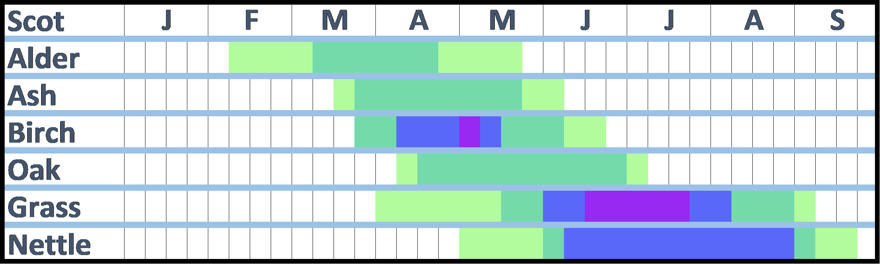
Hazel trees can start producing pollen in January! Peak is Feb/March. Alder is next earliest (see chart below). Pine is quite late, similar to grass. Weeds such as nettle can continue producing pollen through September! Cypress blooms in winter!
Average start of grass season in Scotland is mid-May (dark green on chart below), high counts generally start 1st week of June (blue), peak (purple) is mid-June to mid-July. (Light green is earliest/latest appearance, low risk).
Average start of birch season in Scotland is last week in March, highest counts end April, early May.
It’s not just pollen count – the amount of allergen carried by the pollen (“pollen potency“) varies too. Correlates pretty closely but varies by time and place, 4-5 fold difference geographically (especially grass). France has the highest yearly average grass pollen potency, 7-fold higher than Portugal. Olive pollen from two locations 400km apart varied 4-fold in their allergen potency – in Portugal there are times when pollen from Spain probably more of a problem for triggering hay fever than pollen from “local” trees! [Health Impacts of Airborne Allergen Information Network (HIALINE project)]
Moulds seem more associated with asthma than hay fever.
Management
Watch the pollen count, and choose activities inside or outside accordingly. There are apps that can help with this. But note that the time of day is important too – for grass pollen, the risk is greatest in the first half of the morning and again from about 4pm in the afternoon, until late evening. But can persist into the early hours if temperatures remain high, this effect is particularly noticeable in the cities of the south of England. For tree pollen, the risk is usually during daylight hours only.
Closing windows, or at least not sitting near windows should help. Wash your hair more regularly. Don’t dry clothes outside. Pollen barrier balms available (evidence?). Big, wrap around sunglasses?
Air purifiers with a HEPA filter should help but doors and windows will need to be closed. Unfortunately the best ones tend to be big, expensive and noisy, and price does not mean good quality. Plus you have to remember to replace the filters. The cheapest Which? recommended one (the Electriq EAP500HC) costs over £200.
Choose when and where you are going on holiday carefully, so you get away during the worst period. North of Scotland and the islands have a short, late grass season (late June, early July). Coastal areas likely to be best (although often there are fields just back from the coast, so it may depend on the wind direction!). For tree pollen, season is earlier for most (see above), and there are parts of Scotland (Orkney, Lewis, Caithness, Sutherland) with very few trees. For holidays abroad, see World pollen data.
Medicines
Antihistamines – oral, nasal or eye drops. Various, some people find one works better than another Sedating antihistamines eg Chlorphenamine should be avoided except at night.
Cromoglycate eye drops are available, they work in a different way from antihistamines so may give additional benefit. But need to be given 4 times daily, which is inconvenient.
Nasal steroids useful if used correctly. Fluticasone is licensed from age 4 – Betnesol nasal drops from age 2 (but systemic absorption an issue). Combination steroid/antihistamine spray available from age 12.
Leukotriene receptor antagonist licensed for hay fever in children with asthma.
Short courses of oral steroids might be justified for special occasions.
Metanalysis by Dhami S et al of grass desensitization in children, using either subcutaneous or sublingual therapy, found overall standardized mean difference (SMD) of -0.53 (95% CI -0.63, -0.42) in symptoms scores (roughly equal numbers of SCIT and SLIT studies, roughly equivalent scores) [Allergy 2017]. Deaths reported in asthmatics with poor control.
Grazax is sublingual grass product; Pollinex Grass and rye is subcutaneous (£450 for a course on NHS – Quattro version more expensive again, theoretical benefit). Age not as important as ability to hold in mouth for 2 minutes! Licensed but no grass product approved by SMC (Grazax rejected in 2008 and not re-submitted, Pollinex not submitted) for Scotland.
Itulazax is NICE approved (2025) birch pollen daily sublingual (need to start 16 weeks ahead of season, so last week in November; £80 on NHS so £960 for the year). Scottish medicines consortium (SMC) has approved for rhinitis AND/OR conjunctivitis in adults but specifically says area drug and therapeutic committees may make “paediatric licence extensions”. European license is 5yrs+.
Combined grass and house dust mite products?
[Sian Ludman, St Mary’s]
For symptoms all year round (perennial), triggers such as house dust mite and pets are more likely although even then you probably do still get seasonal variation due to non-allergic factors.
Omalizumab – monoclonal anti-IgE – single injection of 300 mg omalizumab two weeks before start of the pollen season achieves better overall control of symptoms and QoL [adults, China 2022]. Evidence of benefit in allergic rhinitis with difficult asthma [adults, 3 years worth of monthly treatment, Italy 2020].
Group of nuts that includes hazelnut, almond, brazil nut, cashew, pecan, pistachio, walnut and macadamia. Definition of nut is actually a bit complicated, to do with whether the shell comes off spontaneously or not, but I stick to those defined by food labelling law.
Does not include peanut (a legume), coconut, pine nut, chestnut or tiger nut. You can be allergic to these as well, of course.
You can be allergic to just one, a couple or the whole lot. Risk of allergy to peanut is higher than if you weren’t allergic to anything.
Hazelnut and cashew allergies are common. Almond rare.
Cashew allergy goes with pistachio allergy (OR for being allergic to both 575). Cashew allergy is particularly associated with anaphylaxis, even more so than peanut (but less common as allergy and allergen so less well known). 3 components – Ana o1/2 are seed storage proteins. Ana o3 is a prolamin, and the component most likely to be associated with anaphylaxis, plus probably more useful for diagnosis than cashew IgE.
Pecan allergy goes with walnut allergy (OR 150).
Hazelnut goes with macadamia (OR 56.2) supposedly, although that’s not my experience.
One of the tree nuts. One of the most common food allergens in the UK. Adults seem to get less severe reactions than children. Anaphylaxis rare compared with peanut and other tree nuts.
Hazel tree is related to birch, and indeed hazelnut allergy can be associated with tree pollen allergy (hay fever and pollen food syndrome), as well as fruit allergies.
Cor a 1 is the least likely to cause systemic reactions, and then only with raw cf roast. But pretty much everyone tests positive for it, so not v helpful unless it is the only thing that is positive. You are usually also positive for rBet v 1/2, the birch pollen antigens.
Cor a 8/9/14 associated with systemic. Cor a 8 is LTP so likely fruit allergy too.
Cor a 9 and 14 (11s globulin and 2s albumin respectively, ie heat stable seed storage proteins) seem most useful for defining kids at risk of systemic reactions – >1kU/l and/or >5 respectively give specificity of >90% and sensitivity of 83% in kids for “allergy with objective symptoms” viz more than just a tingle/itch, so more likely to have severe reactions. That translates to a negative predictive value of about 93% (PPV not given). [Dutch study, JACI 2013;132(2):393]
German study found Cor a 14 had best AUC (0.89, cf 0.71 for whole hz). Level of 0.35 gave 85% sensitivity with 81% specificity. PPV doesn’t hit 90% until 47.8 though…
Mostly against COVID spike (S) protein that facilitates host cell entry.
Pfizer vaccine is mRNA vaccine, completely in vitro derived, uses nanoparticles to aid absorption into host cells which then produce the S protein themselves from the mRNA.
AstraZeneca vaccine is chimp adenovirus vector for genetic sequence – mRNA produced once virus taken up by host cell.
From Autumn 2025, only children over 6/12 who are immunosuppressed are eligible for a COVID booster (given with flu in the autumn). The other clinical risk groups eg chronic heart/lung, DM no longer apply.