Category Archives: Clinical

Benign neonatal sleep myoclonus

Not a great name, as it can persist for up to 6 months!

Large muscle groups, usually limbs but can be face. Can wax and wane with child remaining sleep. Usually bursts lasting seconds, up to a few minutes.

During sleep only, and stops when wakes.

Other normal baby movements include neonatal release phenomena, including tremors (equal amplitude around fixed axis), jitters (recurrent tremor).

Reassuring if baby unbothered by it; baby in first 7 days of life; if it can be suppressed by passive flexion.

Differential would be hypoglycaemia, hypokalaemia; drug withdrawal; HIE or intracranial lesion; myoclonic epilepsy, startle (including hyperekplexia), hyperthyroidism.

[https://doi.org/10.1093/pch/13.8.680]

ALTE/BRUE

BRUE (Brief Resolved Unexplained Event) from AAP 2016, replacing ALTE (apparent life threatening event).  “Life threatening” is unnecessarily anxiety provoking – and subjective for parents. 

“Brief” is by definition less than 1 minute, but typically 20-30 seconds. Only intended for babies under 1yr.

Guidance for “low risk”:

  • >60 days of age
  • >=32/40 gestation or CGA>=45 weeks
  • No CPR by trained practitioner
  • <1min duration
  • First event
  • No concerning features on history/examination

If low risk criteria fulfilled, no investigations are required – consider gas and urinalysis if clinical concern.

Otherwise depends on history and examination. Consider:

  • Bloods including glucose, gas
  • NPA for bugs
  • ECG

Management could then be a period of observation, or discharge home with safety netting.

AAP advises against home cardiorespiratory monitoring given costs and false alarms vs uncertain benefit.

A US study looking at this guidance found that

  • a serious diagnosis was made in 4.0% of cases; about half the time, the diagnosis was made at the time, but the rest of the time only afterwards.
  • The most common serious diagnoses were seizures and airway abnormalities.
  • The chances of finding a serious diagnosis was higher where there was a history of a similar event (obviously), an event duration >1 minute, an “abnormal” medical history (previous hospitalisation, underlying medical problem), and altered responsiveness as a feature of the event. [Peds 2021]

But I’m disappointed there is no mention in the RHC guidance about SIDS prevention advice.

Pubertal staging

Tanner stages – verbal descriptions but images helpful esp for self assessment.

Pubic Hair Scale (both males and females)

  • Stage 1: No hair
  • Stage 2: Downy hair
  • Stage 3: Scant terminal hair
  • Stage 4: Terminal hair that fills the entire triangle overlying the pubic region
  • Stage 5: Terminal hair that extends beyond the inguinal crease onto the thigh

Female Breast Development Scale

  • Stage 1: No glandular breast tissue palpable 
  • Stage 2: Breast bud palpable under the areola (1st pubertal sign in females)
  • Stage 3: Breast tissue palpable outside areola; no areolar development
  • Stage 4: Areola elevated above the contour of the breast, forming a “double scoop” appearance
  • Stage 5: Areolar mound recedes into single breast contour with areolar hyperpigmentation, papillae development, and nipple protrusion

For males you then have testicular volume, measured by orchidometer (between £26 and £208):

  • 4 ml (1.8cm long by formula below) is first pubertal sign
  • Adult is >20 ml (or >3 cm long)

Cadbury’s Teasers and Truffles (from Celebrations box) are 8ml, equivalent to 50th centile at age 13.

If you only have a ruler, use maximum width in millimetres and the formula: (W-1.5)3 x 0.88, where ss is double scrotal skin thickness (for Tanner stages 1, 2, and 3).

Medically unexplained symptoms

“Persistent physical symptoms” preferred term? Chronic pain overlaps.

“Functional disorder” is used for various gastro and neurological problems, preferred by some adults, but needs explained!

Chronic fatigue syndrome and PANDAS are health disorders that appear to have a physical/scientific cause but disputed.

Health anxiety, malingering, or factitious illness, different from a psychological point of view.

Bleed the symptoms dry! [John Stone, Glasgow].

In a 1965 paper by Eliot Slater, more than half of patients diagnosed as having “hysteria” later turned out to have “organic” disease – but John Stone’s study of adult neurology referrals found very few who turned out to have an occult disease.

Louise Stone in Australia has done a lot of work in primary care. She identifies negative feelings and a lack of diagnostic language and frameworks as barriers to managing these patients effectively. The negative feelings (such as frustration, shame and helplessness), are shared between doctors and patients…

Managing your own feelings and frustrations, and finding ways of understanding and managing the therapeutic relationship important.

Let family feel validated for all concerns – at least in the first instance. Helps develop a therapeutic alliance.

Commit to the patient, which includes advocacy and support.

Family response to symptoms?

Explore beliefs, specific worries (eg cancer). May then allow broadening out to more general worries. 

Manage uncertainty – including managing the need for a disease name! Not having a predictable outcome is hard.

Harm minimisation. Shift from diagnosis to coping with ongoing symptoms.

Good to offer a tentative preamble to difficult conversations! “This is something we as doctors have to deal with every day – signs and symptoms that are very real, with a real impact on a child/family, but where physical examination and investigations do not offer any clues to what the underlying problem might be…”

Paed psychology if issues mostly seem related to child and this is a new problem; CAMHS if new problem adding to existing child/parent issues.  

Can be rewarding in the long term!

[Louise Stone, Aust Fam Physician 2013 Jul;42(7):501-2]
Chest pain

Common in children esp teenagers, often at rest, sharp but brief. Extremely rare to find a cause…

Differential:

  • Oesophagitis
  • Asthma
  • Pulmonary embolism
  • Tachyarrhythmia – but you would expect palpitations and colour change, “on/off”
  • Precordial catch syndrome
  • Costochondritis (Tietze syndrome)
  • Catecholamine secreting tumours??
  • Cardiomyopathy? Ischaemic cardiomyopathy eg anomalous origin of left coronary artery (from pulmonary artery) – but in kids, either too young to describe pain (infants) or else too mild to present with angina (instead present with failure).  Arrhythmogenic ventricular cardiomyopathy (usually right, but biventricular involvement recognised) can present with pain but usually syncopal episodes.  [Circulation. 2019;140:e9–e68]
  • Fabry’s as cause of bizarre pain (heart involvement but pain usually GI). 
  • Aortic root problem – as seen in Marfan’s and other connective tissue problems.

So red flags would be syncope, colour change, sudden dizziness/confusion, sweating/clamminess suggesting cardiovascular compromise.

Assuming normal physical examination, and no family history of inherited cardiac problems (or sudden death), if not exertional then can be reassured. Pain killers not usually helpful as pain settles so quickly.

If exertional then needs ECG. Unlikely to be significant cardiac problem if normal.

[Archives 2014]

Liver Function Tests

Bilirubin needs to be around 60 to see visible jaundice. Isolated high bilirubin could be haemolysis or Gilbert syndrome.

AST is less specific than ALT – also produced in kidney, brain etc. But perhaps changes more quickly than ALT. Most important other source of AST and ALT is muscle – so check CK too, especially if bilirubin normal. Myopathies, viral myositis, muscular dystrophy can all present with “abnormal LFTs”.

Gamma GT is also found in other tissues so not 100% specific but typically suggests cholestasis or other biliary problem (together with alkaline phosphatase).

Alkaline phosphatase also produced in bone, so look at calcium, phosphate and vitamin D as well as signs of rickets or renal disease. Most common cause of isolated high alkaline phosphatase is benign transient hyperphosphatasaemia. There is a rare inherited disease of bone/tooth mineralisation, hypophosphatasia, where levels of ALP are abnormally low;  more commonly though, goes high or low depending on current growth. Low ALP is associated with severe chronic illness, malnutrition, or EDTA/citrate contamination, magnesium/zinc deficiency, coeliac disease, oestrogen use and hypothyroidism.

Falling transaminases can be ominous in situation of bilirubin, albumin, coagulation deteriorating…

Uveitis

The Uvea is the term for the whole eye (uvea=peeled grape). Whereas conjunctivitis looks like a red eye, it’s only really the surface that is inflamed. With uveitis, all the different tissues of the eye are inflamed. Acutely, might not look that different to conjunctivitis but painful, whereas latter usually just itchy. Anterior chamber starts to fill up with inflammatory cells so vision starts to deteriorate. An irregular pupil due to synechiae can eventually be seen, with hypopyon. Cataracts and scarring can follow.

Chronic on the other hand can be subclinical but potential for visual loss so screening important in associated conditions.

Usually idiopathic, otherwise:

  • Juvenile idiopathic arthritis – about 10% of patients with non-oligoarthritis, and 30% of ANA positive oligo so pretty common
  • HLA-B27 – with or without other B27 conditions such as Ankylosing spondylitis
  • Behcet’s disease (so do HLA B51)
  • Crohns disease and other IBD
  • Granulomatosis with polyangitis (ex-Wegeners)
  • Sarcoidosis (so do chitotriosidase)
  • Tubulointerstitial nephritis and uveitis (TINU) syndrome

Some infections can cause it:

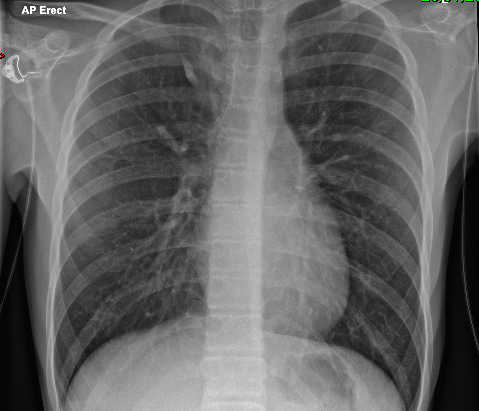
Chest X-ray

Interpretation

  • Start outside, work in – soft tissues, then bones, then lungs/heart, finally neck/infradiaphragmatic.
  • Safety check – position of lines/tunes, check apices for pneumothorax, any foreign bodies?

Adequacy

  • Rotation – look at symmetry of clavicles and anterior rib ends.
  • If clavicles high, then lordotic film. May obscure apices.
  • Penetration – should just be able to make out intravertebral spaces, without lung fields being too dark.
  • Inspiration – hila become artificially prominent if underinflated.

Thymus

Pesky thing! Can look like pneumonia. Latter more likely if air bronchograms, volume loss (displaced fissure/trachea/mediastinum), effusion. Classically:

  • indentations where ribs overlie.
  • Pointy outside edge (“sail sign”).
  • No mass effect
  • Lowish density – should still be able to see vascular markings of lung behind

Spinnaker sign is where pneumomediastinum around thymus creates long curving line.

Other normal things

Azygos lobe – normal variant where RUL has near vertical line curving up and out, from thick point (anomalous azygous vein) – giving impression of mediastinal mass.

Azygos love on chest x-ray
Azygos lobe at upper right

Mach effect – a line parallel to heart border, looks like pneumocardium but actually optical illusion where your eye “detects” border where there isn’t one…

One diaphragm usually higher than other – both ok, as long as no more than 2cm (one rib space).

Other

Hilum – rings or tram lines suggest bronchitis. Round opacity adjacent to and larger than ring suggests vascular prominence due to left to right shunt.

Silhouette sign – where heart border and/or diaphragm obscured in lower zone due to consolidation in lower lobe (left or right).

Effusion – vertical line at costophrenic angle.

Round pneumonia – will have air bronchograms, compare mass.

Collapse vs consolidation – sharp lower border is the fissure so if deviated then collapse.

Pneumothorax – lucency without clear edge may suggest lung hyperinflation eg bronchial atresia.

If edge projects below diaphragm then likely to be skin fold!

Foreign body – get expiratory film, which will enhance air trapping.