Category Archives: Infectious disease

Mycoplasma pneumonia

Most common bacterial cause of pneumonia in children requiring hospitalisation (Clin Infect Dis 2019) – relatively older children (5+ yrs), more likely to have had recent antibiotics but otherwise clinically indistinguishable.

Studies have indicated that the prevalence of M. pneumoniae in the upper respiratory tract (PCR) is similar among asymptomatic, healthy children and children with a symptomatic respiratory tract infection!  Current diagnostic procedures for M. pneumoniae are unable to differentiate between bacterial carriage and infection!

Note rapid worldwide emergence of macrolide-resistant (MRMP) isolates.

Meyer Sauteur PM; van Rossum AM; Vink C.  Current Opinion in Infectious Diseases. 27(3):220-7, 2014 Jun. PMID UI: 24751894

Lyme Disease

Borrelia (spirochaete) infection, spread by ticks (Ixodes), common in localized areas of Europe and North America (forest environments).

Differential includes possible co-infection from other tick born organisms viz anaplasmosis, or babesiosis.

Vaccine available if likely to be at risk.

Clinical

Infection occurs a minimum of 48 hours after bite!

Skin – Erythema migrans is the classic skin lesion, a spreading ring usually at the site of the bite but can be multiple and at different sites.  Typically not hot, itchy or painful. Takes a while for central clearing to develop. Develops over 1-4 weeks (from 3 days to 3 months!), can last months.  Looks like erythema multiforme, but time scale different.  Insect bite hypersensitivity/superinfection looks similar but usually hot, itchy and/or painful, and develops/recedes within 48 hours!

Lyme lymphocytoma is a painless bluish red nodule or plaque, especially on the ear but also reported on the nipple and scrotum.  More common in children.  May persist for months, can precede other features.  Acrodermatitis chronica atrophicans (ACA) is almost exclusively seen in adults, predominantly women, and is an eruption with chronic, progressive red or bluish-red lesions, usually on the extensor surfaces, with later atrophic, fibroid or sclerodermic changes.

Consider Lyme as possible (but unlikely) cause for:

  • fever and sweats
  • swollen glands
  • malaise
  • fatigue
  • neck pain or stiffness
  • migratory joint or muscle aches and pain
  • cognitive impairment, such as memory problems and difficulty concentrating (sometimes described as ‘brain fog’)
  • headache
  • paraesthesia

Arthritis – uncommon, presents as recurrent inflammation of 1 or more large joints, usually the knee. Swelling can be disproportionate to pain.  Can become more persistent – in a minority, despite treatment, inflammation becomes chronic (presumably immune-mediated).

Carditis occurs rarely, and almost always with other clinical features.  Usually partial heart block, but can be complete, usually resolves within a week.

Neurological – isolated facial palsy, meningitis, other cranial nerve palsies, meningoencophalitis, polyradiculopathy.  There is a small proportion of children who can present with non-specific headache, fatigue, neck pain without clear neurological signs (and also the rare case of raised intracranial pressure).

Other rare disease manifestations include uveitis, iridocyclitis and keratitis.

Diagnosis

For erythema migrans, clinical diagnosis is adequate, and antibodies only positive in 30-70% anyway!

Use a combination of clinical presentation and laboratory testing to guide diagnosis and treatment in people without erythema migrans. Do not rule out diagnosis if tests are negative but there is high clinical suspicion of Lyme disease.

  • Offer an enzyme-linked immunosorbent assay (ELISA) test for Lyme disease – consider starting treatment with antibiotics while waiting for the results if there is a high clinical suspicion. (Test for both IgM and IgG antibodies)
  • If the ELISA is positive or equivocal, perform an immunoblot test for Lyme disease (again, consider starting treatment with antibiotics while waiting for the results if there is a high clinical suspicion). [Western blot increases specificity, but cut offs (for both serology and Western blot) can be an issue, with potential false positives for other acute infections and autoimmune conditions.  Definitely needs to be an approved lab…]
  • If ELISA negative and the person still has symptoms, review their history and symptoms, and think about the possibility of an alternative diagnosis.  If tested within 4 weeks from symptom onset, repeat the ELISA 4 to 6 weeks after the first test.
  • If Lyme disease is still suspected in people with a negative ELISA who have had symptoms for 12 weeks or more, perform an immunoblot test.  If negative, consider synovial fluid aspirate/biopsy, or lumbar puncture [PCR – culture is difficult – or CSF antibodies for neuroborreliosis; consider for isolated facial palsy]
  • If immunoblot negative and symptoms resolved, no treatment is required.

For early neuroborreliosis, antibodies 80% sensitive, rises to virtually 100% for late or ACA.

Early antibiotic treatment is also believed to potentially block antibody production.

Antibodies can then persist for months or even years after successful treatment of the infection, so repeat testing is not useful for monitoring treatment success.

First line ELISA test can have false positives for other spirochaetes, glandular fever and autoimmune conditions.

The idea that there are seronegative “chronic Lyme” cases has little evidence to support it, with only 2 possible cases reported (ACA and arthritis, not neuro).

NICE says “Discuss the diagnosis and management of Lyme disease in children and young people under 18 years with a specialist, unless they have a single erythema migrans lesion and no other symptoms. Choose a specialist appropriate for the child or young person’s symptoms dependent on availability, for example, a paediatrician, paediatric infectious disease specialist or a paediatric neurologist.”

Treatment [check NICE]

The most commonly recommended first-line treatments for different stages of Lyme borreliosis in Europe are:

  • Erythema migrans/borrelial lymphocytoma:  10-14 days Doxycycline if 9yr+ (initially 5 mg/kg in 2 divided doses on day 1, then 2.5 mg/kg daily in 1–2 divided doses, max dose 200mg, for a total of 21 days, option for higher dosing) – 10 days courses of doxy effective in US trials.  Else Amoxicillin 50mg/kg/d, max 500mg TDS (10-14 days)[BNFc says 30mg/kg/d, max 1g, TDS for 21 days].  Don’t delay treatment pending test results.  Scandinavia use 10 days Pen V (100mg/kg/d, max 1000mg TDS). BNFc says Azithromycin as alternative.
  • Isolated facial palsy: 14 days Oral doxycycline  – else as above.  Doesn’t probably help resolution but may prevent later complications.
  • Meningitis/radiculopathy: PO Doxycycline or IV Ceftriaxone  50-100mg/kg/d, max 2g daily (14-21 days). [BNFc talks about CNS disease separate from cranial/peripheral nerves]
  • Encephalitis, myelitis: Ceftriaxone (14 days)
  • Lyme arthritis: Doxycycline (28 days) else Amoxicllin (21-28 days)
  • Carditis: Ceftriaxone during pacing, else PO doxycycline (14 days)

Ceftriaxone is the most commonly preferred parenteral agent, with once-daily dosing facilitating outpatient treatment. Recent prospective studies have shown that oral doxycycline is noninferior to ceftriaxone in neuroborreliosis, and it is now recommended in Europe for the treatment of acute facial palsy (FP), meningitis and radiculoneuritis. Ceftriaxone currently remains the preferred choice for children with other presentations of neuroborreliosis and for those with contraindications to doxycycline.

Several recent EM treatment studies have incorporated noninfected control groups. Excellent responses were seen, with resolution of rash within 7–14 days. Nonspecific symptoms including headache, myalgia, arthralgia, fatigue and parasthesias were no more common in cases than controls at 6-month follow up.

[position statement by the British Infection Association, J Inf 2011;62:329]

[Pediatric Infectious Disease Journal Volume 33(4), April 2014, p 407–409]  

Clostridium difficile

Classically causes pseudomembranous colitis.  A soil anaerobe, spore producing.

In children, most will have had antibiotics within past 4-12 weeks, other risk factors are past and/or prolonged hospitalization.  Many comorbid conditions associated esp cancer, inflammatory bowel disease. Clindamycin was classically the antibiotic most associated but any will do.

There may be fever and abdominal pain.  Colitis can mimic (or exacerbate) IBD.  Severe infection unusual.  Markers established in adults for severe infection resulting in colectomy or transfer to ICU have not been shown to correlate in kids.

“Pseudomembranes” are a non-specific endoscopy finding.  Not always tested for automatically by lab, you may need to specify. Toxin test (not 100% sensitive).

Current Opinion in Pediatrics. 26(5):568-72, 2014 Oct. PMID 25032717

Meningococcus W

MenW now appears to be endemic in England, with cases now in young children, and across all regions.  Previously used to only be seen in epidemics, particularly related to Haj travel.

Numbers now about 1/4 those of MenB.

Mortality rate approx 12%.  Some adult cases of septicaemia progressing rapidly to death.  Some atypical presentations eg arthritis, severe pneumonia, GI symptoms without non-blanching rash (still rapidly progessive).

JCVI have recommended vaccinating all UK adolescents aged 14-18 years of age (school years S3-S6 in Scotland) with MenACWY as soon as practicable, this is in addition to introduction of Bexsero® vaccine (MenB) for all infants in Scotland.

Fever

See also antipyretic treatment.

Fascinating how fever affects parents!  Fever phobia first described in the literature in 1980 by Schmidtt. Found in many different cultures and countries, not related simply to child mortality rates or education.  And does not appear to be declining over time.  Also commonly found in health care professionals esp nurses. 

Interesting cultural variation eg Hispanic Americans vs white, Bedouin vs Jewish Israelis.

The main fears for parents are seizures, brain damage, dehydration, whereas the issue for health care is the potential for underlying, serious illness, typically bacterial eg meningitis, pneumonia, septicaemia etc.  

Hyperthermia, ie unregulated rise in temperature (think dogs in cars) is dangerous, causes brain damage.  Hyperpyrexia on the other hand, where body “thermostat” reset, is not dangerous.  It can precipitate febrile convulsions, but only really in children with a genetic susceptibility or at least an underlying predisposition to seizures.  

In a qualitative study of Dutch parents, it was clear that when parents did not feel recognised in their concern or felt criticised, anxiety increased as well as the threshold to seek healthcare for future illnesses.  The authors recommend that health care professionals recognise parental intuition and provide clear information on alarming signs and potential diagnoses to empower parents [BMJ Open 2018;8:e021697].

Measuring/Detecting

Touch is sensitive (90%) but not specific (50%) for fever – so don’t dismiss parental reporting entirely. [J Trop Pediatr. 2008 Feb;54(1):70-3 PMID 18039678]

NICE recommends digital thermometer in axilla, else tympanic thermometer or chemical dot thermometer in axilla (still not great cf rectal, particularly when parents doing it with over the counter devices cf nurses with hospital equipment [BMC Fam Pract. 2005; 6: 3]). 

Over the counter devices sadly provide little useful practical information to parents – in fact most do not even give correct criteria for pyrexia and few give useful advice on managing fever [Br J Gen Pract. 2015 Jun; 65(635): e366–e371.]

Assessment

The height of fever is associated with bacterial, rather than viral infection, but only over 40 degrees: in hyperpyrexia (> 41.1.degC) still only 20% will have serious bacterial infection so really not v helpful.  Chronic underlying illness, prematurity or diarrhoea increase the risk of a bacterial cause, rhinorrhoea or other viral symptom decreases it. Age, maximum temperature, and total white blood cell count were surprisingly not predictive of either bacterial or viral illness! (n=103). (Pediatrics. 118(1):34-40, 2006 PMID 16818546)

Red flags:

  • Cold limbs – sepsis
  • Leg pains, thirst – sepsis esp meningococcal
  • Short history – meningococcal
  • Disproportionate heart rate – sepsis
  • Foreign travel
  • Unimmunised – Pneumococcal, Hib
  • Prematurity, chronic disease

History of fever at home, compared with actual fever on admission, is  lower risk (RR 0.68) but not enough to ignore [Journal of Pediatrics. 204:191-195, 2019 01.PMID 30291019].

Fever without source causes concern, although generally it will either become more obvious where the source is or else it will sort itself out.  Only when fever has been persistent for more than 7 days in a child in whom a careful thorough history and physical examination, and preliminary laboratory data fail to reveal a probable cause for the fever, can you reasonably start talking about a pyrexia of unknown origin (PUO)!.

The risk of invasive bacterial disease in young children with unexplained fever presenting to hospital has certainly declined with modern immunisation schedules so difficult to compare with historical data.  

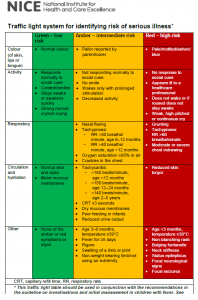
NICE published a Traffic Light system for detecting serious illness in febrile under 5s. A bit unwieldy, seems to cover the main issues, retrospectively sensitivity is only about 85%, and specificity only 29% for serious bacterial infection.Traffic lights NICE fever

Red symptoms/signs are ones that clearly indicate serious illness eg

  • weak, high pitched or continuous cry (meningitis)
  • grunting
  • tachypnoea >60
  • reduced skin turgor

The Amber group includes the vast majority of children coming to hospital with fever. In particular:

  • creps
  • tachypnoea >50 (under 1) or >40 over 1
  • tachycardia >160 (under 1), >150 (1-2), >140 (over 2)
  • rigors (not probably much more predictive than high fever – ?higher risk of urinary sepsis?)

And anyway, we know signs and symptoms other than classic neck stiffness etc fail to predict outcome; best predictor is still “something is wrong” or “appears unwell”.  In Jonathan Craig’s big Australian study looking at more than 25 clinical indicators for bacteraemia, UTI and pneumonia, “appearing generally unwell” was the strongest diagnostic marker for all 3 groups.  Raised temperature, no fluid intake in the previous 24 hours, increased capillary refill time, and chronic disease also predictive. [BMJ 2010;340:c1594]

Hence most important primary care action is prompt clinical assessment by experienced clinician. [BrJGP 2007;57:538, pmid 17727746]

Compared with other scoring systems, NICE traffic lights work pretty well but note how none of these systems work as well as they were supposed to, and performance varies across different datasets.

Adding urinalysis improved sensitivity to 92%, since most of the missed infections were UTI. (De et al, BMJ 346: f866 ).  Thus, prize winning haiku:

Improve the NICE guide
for under 5s with fever
Urinalysis

[Brian Attock]

See also antipyretic treatment.


Malaria

Protozoal infection, spread by Anopheles mosquitoes.

A crippling problem in sub-Saharan Africa but also seen in South and South East Asia, Caribbean (Dominican Republic has low risk). The only malaria free zones in the tropics are cities (some) and communities at altitude. Used to be endemic in Europe (even Southern England) and southern states of US.  800 000 deaths per year, mostly young African children.  Hypoendemic areas eg SE Asia do not acquire immunity and whole population is at risk of severe disease.

Resistance continues to be a major problem and a vaccine remains elusive. The prevalence of fake medicines in endemic countries is another major problem.

Malaria has been with human beings for a long time in evolutionary terms, as seen in the numerous genetic mutations that occur for the express benefit of conferring partial immunity eg sickle cell trait, G6PD, hereditary spherocytosis, HLA B53 (confers 40% protection vs severe malaria). At the same time, the parasite has evolved multiple ways of avoiding the immune system, which is why developing a vaccine has proved so difficult.

  • Plasmodium falciparum – causes the most severe disease, predominates in Africa, widespread resistance, but no liver stage
  • Plasmodium vivax/ovale – cause less severe disease, predominates in Asia, resistance rare, liver stage
  • Plasmodium malariae – causes less severe disease, predominates in Asia, resistance rare, but no liver stage
  • Plasmodium knowlesi – rarely severe

The parasite sporozoite form is injected with salivary secretions into the human host. It circulates until it reaches hepatocytes, where it replicates and forms clusters called schizonts. These release trophozoites into the blood stream, where red cells are infected and further replication occurs. Disease only appears once widespread haemolysis has occurred, usually 3 weeks or more after initial infection. A proportion of trophozoites transform into gametocytes. When these are ingested along with human blood by another mosquito, they can then continue the life cycle in the mosquito. In P vivax and ovale, longlasting hypnozoites may persist in the liver, which can be responsible for late reactivation of disease. So suspect for up to a year after exposure (although Falciparum will present within 3 months).

Clinical

Young children, hyposplenic, pregnant at particular risk (even if prev immunity).

Incubation period 10-21 days, but up to 3 months for falciparum, and note liver stage and late reactivation above.

No typical clinical features! Even fever is not a reliable sign!  Can present with GI symptoms, sore throat, lower respiratory complaints!

Clinical effects due to RBC destruction, cytokines release, micro circulation disturbance.

In endemic areas, intermittent asymptomatic low level parasitaemia is seen commonly, with recurrent, usually self-limiting, episodes of mild disease (plus chronic anaemia). Severe disease on the other hand can present as:

  • cerebral malaria
  • severe haemolysis
  • ARDS
  • acidosis

In non-endemic disease, particularly travellers or people who have lost their immunity by long term lack of exposure after emigration, the infection is more likely to be symptomatic, and the disease is more likely to be severe.

Mild disease

Fever, chills, sweats, myalgia, headache.  Anaemia, splenomegaly. Gastro and resp symptoms (even sore throat) common! Fever periodicity traditionally described as daily (falciparum), Tertian (vivax/ovale), Quartan (malariae) ie spikes every 3 or 4 days.  In practice this is wholly unreliable!

Moderate Risk

Parasitaemia >5% (not very well correlated, and not relevant for non-falciparum)

Sickle cell disease (who have worse outcomes, despite being relatively protected!)

High Risk

  • Pregnancy (high levels in placenta, even if not so obvious in blood).  Use clinda instead of doxy.
  • Asplenic or splenic dysfunction
  • Acidosis (BE >-8)
  • Hyperkalaemia (>5.5mmol/L)
  • Hypoglycaemia
  • Impaired conscious level

Respiratory distress usually due to acidosis rather than cardiac failure. Hence Kussmaul breathing predicts death.

Diagnosis

Do not wait for the results of tests if symptoms/signs suggestive, since falciparum can be rapidly aggressive.  Stop chemoprophylaxis, as can obscure!

Malarial retinopathy (Malawi eye) found in severe malaria: patchy white spots similar to hard exudates, frosted branch appearance of vessels, and ring shaped haemorrhages (not pathognomic though, seen in infarction).

The blood smear is the classic test. Thin smears are best for identifying the particular type of malaria and the percentage parasitaemia (percentage of erythrocytes infected), but thick smears are more sensitive. Repeat testing is important – at 12-24hrs and again at another 24hrs. Best at time of fever spike? Sensitivity is only 70% on a single smear, but rises to over 95% with 3 smears.

Having >20% of periph forms with pigment (mature) reflects high burden of deep circulating parasites cf young ring forms, so a risk factor for poor outcome. >5% neutrophils containing ingested pigment is another risk indicator.

New molecular based antigen tests are expensive but are less reliant on operator experience.

  • HRP2 (histidine rich protein) is specific to falciparum.
  • pLDH versions are available for falciparum and vivax.
  • Aldolase is a pan-specific antigen, but probably not as sensitive as the others.

These are pretty much as good as smears for falciparum and vivax, not quite as good for other species.

Thrombocytopenia common, not significant in isolation.  Check FBC, U&Es, LFTs, Glucose.  If ill, lactate, blood gas, blood cultures (accompanying bacterial sepsis common esp salmonella in endemic areas). Consider LP if impaired consciousness, seizures.

Notifiable! Other family members likely to be infected too?

Differential

Typhoid, hepatitis, dengue, VHF, HIV, avian influenza

Treatment

UK Guidelines 2016. Journal of Infection. 72(6), 635-649 (Lalloo, Shingadia).

Treatment of choice for non-falciparum is 3/7 oral Chloroquine or Co-artemether.  Co-artemether if mixed infection or concern about chloroquine resistant vivax (some areas). Must be followed by Primaquine, the only effective treatment for liver stage – beware G6PD deficiency (test at same time as doing films! Use only under expert supervision!)

For falciparum, treatment of choice for uncomplicated is Riamet (co-artemether) – alternative is Eurartesim.  If not available, use oral quinine or atovaquone-proguanil (Malarone).

Admit falciparum initially – risk of deterioration on  treatment, and check tolerating oral therapy.

Quinine is effective but poorly tolerated in prolonged treatment, and should always be supplemented by additional treatment, typically doxycycline in adults, clindamycin or Fansidar (Pyremethamine-sulfadoxine) in children.  All with falciparum should be admitted for at least 24hrs, given risk of sudden deterioration even with treatment.

IV artesunate should be used for severe disease, or infections with >2% parasitaemia, until well enough to tolerate oral treatment.  IV artesunate works quicker and is more effective in selected situations than IV quinine but is unlicensed, obtain through specialist centre on named patient basis. If not immediately available start IV quinine (and monitor for hypoglycaemia).

Adjunctive

  • Broad spectrum antibiotics in severe cases until bacterial infection excluded.
  • Surprisingly, shock usually responds to just 1 bolus of fluid. Excessive fluid resuscitation is likely to precipitate cardiac failure in severe anaemia, may exacerbate anaemia and raised intracranial pressure. Albumin appears to be superior to crystalloid (esp in coma – less mortality, ?membrane stabilizing).
  • Oxygen for respiratory distress
  • Glucose if hypoglycaemia
  • Poor evidence for exchange transfusion – consider for persistent acidosis or multiorgan failure, sickle cell
  • Seizures: follow standard guidelines. Partial, subtle seizures are common. No evidence to support prophylactic phenobarbitone.  Posturing common, assoc with spike in ICP so ventilation with paralysis may be advantageous. Exclude hypoglycaemia.

Follow up

Haemolysis occurs in 10-15% of patients treated with IV artesunate – check FBC at 14 days.

Vaccine?

A vaccine would be fantastic, but a potential candidate is yet to be found. There are several barriers:

  • Antigens of the different life cycle stages differ
  • Need to generate v high immune response
  • Need to overcome escape mechanisms

First phase III results in 2011 in Africa showed that RTS,S vaccine reduced clinical reports of malaria by 51 per cent.  After 3 years, reduces cases by 36%.  60 000 to be recruited across 7 countries.  Works against circumsporozoite protein (CSP) so blocks liver infection, has HBsAg adjuvant.
 

Nasal flu vaccine

Live attenuated influenza vaccine (LAIV).  Now available in quadrivalent form, Fluenz Tetra in Europe, Flumist in US.  Transmission to another person has only ever been documented once, and it was asymptomatic!

The extra B hopefully makes it better than 2014/15 where poor coverage.  Live attenuated is more effective and has less systemic effects than injected vaccines.

Current annual programme in Scotland is for all 2-5yr olds to be offered vaccine by public health, whereas all primary and secondary school children will be offered vaccine at school.
Cut off for 2yr olds is age 2 on 1st September.
For infants between 6 months and 2, previous hospital admission for lower respiratory tract infection (which would include all our bronchiolitis babies!) is a clinical risk indicator, along with asthma, chronic heart/kidney/neuroresp disease, or indeed anything else where you thing getting flu is likely to exacerbate the underlying condition.

If you miss your school appointment, up to the family to request another via NHS Lanarkshire vaccine helpline 01698 687456.

Although GPs aren’t much involved anymore in vaccine programme, they should still offer it if a family prefers it, or if a family are keen to get it earlier than they might otherwise as part of the schools programme.

Most kids will be offered nasal live flu vaccine (Fluenz Tetra).  Contraindications to nasal flu vaccine are:

  • under 2yrs of age,
  • wheezing or extra bronchodilator within the previous 72 hours,
  • severe immunodeficiency (esp cellular) or immunosuppression eg leukaemia/lymphoma, high dose oral steroids
  • aspirin use (eg Kawasaki) – theoretical risk of Reyes [reported with wild type influenza and aspirin]

Kids on high dose inhaled steroids no longer require consultant approval to get nasal vaccine.

Kids previously in PICU for asthma, or who require regular oral steroids for asthma, require consultant approval to get nasal vaccine. Otherwise they should get injectable.

If you can’t have nasal, then should get injectable (inactivated) vaccine.  Can be given from age 6 months.

A second dose is needed after 4 weeks minimum if you are in a clinical risk group, and under 9yrs, and this is the first time you are getting flu vaccine.  This applies whether you get nasal or injectable flu vaccine.

For egg allergy, advice, as before, is that children with egg allergy – including those with previous anaphylaxis to egg – can be safely vaccinated with nasal vaccine in any setting (including primary care and schools). The only exception is for children who have required admission to intensive care for previous severe anaphylaxis to egg, who should be offered nasal flu vaccine in hospital [lack of data, not definite risk!].

If a kid with egg allergy has a contraindication to nasal flu vaccine (eg immunosuppressed) and needs injectable vaccine, then it should be either an egg free (cell based) injectable vaccine (the one from Seqirus is licensed from age 2) or low egg content (“split virion inactivated vaccine”), viz less than 0.12mcg/ml (equivalent to 0.06 µg for 0.5 ml dose).

UTI diagnosis

See NICE 224 (2022).

Classic symptoms – dysuria, frequency, new wetting, dark or cloudy or smelly urine.  Frank haematuria, loin pain.  Fever, shivering (rigors), history of UTI. 

Clean catch ideally, pad (commercial, not cotton wool balls or gauze) if clean catch unsuccessful. Else catheter.  Suprapubic aspiration is an option but needs ultrasound to confirm bladder full.

See Sofia method of urine collection.


Testing

Under 3 months – send for culture and microscopy. Urgent?

Microscopy interpretation is simply on basis of pyuria pos/neg, bacteria pos/neg.

Over 3/12, dipstick is standard. A positive dipstick urinalysis for BOTH leucocyte esterase (LE) and nitrite is specific, negative both is a good negative predictor. If dipstick positive for just one, not reliable either way. Metanalysis, Huicho Luis, PIDJ 2002;21:1-11. Previous metanalysis by Gorelick and Shaw (Peds 1999) concluded nitrite/LE tests superior to microscopy!

If nitrites and leucocytes positive, assume infection. Culture only if high risk for serious infection or recurrent UTI.

Nitrites only positive, treat but send culture.

Leucocytes only positive, send culture, treat if classic UTI symptoms or under 3yrs, else await result before treating.

Culture if high risk of serious illness, upper tract signs, poor response to treatment, recurrent UTI.

Most studies show that clean catch is equivalent to suprapubic aspiration (SPA); limited data on pad, nappy or bag specimens.

Uricol (Euron, Newcastle) urine pads. Check at 10 min intervals (discard after 30mins). Cost 18p each. Agrees with clean catch for gluc/ket/blood/nitrite (within 1 block ) but in study only 2 cases with leucocytes so ?reliable.

Health Technology Assessment (Winchester, England). 10(36):iii-iv, xi-xiii, 1-154, 2006 Oct.

Listeria

An intracellular gram positive rod – not many of those, apart from in probiotic drinks!  Resistant to cold and salt, so particularly a problem in ready to eat foods eg deli meats, hot dogs (unless steaming hot), cheese esp soft (incl blue veined, but excl mozzarella), raw and cooked poultry, ice cream, raw vegetables, raw and smoked fish (unless in shelf stable form). Melons and hummus have been sources in US.  In adults, tends to affect those with underlying health problems.

Infection in pregnancy often undiagnosed. May cause preterm labour or intrauterine death. Infection at birth may be severe, with classic fine papular rash, widespread microabscesses and granulomas, and bacteria visible on gram stain of the meconium. Or infection may be late in onset eg 1-2 weeks, with meningitis (note low counts cf other causes), else endocarditis, osteomyelitis etc.

Preterm meconium staining of the amniotic fluid (MSAF) is a “classic” feature – was observed in 4.3% of infants below 33/40. No maternal or infant listeriosis was identified in any of the 1000 cases. MSAF was associated with prolonged rupture of the membranes and severe (grade 3/4) intraventricular haemorrhage (OR 2), not sepsis or mortality. (Simpsons, Arch Dis Child Fet 2004)

Surveillance study of bacterial meningitis in infants aged <90 days in the UK 2010-11 showed that then usual three bacteria (GBS, E. Coli and Listeria) remained dominant, their frequency varied significantly by month of life. In the first 30 days of life. L. monocytogenes was the third most common bacteria, responsible for 6% of cases. The median age of meningitis due to L. monocytogenes was 13 days (IQR 3–18 days) with the oldest infant being 29 days; Listeria meningitis was therefore not seen beyond the 1st month of life. Of the 11 cases of Listeria meningitis, a good number (although a minority) were preterm and most first became unwell when at home. 2 cases had serious complications but no deaths.

Public Health England have published 24 years data on listeria septicaemia and meningitis. 97% of all cases presented in the first 30 days of life. Bacteraemia is more common but tends to be early onset (<7 days of age) whereas most meningitis were late onset.

It is also prudent to consider the possibility of Listeria infection in older infants (and therefore add amoxicillin) if:

  • Gram-positive rods are seen in the cerebrospinal fluid,
  • if the infant is immunocompromised
  • or if the clinical response to empirical therapy is suboptimal

Treat with high dose amoxicillin/ampicillin. Gentamicin is synergistic but does not penetrate intracellular compartment (or CSF) – can be stopped after a week assuming good clinical improvement. For allergic, TMP-SMX (Septrin) is best alternative! Cephalosporins are useless! Treat for 2 weeks if no meningitis, at least 3 weeks if meningitis, longer if abscesses or heart involvement.

[Okike, Arch Dis Child 2015;100:426-431]

Hepatitis B

Highly infectious blood borne virus. A single contaminated needle stick injury carries a significant risk of transmission. In endemic areas, significant rates of postnatal infection in children, presumably from minor trauma.

Acute infection develops over 1-6 weeks and can be fulminant. Symptoms are non-specific fever, lethargy, abdo pain.  15% have serum sickness type  symptoms in pre-icteric phase viz fever, arthralgia, urticaria. Jaundice then develops.   Various antigens, which may or may not clear as antibodies produced, used to diagnose, judge stage of infection, and infectivity.

  • HBsAg – shows Acute or chronic hepatitis B infection. Can be negative in acute fulminant disease.
  • Anti HBs (or Anti HBs) – Immunity to hepatitis B, postinfective (only 6% of patients) or with active or passive immunization
  • Anti HBc IgM – first antibody to appear, even before HBsAg.  High titer: acute hepatitis; Low titer: chronic infection
  • Anti HBc IgG – Past exposure to hepatitis B, or maternal antibody crossing placenta in young infants
  • HBeAg – highly infectious.  Without treatment, 85% of children clear HBe.
  • anti HBe – not immune, but low infectivity. Do not develop chronic hepatitis; but low risk of hepatocellular carcinoma persists.

NB there may be an interval following the disappearance of a hep B antigen before its antibody becomes detectable.

For acute hepatitis, no specific treatment is required, just supportive. If fulminant, some people use antivirals, but basically the issue is whether you need to transplant – see below.

Carrier rate (ie chronic infection, = HBsAg pos for 6/12, and hence potential for serious sequelae) is higher in males and greatest in those infected in first 3 years of life.  Also higher in those with mild symptoms viz anicteric with minimal elevation of transaminases.

Some carriers will be inactive with anti-HBe, low levels of DNA (<100 000 copies on PCR) and normal transaminases. Liver disease progresses very slowly if at all, although hepatocellular carcinoma risk is still higher than normal (but much less than in HbeAg positive). Monitor LFTs every 6-12 months.

In active chronic infection, DNA levels are high indicating active replication, transaminases are 2x the upper limit of normal or higher, and biopsy will show stage 4 histological activity or more. HBeAg is usually positive although some mutants will be negative. Adults with chronic hep B have 20% cirrhosis rate after 10 years and 37% after 15 years. Alcohol intake is an independent factor. Hepatocellular Ca rate is about half that.

When to biopsy is tricky, partly because the clinical course is unpredictable but also because treatment is ineffective. Transaminases can be raised transiently, so repeat after 1-3 months. Histological cirrhosis has a poor prognosis. With treatment, 32% of patients with chronic disease clear HBeAg cf 11% of untreated (metanalysis). There is no benefit in patients with normal LFTs.

Do USS and alpha fetoprotein every 2 years as screening for hepatocellular Ca for both inactive carriers and chronically infected.

Other management points –

  • immunisation of household contacts
  • vaccination against hepatitis A (in low prevalence areas)
  • avoiding alcohol
  • safe sexual practices
  • weight reduction
  • Careers advice
  • Immunosuppressive drugs may activate hepatitis B infection. Equally, immunosuppressed children may have hepatitis B infection without serological evidence – so do PCR.

Treatment

For acute, no specific treatment, just supportive. If fulminant, look for co-infections that may have precipitated episode. Main issue is whether transplant required, although American Association for study of liver diseases recommends using antivirals in adults: no great evidence but seem reasonably safe, and reduces risk of re-infection of grafted liver after transplant (pretty inevitable – HBIg post transplant also delays infection but resistant mutants come through). Lamivudine or telbivudine suggested when the anticipated duration of treatment is short; otherwise, entecavir is preferred. Treat until HBsAg cleared or indefinitely in transplants. Interferon is contraindiated.

For chronic infection:

  • Pegylated IFN alpha (5 million units a day or 10 MU thrice SC for 48 weeks) both antiviral and immunomodulatory activity.

Other issues:

  • Co-infection with HCV has a poorer prognosis even though DNA levels may be less; treatment should be considered at 1000+ copies.
  • In decompensated cirrhosis, transplantation is the only definitely effective option. Lamivudine may help (historical controls). IFN increases complications.