Category Archives: Allergy

Food allergy labelling

The UK still currently follows the European Food Information For Consumers Regulation (FIR) that took effect from December 2014.

This applies to unpackaged food eg restaurants, takeaway’s deli’s, bakeries etc. It now also applies to food prepacked for direct sale (PPDS) such as a sandwich made on the premises of a cafe but wrapped (Natasha’s law).

Allergy advice boxes are no longer permitted, although “may contain” advisory labels are. The allergen should be emphasised in the ingredients panel through typeset eg font, style, colour.   The specific type of cereal or nut must also be stated.

The 14 allergens that must be highlighted under UK/European law are: cereals containing gluten (wheat, barley, rye etc), crustaceans (eg shrimp, prawn), molluscs (eg mussel, oyster), eggs, fish, peanuts, nuts, soybeans, milk, celery, mustard, sesame, lupin and sulphur dioxide at levels above 10mg/kg, or 10 mg/litre, expressed as SO2. Lupin and Molluscs added later.

There are some exceptions, where the food is so highly processed that they are no longer capable of triggering an adverse reaction eg fish gelatine in beer/wine, soya in vegetable oil.

If your allergy is not one of those listed, eg lentil, there is no legal duty for the manufacturer to highlight the presence of that ingredient, or for the restaurant to provide a full list of ingredients.  So you need to read the full list of ingredients carefully, and plead with the restaurant for details relevant to your allergy. In the past, some manufacturers highlighted allergens in a separate box, but this is no longer permitted.

The rules list nuts as:

  • almond,
  • hazelnut,
  • walnut,
  • cashew nut,
  • pecan nut,
  • Brazil nut,
  • pistachio nut,
  • macadamia nut or Queensland nut
  • and products made from these nuts.

Other types of nuts, and other foods which are not nuts (even though they are called nuts i.e. chestnuts, pine nuts and coconut), are not named in the rules, even though they are known to cause allergy in some people.

Note that by law, “cereals containing gluten” includes oats! Spelt and Kamut should be declared as containing wheat. Oats contain avenin, rather than gliadin, but related. Products containing oats that have not been contaminated by wheat can be declared “gluten free” by law, so effectively the law considers oats as both containing but not containing gluten…

See also Advisory labels.

(food.gov technical guidance on new labelling law)

There is no legal duty to highlight changes in recipes on packaging.  The same product with the same packaging can sometimes have different ingredients, depending on where it is produced.

The Food Standards Agency (FSA) has ordered councils to encourage restaurant owners to check their ingredients.

Note that non-EU countries will have their own rules eg US has only 10 ingredients that must be highlighted (not molluscs, mustard, celery, or lupin).

Peanut immunotherapy

In Scotland, now available at Glasgow Private Clinic – see www.peanutimmunotherapy.scot for more details.

More than 10 years ago, shown to be effective in children – 2014 Andrew Clark Lancet STOP II study – 39 children 7-16yrs, peanut flour orally.  2 weekly up dosing,  starting with 2 mg, increasing to 800 mg of peanut protein (5 peanuts) then maintained for total of 26 weeks.  Tolerance then assessed with challenge.

91% achieved final daily dose (although only 62% actually had negative challenge, which was to 1400mg, nearly double – and previous evidence has suggested that most people at this level can tolerate substantially more with only mild symptoms).

Side effects mainly oral itching (6% of doses), nausea, vomiting.  1 patient needed IM adrenaline (twice) for wheeze. Even minor reactions are annoying especially GI, or if daily!  And not always predictable.  Tend to get less over time, of course.  Paul Turner feels adverse event reporting “massaged” somewhat (no international consensus on reporting) – the word anaphylaxis not used except to thank the Anaphylaxis campaign, yet 22% of patients had wheeze at some point, even though reported rate of wheeze is 0.4% of doses. Still, anaphylaxis in hospital when potential reaction expected not the same as unexpected reaction in community.

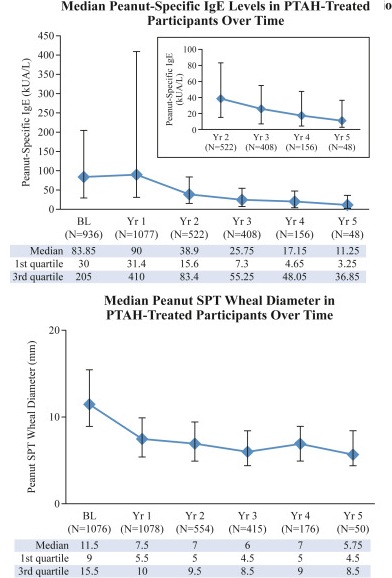
Peanut IgE significantly reduced but not SPT! So works as long as you keep taking your daily dose, definitely side effects incl anaphylaxis, but not a cure.

No data yet on rates of reactions after treatment. But using anxiety model, OIT helps with “perception of severity” (as lots of minor reactions), “perceived ability to cope” (as managed already) and “rescue factors” (as more used to carry medicines).  Note how experience of using AAI seen as positive (and kids often laugh at anticlimax of it!). 1/3 of benefit of OIT seen after initial confirmation challenge, particularly where anaphylaxis occurred (and in patients as well as parents)! [Sarah Burrell, ADC 2021]

Roughly 10-20% don’t desensitize at all. A further 10-20% don’t achieve full dose.  And another 10-20% fail to achieve pass full dose challenge.  Benefit likely to be highest for those most at risk of anaphylaxis, yet tendency will be to cherry pick lowest risk cases…

AR101 Oral Immunotherapy trial (PALISADE) –  multiple authors including Jonathan Hourihane and George du Toit.  US/Europe, N=496 aged 4-17yrs.  Dose escalation then 24/52 maintenance (so about 12 months total) with peanut derived product, 67% passed 600mg peanut protein challenge (equivalent to 5-6 peanuts). [Some adult patients included initially but unsuccessful in all of them!]

Frequent mild/moderate events, but also in placebo group! 4.3% had severe events cf 0.8% of placebo group.  About 10% withdrew due to adverse events , mostly GI- interestingly another 10% were lost due to parents withdrawing consent, I wonder what their reasons were.

Michael Perkins NEJM editorial – possible risk of eosinophilic oesophagitis? Only 1 case confirmed.

[N Engl J Med 2018]

Second trial, just in Europe (ARTEMIS), n=227, up dosing every 2 weeks, just 12 weeks maintenance (300mg), so about 9 months treatment total.  58% tolerated 1000mg peanut (about 8-10 peanuts).  Again, lots of mild/moderate adverse events but in the controls too! 1% rate of severe in treatment group (1 patient).  10% withdrew due to adverse effects.  No eosinophilic oesophagitis reported. “Clinically important” improvements seen at the time of final food challenge in QOL scores related to “Allergen avoidance and diet restrictions” and “Risk of accidental exposure”, and in FAIM domains relating to perceived likelihood and chance of dying (both self and parent/carer reported) in the future.

Follow up study of self selected group of those who successfully completed 1yr PALISADE programme, who then opted to continue treatment for total of 18 vs 24 months – 48% of former still able to tolerate 2000mg, cf 80.8% of latter. Less adverse events over time of treatment, improved quality of life scores (“clinically meaningful”). Still peanut SPT positive (IgE a bit less for the 24 month group)!  There were more accidental peanut exposures in this study than in the original trial, suggesting less vigilance, but the severity of these reactions and need for adrenaline was low, which might confirm an immunomodulatory effect.

Another follow up study (ARC004, Vickery) looked at daily vs non-daily dosing (6 months twice weekly 300mg) after PALISADE. Non-daily dosers had 40% more adverse events, although 80% mild-moderate. Daily dosers had best evidence of desensitization – more than 70% passed 1000mg challenge with NO symptoms (better than PALISADE), and 69% of the cohort (“3A”) who did 2yrs plus could do 2000mg with no symptoms. Evidence of “ongoing immunomodulation” with extended dosing – IgE reduced, SPT did not.

Does not discuss whether non-daily dosing might be appropriate for subgroup who have best immune response to treatment.

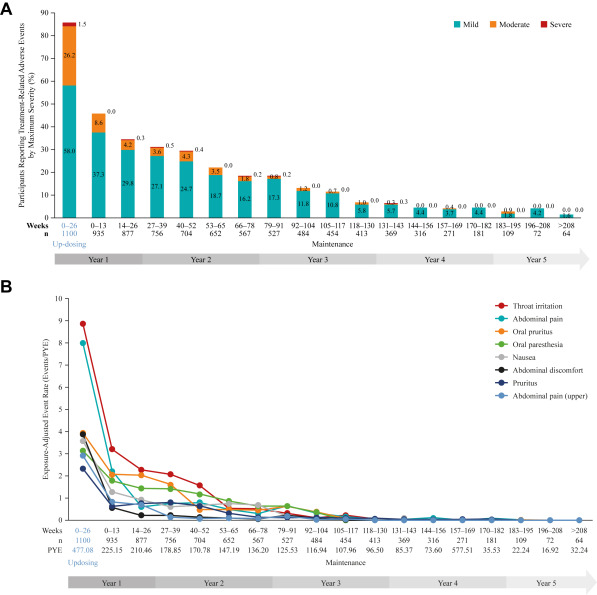
ARC0008 study still to report (closed 2023), but provisional data reported show the trend towards decreased adverse events (AEs) at years 1 and 2 is maintained up to 5 years, with 94% of patients experiencing mild or moderate AEs and only 13% discontinuing PTAH use because of AEs overall.

Gastrointestinal symptoms were the most commonly reported treatment-related AEs. A downward trend in systemic allergic reactions was also reported. PTAH treatment resulted in reduced levels of peanut-specific IgE after the first year and increased levels of peanut-specific IgG4, with a lowered peanut-specific IgE:IgG4 ratio. A reduction in median peanut skin prick test wheal diameter was observed (11.50 mm at baseline vs 5.75 mm at year 5). Unpublished draft is available here.

Severe and uncontrolled asthma was an exclusion criterium, obviously. Similarly chronic/recurrent abdominal pain.

AR101 (Palforzia) has now received NICE approval for use in NHS England, which has set targets for patient numbers. In Scotland, SMC did not find sufficient evidence of economic benefit, which fits with ICER report (US economic review) 2019 which showed that peanut immunotherapy led to more systemic reactions and more adrenaline use with no cost benefit. But hard to quantify benefit of reduced anxiety and increased quality of life. Natasha trial currently looking at immunotherapy using commercial peanut flour across several UK sites.

Various forums about immunotherapy. One young person’s blog is Ask About My Peanut Allergy (stopped regular peanut!!! But doing well).

Future may be to combine different routes eg sublingual/patch.

Allergic Rhinitis

Under-recognized, particularly when chronic blockage (without itch/sneezing) rather than sneeze/discharge. Late phase reactions involving Eosinphil induction by T cells tends to produce chronic swelling and non-specific irritability eg cold air. Nose problems impact with everything connected eg eyes, sinuses, middle ear, lungs. Differential is wide eg CF/PCD, deviated septum, polyps.

ARIA= allergic rhinitis in asthma report (WHO).

Food protein–induced enterocolitis syndrome (FPIES)

Non–IgE-mediated severe gastrointestinal food hypersensitivity, typically presents in early infancy with repeated vomiting, dehydration, lethargy, metabolic acidosis (even mimicking sepsis).  Watery diarrhoea (sometimes with blood and/or mucus) can develop in some cases. The severity is really what makes it worthy of a distinct name, debatable if it is actually distinct from other non-IgE mediated food allergy.

Probably underdiagnosed.

A few unusual features cf type 1 allergy.

The most common offending foods are cow’s milk and soy in young infants; in older infants, there are a range of food triggers including some foods usually not considered allergenic eg rice, oat, chicken, sweet potato!  Egg an unusual cause in some countries!  Cases in breastfed infants have been reported, even severe hypotension requiring intensive care.

Acute symptoms occur 1 to 5 hours after ingesting the offending food.  Lasts up to 24 hours. Not always consistent, which might suggest co-factors important.

In Europe, rare to get multiple food FPIES but in UK/US/Australia about 25% (English speaking!?).

Diagnosis

Diagnosis is based, predictably for a non-IgE condition, on clinical history and food challenges. Leucocytosis and methaemoglobinaemia are associated but low specificity/sensitivity.  

2017 Consensus out of date but diagnostic criteria still used – 

  • Major – vomiting at 1-4 hours in absence of type 1 skin/resp symptoms.
  • Minor – at least 3 minor criteria eg second episode of repetitive vomiting after same food; extreme lethargy; hypotension; need for hospital care or IV fluids; etc

Probably mild, mod and severe! Proposed BIO-FPIES criteria includes abdominal pain, nausea, increase in neutrophil count (but 3 points for second episode of repetitive vomiting after same food).

Phenotype switching

Egg and nut FPIES often go on to develop IgE sensitisation (about 20%), less for others. Of those, about 30% of milk FPIES will switch to type 1 phenotype, 15% for egg, less for other foods. But overall, unlikely to make much of a difference to care (and doesn’t help predict resolution).

Management

No role for antihistamine/adrenaline!

BSACI has FPIES plan.

Family support at www.fpiesuk.org.

For introducing weaning foods, when known FPIES to one food, start with low risk foods, supervise common triggers eg rice/egg.

Challenge

Challenge is necessary to decide whether things are getting better or not. Consensus is that 12-18 months after last reaction is a good balance between chances of things being better, and risk of causing severe reaction.  

50% milk/soya resolve by age 3-4, more like 4-5 years for other foods. 

Traditional protocol is 0.3g/kg protein, divided into 3 doses over 30 mins.  But unrealistic for low protein foods eg fruit. And doesn’t really make sense to split dose when you don’t expect a reaction for hours (but risk of switch to type 1 allergy for egg/nuts).

2 day protocol (25% portion then whole portion next day) had less severe reactions. 

25-30% of age appropriate portion triggers reaction in most children. [Baked???] Over 50% react after at least 2 hours. 

Beaudoin 2024 has home challenge protocol but brave… 

[Marta Vazquez-Ortiz systematic review]

[BSACI FPIES grand round – Marta Vazquez-Ortiz (Imperial/St Mary’s, BIO-FPIES research network)] [2025 Shaker shared decision making] [2024 Anvari]

Immunotherapy

First described in the literature in 1908! For egg. Noon and Freeman described grass immunotherapy in 1911. First double-blind trial was by William Frankland in 1954 for subcutaneous grass immunotherapy for seasonal asthma.

Should always be done with extreme caution, if at all, if asthma.  Available for wasp/bee stings, grass and tree pollen.  Lots of evidence for food allergies, especially in younger children eg peanut immunotherapy.  House dust mite sublingual now approved by NICE for resistant allergic rhinitis.

Some evidence that immunotherapy for rhinitis also prevents asthma, which fits with “one airway” hypothesis.

Immunotherapy should be initiated and monitored in a specialist centre experienced in immunotherapy.

Text message reminders doubles adherence – even non-personalised.

Immunomodulation with omalizumab appears to improve success rates of immunotherapy. Treatment with dupilumab (anti-IL4/13) reduces specific IgE levels in people with atopic dermatitis (clinical effect unknown just now).

Grass/pollen allergy

EAACI indications for rhinoconjunctivitis immunotherapy includes:

  • mild rhinitis for reasons of asthma control.
  • Moderate-severe symptoms.

Bad asthma and poor compliance are contraindications. Bad asthma was an exclusion criterium for most of the studies, so no evidence of safety.  Poor evidence for under 5yrs (for HDM).

Polysensitization common, US tend to to treat all, Europe tends to pick 1 or 2 most useful, at intervals. 17 fatalities to date with immunotherapy. 1 per million injections (risk with sublingual much less, even though used for higher risk patients). Large local reactions common but don’t predict further reactions. Risk of systemic reaction only increased if recurrent. Consider predosing with antihistamine, else reduce dose.

Sublingual immunotherapy (SLIT) in children aged 4 to 12  years with grass pollen-allergic rhinitis/rhinoconjunctivitis significantly  reduced symptoms and medication use, well tolerated, and no serious treatment-related  events were reported. [Journal of Allergy & Clinical Immunology.  130(4):886-93.e5, 2012 Oct.]

In metanalysis by Dhami S et al, overall standardized mean difference (SMD) of -0.53 (95% CI -0.63, -0.42) in symptoms scores, roughly equal numbers of SCIT and SLIT studies, roughly equivalent scores.  When looking just at children, benefit seems less (SMD -0.25 (95% CI -0.46, -0.05)).  Continuous treatment probably slightly better than pre/co-season treatment.  Manufacturers suggest “disease modifying effect” of treatment beyond first year, which has theoretical rationale.  Four studies of long term outcome, demonstrates continuing benefit if treatment continued beyond first year [Allergy 2017]. 

Grazax (grass) can be safely administered by general practitioners (£80 per month, licensed from 5yrs up): tablet needs to be kept under tongue for at least 1 minute, first dose should be monitored by doctor for 20 minutes.  Don’t eat or drink for 5 minutes.

Give antihistamines for local effects. Oral blistering occurs!  Isolated cases of eosinophilic oesophagitis but impossible to link of course.

Contains fish gelatine but no reported problems in those with fish allergy.  Severe asthma contraindication (in children, defined as <80% predicted FEV1 on treatment).

Aim to start 4 months before season starts, although still some benefit if started 2-3 months before.  If no benefit in first season, no point continuing (according to Grazax own SPC).

Symptom relief begins only in the second season of therapy?  BNFc says continue only for 3 yrs.  Not approved by SMC for Scotland, because no great evidence for benefit after first year – would need individual patient treatment request.  Rosie says children wouldn’t tolerate daily doses for months and years.

Pollinex subcut, given into middle third of upperarm.  2 versions: Trees, and 13 grasses incl rye. 3 injections at 7-14 day intervals each year (£450 each), before season starts.  Maintenance kit of 4 vials also available, presumably if additional benefit thought possible.  Manufacturer recommends using for 3 successive years. Asthma and beta blocker treatment are relative contraindications.  Age 6+, not in SMC at all. [Metanalysis, Chest 2008; 133:589, Journal of Allergy & Clinical Immunology. 115(4):676-84, 2005 Apr.]

Some evidence for short course – in multicentre study of adults (not UK) with grass mix SPT positive rhinitis, 8 subcutaneous injections of placebo or Lolium perenne (LPP) were administered in 4 visits (2 jabs each visit, 30 mins apart, different arms) over 3 weeks between January and April. Combined symptom and medication score (CSMS) measured over the peak pollen season was reduced 15.5% (P = .041) during the peak period and −17.9% (P = .029) over the entire pollen season. Also lower rhinoconjunctivitis QOL global score (P = .005) compared with placebo group.

Asthma

Dhami metanalysis immunotherapy for asthma in kids – symptoms improved, less medication, esp HDM, grass, cat/dog. Not just severe asthma! But no prolonged benefit.

1 study of adults with poor control, HDM. Reduces time to first exacerbation.

Mite allergy prevention study n=111 HDM treatment effective. 2002 PAT study reduced asthma at 10yr follow up after grass/pollen treatment.

[Gillian Vance, Newcastle]

Eczema

House dust mite immunotherapy with SLIT (3 doses per week) shown to have some benefit in RCT from Brazil (66 children and adults) using SCORAD eczema severity questionnaire. Placebo group showed 35% improvement over 18 months, SLIT group showed 55%. No difference in Dermatology Life Quality index, pruritus score or any of the various other measures used!
Scombroid Poisoning

Differential diagnosis to allergy. Basically Histamine poisoning, rather than release of endogenous stores! Mild examples are not uncommon but severe cases rare. Clue is that several people who eat the same seafood meal fall ill with similar allergic symptoms!

Histamine and other amines are produced by bacteria from certain amino acids (can occur during production eg Swiss cheese or by spoilage). Particularly affects fish of the Scombridae family (viz tuna, mahi mahi, bluefish, sardines, mackerel, amberjack, and abalone) but can be any food containing the right amino acids and subject to the right bacterial enzymes.

Fish/shellfish allergy

Seafood as a term includes fish and shellfish. Shellfish usually refers both to crustaceans and molluscs, even though some molluscs don’t have shells (octopus/squid, for example), so not the best term.

But allergy to one does not imply allergy to the other! In fact, shellfish allergy is linked strongly to house dust mite allergy rather than fish, probably since they are all invetebrates with the same sort of Tropomysins.  Co-sensitivity is relatively common (20-40% of fish allergic also allergic to shellfish) so must simply be atopic disposition!

Chordata (finned fish) subdivide roughly into bottom feeders, mackerel/tuna [perciformes] group, salmon/trout [salmoniformes] group and the rest (so called “bony fish”) but this doesn’t mean much in allergy terms.  The best studied allergen Gad c1, found in cod, is a parvalbumin.  These are found in muscle, esp slow twitch white flesh (cf dark muscled, fast fish eg tuna, swordfish).    At least 50% of those with allergy to one type of  fish will be allergic to another; there are no good predictors for this. Cod allergy typically means allergy to herring, plaice and mackerel but not great published evidence. Anaphylaxis UK and Allergy UK do not discuss cross reactivity at all (risk of cross contamination, of course). “White fish” is used as a grouping but doesn’t really have much biological meaning (and confusing because there is a N American white fleshed fish called whitefish…).

The rate of cross reactivity between different kinds of shellfish/molluscs is high since there is less variation in tropomysins.

Shellfish (crustaceans) are related to molluscs including abalone, clam, mussel, squid, octopus.  Allergy to these is more common in countries where these are commonly eaten viz Spain, Japan – which is not surprising when you think about it, although typically surprising to the people who live there.

Sneaky places you find seafood:

  • Soups eg bouillabaisse
  • Pate
  • Seafood “crab” sticks – usually fish, not crab!
  • Worcestershire sauce (anchovy)
  • Pizza (anchovy)
  • Caesar salad (anchovy)

Reactions to seafood may not be allergic:

  • Anisakis is fish parasite, worldwide distribution, with a range of different allergens.  Larvae can cause immediate allergic response, but infection can also produce inflammatory symptoms of varying kinds, depending on where in the digestive tract the larvae are deposited.
  • Scombroid toxicity esp associated with salmon, tuna, mackerel.  Besides flushing, vomiting and wheezing, there can be severe headache and dizziness.  Onset is minutes to hours.
  • Ciguatoxin poisoning associated with reef fish eg sea bass, snapper.  Onset is slower – 30 minutes to hours, besides cramps, D+V there can be myalgia and paraesthesiae.
  • Shellfish (mostly bivalves) can be the source of a range of toxins with effects as diverse as paraesthesia, myalgia, ataxia, even seizures.   Mostly D+V though.

Cod IgE >20 gives 95% PPV, other cut offs lacking.  IgE>8 (>5 for salmon) predicts objective symptoms and non tolerance (cf partial tolerance).

Given importance of omega 3, unnecessary restriction should be avoided – Canning fish reduces immunogenicity, challenge?  Interestingly, many fish allergens seem to get MORE allergenic with heating, not less – Gad c 1 is known to become airborne in steam without denaturing! Various cases of fatal anaphylaxis simply to inhaling vapour of frying fish (aerosolised proteins, NOT smell, that causes reaction).

[JACI 2017 letter – small numbers though]

Food additives and allergy

Sorbic acid used as preservative.  Very low level of toxicity, as rapidly metabolized (a fatty acid).  A few reports of contact dermatitis and pseudo-allergy only.

Similarly with Tartrazine, MSG, Benzoate – in most children, there is very limited evidence for any role of food additives in causing non-allergic food hypersensitivity. Reactions may be more common in children with chronic urticaria and angioedema.  While other symptoms including migraine, gastrointestinal disturbances and arthralgia have been attributed to food additives, there are no reproducible and consistent data from DBPC studies to support this.

Natural additives eg Annatto can also cause problems in some patients!

Sulphites (sulfites, eg sodium metabisulfite) and natural salicylates may cause skin (usually contact dermatitis, but can be angioedema), GI, respiratory problems (even anaphylaxis) but these are best termed adverse reactions as they have a pharmacological basis.  Patch and IgE test available, however.  Very common in our food – in fresh foods to control browning, soft drinks, dried foods (as preservative), wine and beer.  Yet very rare in childhood and therefore hard to spot.  Also seen in in anaesthetic solutions, antibiotics, adrenaline (!!!), cosmetics.  Sulphites can have effects when used topically, orally or parenterally – mostly seen in those with asthma.  Can be acute or chronic.  Given the problem with using adrenaline, may need to be treated with steroids, antihistamines, bronchodilators instead! [Clinical & Experimental Allergy. 39(11):1643-51, 2009 PMID 19775253]  

Salicylates are a large group of assorted foods and other things that can cause problems including anaphylaxis.  Natural salicylates are generally acetylated so no need to automatically avoid them if intolerance to aspirin/NSAIDs.

[PJ Turner, J Paeds Child health 2010]

Pregnancy and nut allergy

No increased risk of peanut allergy with antenatal intake or intake during breast feeding, or with infant intake (Fox, J Allergy Clin Immunol. 2009 Feb;123(2):417-23). But did find dose response with household intake, esp peanut butter – so avoid!?

10 000 mums in US, not high risk, Eating Peanuts/Tree Nuts ≥5 times vs <1 time per month in their peripregnancy diet reduced risk of allergy by 2/3: odds ratio = 0.31; 95% CI, 0.13-0.75; Ptrend = .004). [Lindsay Frazier JAMA Pediatr. 2014;168(2):156-162. doi:10.1001/jamapediatrics.2013.4139]

60 000 mums in Danish National Birth Cohort, those eating peanuts and treenuts at least once weekly had kids with less asthma (OR 0.66), tree nuts also appeared to protect against rhinitis.

1200 US mums (not high risk) Higher maternal peanut intake (each additional z score) during the first trimester was associated with 47% reduced odds of peanut allergic reaction (odds ratio [OR], 0.53; 95% CI, 0.30-0.94).[J Allergy Clin Imm Volume 133, Issue 5, May 2014, Pages 1373–1382. DOI: 10.1016/j.jaci.2013.11.040]

Beer allergy

Well described, mostly due to a non-specific lipid transport protein (LTP) so likely to find various co-sensitivities.  Some will be wheat, barley, maize, rice, yeast etc positive but history likely to be suggestive.  Consider hops, metabisulphites.  Malting, filtration etc probably affects allergenicity.  Presence of alcohol may enhance absorption?  In the case below, maize LTP eventually identified but patient could eat polenta and popcorn!

But individual beers vary in their allergenicity, and skin prick testing can reveal types that are safe! Hoegaarden in this report – Allergy 2012:67;1186