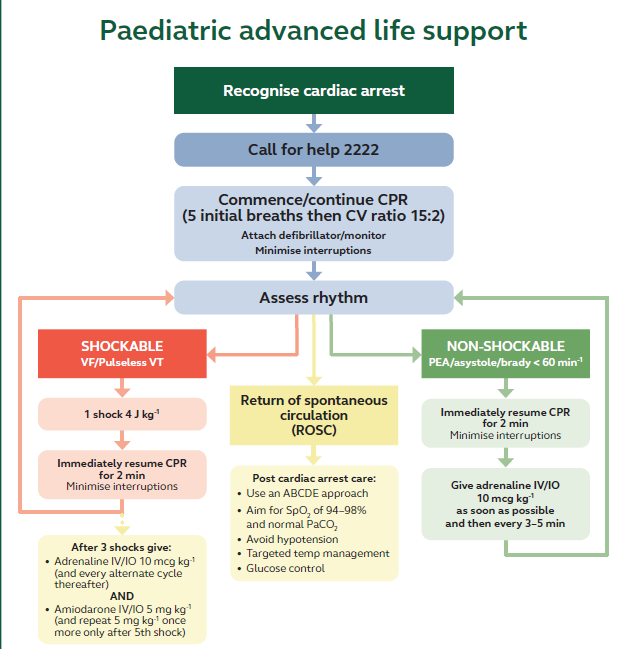
Atropine not part of guideline – neonates 10mcg/kg (no minimum). Else 20mcg/kg min 100mcg.
Out of hospital – Shout for help AND ask for an AED. Sudden OOH collapse likely to be cardiac, even in a child – don’t wait till after rescuer breaths!
Compressions 100-120.min for both infants and children. One third depth of chest – 4cm infant, 5 child (6 adult). 1 finger breadth above xiphisternum to avoid organs.
40% blood volume might be lost before hypotension appears…
5th centile for systolic BP is 70 at 1yr, 80 at 10, 90 at 15yr.
Haemothorax might be picked up in B but don’t manage until C!
C – compartments of body incl long bones. 1:1 RCC:FFP
TXA – bolus, remember 2nd dose (or double bolus).
Log roll can be missed if suspected spinal unless penetrating back wound suspected (or found on absorbent surface…)
It therefore joins beneficence, non-maleficence and respect for autonomy as one of the cardinal principles (Beauchamp and Childress).
What fairness means is debatable, however. And these different principles can conflict.
But it still has value as a way of analysing ethical problems. Hopefully in advance of the problem becoming real for someone.
Aristotle’s theory of justice or fairness is a good place to start – “equals should be treated equally” is straightforward, but it also includes “unequals should be treated unequally, in proportion to their inequalities). In other words, some people may need to be treated differently (“unequally”) because they need the treatment more.
Once a child starts school/nursery, the risk of reactions (and anxiety about potential reactions) starts to ramp up. Obviously, this is because other people are responsible for sourcing and providing food, often to many different children at once.
In the UK, probably 1 pupil with a food allergy in every classroom.
“Schools are the most common setting for severe allergic reactions, with 18% of all food allergy reactions and 25% of first-time anaphylactic episodes occurring there. Fatal anaphylaxis in children occurs more often in schools than any other setting” [Benedict Blythe Foundation “Keeping the promise” document] – but this data appears to be from old US studies. From my data (19/8/26) I see 4 mentions of anaphylaxis related to school in the last 2 years (about 10% of all anaphylaxis reports) – but half of these were actually related to after school.
Miranda Crilley (CHI Dublin) reported on 521 food allergic children attending school/nursery, and found a 4.5/5% annual rate of reactions in schools. Half of nursery reactions due to milk. 6 of 7 nut reactions in schools with nut bans! 33% of children had not provided copies of their allergy action plans to the school. 22% or the reactions were judged as anaphylaxis, none received adrenaline from school staff. “Promoting milk/egg tolerance in infancy would prevent”.
Scottish government policy on healthcare needs in schools (2017): talks about “coordinated support plans” as well as individual health plans and child plans. Talks about local strategic joint arrangements between NHS boards and educational authority. Inhalers and defibrillators (!) specified. “General awareness raising training of common conditions should be provided… for example, asthma, diabetes, epilepsy, eczema and allergic reactions (including anaphylaxis).”
Specific school arrangements may include:
who in the school accepts responsibility, in principle, for supporting the healthcare needs of children and young people in the school;
who is responsible in school for staff training in regard to supporting healthcare needs and administering medication;
emergency procedures at the school including a main point of contact in the school health team [defined how?];
details of any centrally held inhalers; anaphylaxis auto-injectors; the storage of and access to medication in the school;
who is responsible for ensuring the safety of children and young people’s self-management of their medical conditions;
the arrangements in place to ensure that staff are informed and kept up to date about children and young people’s healthcare needs at school.
First do no harm – parents tend to overestimate risk of anaphylaxis, whereas there are clear consequences to restricting the child’s ability to sit with other children at snack/meal times, or restricting the food choices of other children.
Recommends that an Allergy management policy should be in place (even if incorporated into wider medical conditions policy) even if no currently diagnosed allergic children [quotes 25% undiagnosed reaction rate in school] – cites 2017 Government supporting CYP with healthcare needs document:
Procedure for identifying pupils with allergy and high risk pupils.
Details on developing Individual Healthcare Plans.
Protocol for storage and access to emergency medication – emergency kits.*
Arrangements for staff training.
Policies and arrangements on Preventative Measures.
Details on the administration of medications.
Protocol for the emergency response to anaphylaxis.
The rights, roles and responsibilities of staff, pupil(s) and parent/ carer(s).
Highlights breakfast clubs and after school as under the remit of schools (and school trips, too).
And another about how schools can become more allergy aware – because it’s not just about nuts – https://youtu.be/JHnmcmUP6Cs?si=FgjhoxcOdMoEb7eS. George Raptis has shown how school allergy training (in NW England) can improve allergy awareness, not just confidence in managing an allergic emergency.
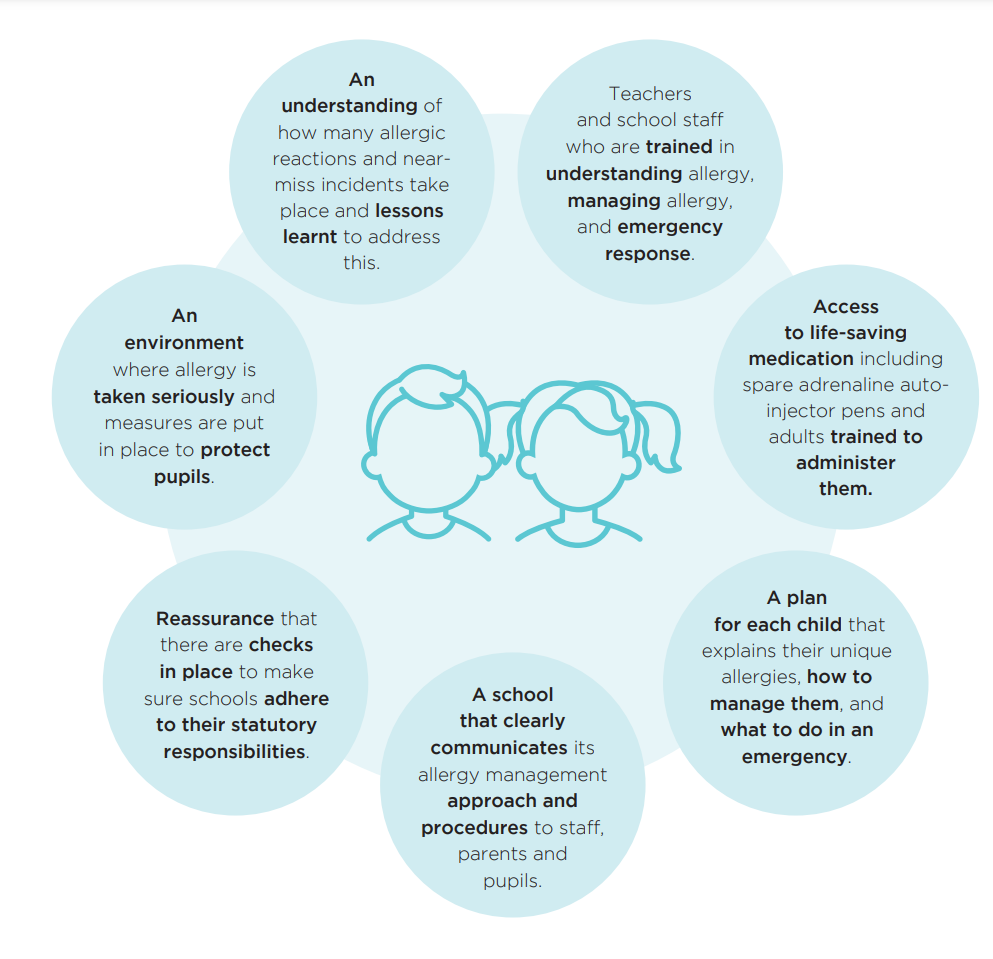
Whole school approach – not just catering/medical – skills (risk reduction, inclusion, first aid); allergy awareness in classroom activities [curriculum?]
Communicate clearly – Allergy and Anaphylaxis Policy (no template!) – (accessible), – and designated allergy lead. IHPs (individual health plans)
Clear governance and risk management – designated lead, other roles/responsibilities. Allergies in every risk assessment
Readiness to respond – 2 in date AAIs for those prescribed them. Hold spare pens in obvious place. Annual risk reduction and ana training. “Ana emergency response plan” [in allergy policy, presumably?], rehearse
Schools allergy code backed by Dept of Education in England.
React report
Data from 2000 English schools, about 10%.
Assessed 4 allergy safe guards: a specific allergy policy, spare pens, allergy training for staff, incident reporting.
69% did not have all recommended safe guards in place. “Pot luck whether your local school has medication, communication and education relating to allergy made available to teachers”. But commented on how well schools are managing despite “seeming lack of guidance, training and funding from government”.
School Allergy Code recommendations
Training
“All schools that are OFSTED monitored AND provide early years education must have at least one member of staff paediatric first aid trained including anaphylaxis treatment”.
First aid training, and even anaphylaxis training, is not the same as allergy awareness, however. 25% of schools don’t train staff on identifying allergy symptoms and anaphylaxis, and what to do in an emergency. Mandatory in New York day care (Elijah’s law), Canadian schools (Sabrina’s law).
Various free and paid for training programmes available. KITT Medical includes training in its package, that includes emergency adrenaline autoinjectors. Natasha Allergy Research Foundation offers Allergy School – includes self assessment for primary schools (also for clubs). Free. Resources for age groups eg 5-7 including going to a party (Armadillo film), assembly plan, top 14 allergen poster.
School Allergy Policy
BSACI Model policy includes (last 9 pages actual template – mostly repetition of initial text):
reference to laws on supporting pupils with medical conditions;
how first aid falls under health and safety policy (designated first aiders)
Anaphylaxis management
SPare pens in schools
Allergy action plans
Staff allergy training (says “all staff”, annually) incl risk reduction (no detail), asthma
Bullying
Storage of medicines, expiry dates
Catering – staff must be able to identify pupils with allergies; menus should be available (with ingredients); may contain; [cross contamination is a heading but nothing further]
Ana UK safer schools programme and allergyWise training;
Working with parents – must keep school updated, provide medicines and allergy plans.
Links to Wiltshire anaphylaxis risk assessment template
Sports (in/out school)
Insect stings (v brief)
Checklist (11 points)
Individual Healthcare Plan
The need for an individual healthcare plan and the medical detail of such a plan should only be assessed by an appropriate designated health practitioner. May include:
details of any diagnosed condition or symptoms;
the impact that the condition or symptoms has to the individual;
details of any medication, dosage, side effects and storage information;
special requirements e.g. dietary needs, pre-activity precautions, access to facilities and other reasonable adjustments etc.;
what to do, and who to contact, in an emergency;
training needs for the support, how often these should be reviewed and who will deliver the training;
consent;
how often and when the plan should be reviewed;
consideration of existing emergency plans, such as Anticipatory Care Plans.
Muscle breakdown with release of products into blood stream that can cause acute renal failure. Can be associated with compartment syndrome, disseminated intravascular coagulation.
Typically occurs with crush injuries, sometimes seen with extreme endurance sports.
Children are small adults, when it comes to trauma!
Mortality jumps when airway management instituted more than 45 mins after 999 call. (NICE) Mortality actually rare with isolated head (7%) and abdominal (20%) trauma. But jumps to 50% for multiple sites.
Beware head impact apnoea.
Collars not required as part of immobilisation in children. Cx spine trauma v rare. Manual in line stabilisation best if necessary. Extrication maybe?
Triage tool highlights who needs to go to trauma centre eg mangled limbs, penetrating or open trauma, mechanisms eg ejection from vehicle. But always clinical judgement.
If “hot critical” then decide on transfer to tertiary centre within 8 minutes. Airway, catastrophic haemorrhage and move.
C-ABC is catastrophic haemorrhage first.
Access above and below diaphragm if possible. Blood first line if bleeding. 10ml/kg aliquots. 1:1:1 packed cells, FFP and platelets as able.
Tranexamic acid dose 15ml/kg (same as paracetamol!). See major haemorrhage protocol. No role for permissive hypotension in children.
Avoid over resuscitation with crystalloid.
Pelvic binder problematic if moves. Fixes greater trochanters and public symphysis.
AVPU – but specify pain response!
Head injury: 3% saline preferred. Aim for high MAP, with inotropes if necessary. GGC has guideline. Adrenaline preferred.
Agitated kid – persevere with getting them into scanner without anaesthetic! In Wishaw, induction best in theatre but would then need to go in lift! Limited expertise with waking them up! Discuss with Scotstar, maybe move, maybe tube.
Log roll 90% out, 20% in? Conrad 2012
Traumatic cardiac arrest: in adults, evidence for aggressive treatment of reversible causes. Consensus is for bundle of simultaneous interventions (not all necessary for every case), prioritised ahead of CPR!
Haemorrhage control
ETT or equivalent
Bilat finger thoracostomies
Rapid volume replacement with warmed blood NOT thoracotomy or inotropes. Persistent low ETCO2 is poor prognostic sign.
Even if death declared out of hospital, should be admitted for after care.
NAI audit – 5.2% rate of suspected child abuse. 75% under 1 yr. Often major trauma, often severe brain injury.
Major Incident
Workload should be spread out. Over 12 should go to adults (unless lots of adults too). Walking wounded to non trauma centres. Try not to separate children from injured parents – who worst affected?
Still routine practice in many parts of the world, including the USA. Last figures I can find suggest 56% of US boys circumcised, with higher rates among non-Hispanic white boys, which is down from previous decades.
The Royal Dutch Medical Association declared in 2010 that male circumcision as routine practice or for religious reasons is medically unjustified and therefore an abuse of the rights of the child.
In 2013 the Children’s ombudsmen of the Nordic countries proposed a ban. In Sweden it is illegal in the first 2 months of life, following a death from complications in 2001 (an attempt at an outright ban was watered down).
In the UK there have been legal cases where parents have disagreed on their son having the procedure.
Trials in Africa suggested that circumcision might help prevent spread of HIV (38-66% reduced risk). South African president Jacob Zuma made a point of getting circumcised, to encourage others.
Risks are low in neonates cf adults.
Muslim and Jewish cultures see it as part of cultural identity, of course.
Alliums, as are leeks, shallots and chives. Part of same bigger family as asparagus but probably not co-sensitivity.
The main issue with onion is the chemicals released from cut surfaces, which can trigger eye/nose reactions and potentially asthma. But there’s actually some evidence that onion has an anti-allergy action.
With garlic, there is a well recognised contact dermatitis relating to chopping it.
As with that syndrome, the problem for the allergic person is that not only is it not one of the 14 UK recognised allergens for food labelling and restaurants, but it can be included under “spices” if less than 2% of the overall product, without further detail.
Humans, and children in particular, learn through play. Play is how we develop new models to understand the world around us.
Expert game designers are well-versed in sociology, psychology, and the cognitive sciences that underlie motivation and behavior. They know how to achieve the perfect balance between challenge and mastery – too hard is off putting, too easy is uninvolving – and they build reward-driven experiences that capture attention.
Games are ultimately how we work out rules, and hence strategy.
All these things are essential components of learning, and indeed life.
A good game requires intense concentration, and this is where maximally efficient learning occurs, which contributes to better knowledge retention and skill development. And with a game this is almost an unintended consequence.
Mixed up with “intolerance” and “sensitivity” – intolerance is a vague term for any kind of reaction, agnostic to cause (most commonly used for gastrointestinal symptoms); “sensitisation” has a specific meaning (see allergy diagnosis) so not to be confused. Allergy is where there is an immune mediated problem (based ideally on history and testing) – but sometimes hard to know the mechanism.
2 basic types of food allergy, you can have both at the same time – type 1 (IgE mediated), and non-type 1 (non-IgE mediated – possibly type 4 hypersensitivity).
Most commonly (in Scotland – but varies across UK, especially with different ethnic groups), and varies widely across the world):
Milk
Egg
Peanut
Tree nuts
Legumes/Pulses
Sesame
Wheat
Crustaceans/molluscs
Various fruits
Birch pollen sensitization in Northern Europe changes the kinds of allergies you get – cross sensitivity with fruit and nuts (pollen food syndrome) – whereas in the rest of Western Europe you get more fruit and seed allergies based on LPS.
Allergy has increased over recent decades – “hygiene hypothesis” has now been developed further to address entire “exposome“. Eczema increases the risk of food allergies 6-fold, via genetic and environmental factors (esp filaggrin mutations, and IL-4 receptor alpha chain polymorphisms).
Hospital admissions for food allergy in the UK have increased 3 fold over the last 30 years, with the biggest increase in children [BMJ 2021; 372: n251]. In big English study of primary care records, estimated incidence of probable food allergy doubled between 2008 and 2018; prevalence highest in children under 5 years (4·0%). Rate in children aged 5–9 years 2·4%, 15-19 years 1·7%. In those with previous food anaphylaxis, only 64∙0% of children and young people had at least one prescription for adrenaline autoinjector, and only 50.3% had them on repeat. Adrenaline autoinjectors prescription was less common in those resident in more deprived areas. 93.3% of first health care encounters for children regarding allergy were in primary care, with 2.2% in emergency departments. Only 7.4% of children had been seen for allergy in a hospital clinic. 92.2% of children had only ever been seen for food allergy in primary care (and looking at those prescribed AAIs, 93.5% only ever seen in primary care!).[Lancet Public Health 2024, Paul Turner]
If you ask people about their children’s allergies, up to 28% of infants will report allergies! Lifetime and point prevalence of self-reported food allergy 20% and 13%, respectively – point prevalence of sensitization as assessed by sIgE stands at 17%, skin prick test 6%, and food challenge positivity 1%. Based on clinical history or positive food challenge, food allergies have increased from 2.6% in 2000–2012 to 3.5% in 2012–2021. Point prevalence for under 16s for self reported but physician diagnosed food allergy is 3.75%. Patterns vary across European regions but not in a consistent way. [Spolidoro and Venter 2022]
Having a child with a food allergy has a significant effect on the quality of life for the whole family. One study suggested that having a peanut allergic child had a worse effect on a family than having a child with diabetes, even though with diabetes you also have restrictions on eating and the potential for serious adverse events. A similar study found the same comparing food allergic families with families where a child had a rheumatological diagnosis. The main domains affected were social. Patient/parent feedback pretty consistent across the world however (although most studies done in Europe and English speaking countries), and across time:
Parents lived in fear after the first reaction, often perceiving it as traumatic, and often feeling guilt too
They tried to live an ordinary family life and had to learn how to be one-step ahead and understand early signs.
The family’s social life was also influenced.
Parents asked for support and information from health professionals
More knowledge and skills increased parents’ confidence (and by implication quality of life – Knibb 2015)
Mothers tend to report greater impact on the child’s quality of life and experience more anxiety and stress than fathers. Mothers tend to shelter the child, whereas fathers more often express a desire to expand their child’s life, and these differences are often greater where parents are separated.
The concern for the child’s safety affected eating outside the home, with birthday parties and visits to peers’ homes particularly threatening. School and nursery are a major source of concern and often led to more parental work, preparing safe lunches.
Parents often felt they had to teach themselves about allergies, due to the lack of early information provided by health care, and then ended up having to teach family, friends and educational institutions too.
Adolescence is a particularly stressful time, as parents recognize the need for the child to become more independent, at the same time that the adolescent can see the parents as excessively controlling (at least with respect to peanut allergy). Supportive friends particularly important for adolescents.
Usually due to renal failure. Causes arrhythmia and death…
Treatment
Slow injection of calcium – note calcium chloride and gluconate both available so potential for confusion. Dose is 0.11 mmol/kg, to be given over 5–10 minutes, maximum 4.5 mmol (0.11 mmol/kg is equivalent to 0.5 mL/kg of calcium gluconate 10%). Repeat as necessary if ECG changes do not improve.
Bicarbonate indicated if hyperkalaemia due to acidosis or renal failure.
Insulin/dextrose – 10ml/kg 10% dextrose (so 5x usual dose for hypoglycaemia!), plus 0.1u/kg insulin (max 10 units), give over 5 mins. Likely peak action at 30 mins.
Dialysis.
Hydrocortisone if suspected Addisons.
ECG monitoring
Repeated salbutamol nebs
Frusemide and calcium resonium only for asymptomatic!