UK Resuscitation council updates guidelines from time to time.
See also anaphylaxis (now 2 guidelines, basic and refractory) and arrhythmia.
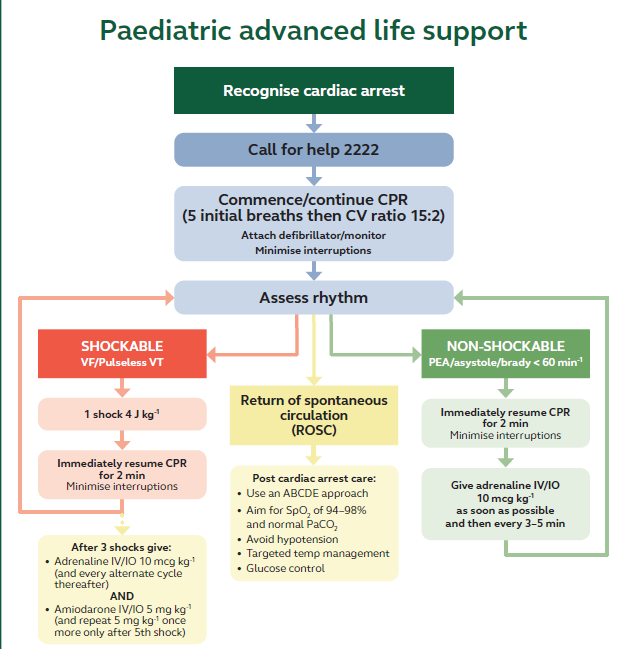
Atropine not part of guideline – neonates 10mcg/kg (no minimum). Else 20mcg/kg min 100mcg.
Out of hospital – Shout for help AND ask for an AED. Sudden OOH collapse likely to be cardiac, even in a child – don’t wait till after rescuer breaths!
Compressions 100-120.min for both infants and children. One third depth of chest – 4cm infant, 5 child (6 adult). 1 finger breadth above xiphisternum to avoid organs.
40% blood volume might be lost before hypotension appears…
5th centile for systolic BP is 70 at 1yr, 80 at 10, 90 at 15yr.
Haemothorax might be picked up in B but don’t manage until C!
C – compartments of body incl long bones. 1:1 RCC:FFP
TXA – bolus, remember 2nd dose (or double bolus).
Log roll can be missed if suspected spinal unless penetrating back wound suspected (or found on absorbent surface…)
ATMIST – age, time,
Parents need a senior person who understands!
CT head might be better done at trauma centre…
Team Dynamics
Higher scores on teamwork were associated with faster patient defibrillation. 50% of errors in trauma resuscitation were directly related to teamwork and leadership failures. A study looking at barriers to teamwork in pediatric resuscitation highlighted leadership and communication within the resuscitation team. Integrative review (2022) highlighted the following as important for effective teamwork –
- Interactions between team members – shared mental models, communication, co-operation, coordination, prioritization, and cognitive aids
- Skills of the leader and team members – role allocation, information needs, situational awareness, adaptability
- Environmental elements – Family presence, team climate, clinical standards, scene organization, and training