All posts by admin

Ketotic hypoglycaemia

What happens when you don’t eat enough and your carbohydrate stores run out!  Typically due to illness, especially with vomiting.

But  can be endocrine cause eg hypopituitarism, adrenal insufficiency. Growth hormone deficiency associated with recurrent hypoglycaemia even before growth failure apparent, associated with sudden death.

If you have excluded glycogen storage disorders (big liver, high lactate), glycogen synthase deficiency (normal liver, high lactate) and organic acidurias (acidosis, encephalopathy, usually high ammonia too), can be idiopathic (usually SGA at birth, thin, presents under 4yr, resolves by 7yr).

If ketones low and fatty acids high, then suggests fatty acid oxidation disorder (but usually just means hypoglycaemia was treated before sample was collected).

Regular meals + night time complex carbo snack, optimize nutrition, carbs if unwell eg Maxijul + Electrolade else Ribena/apple juice.

Childhood absence epilepsy

  • Age 3 to 10 yr
  • Abrupt onset and cessation
  • Most are complex ie clonic movements, minor changes in tone (eg head drops, or held object dropped),
    automatisms (repetitive movements of eyes, mouth).
  • No myoclonus (else likely to be juvenile myoclonic epilepsy). Some get generalised tonic-clonic seizures in adolescence but these are infrequent and respond well to treatment.
  • Precipitated by flashing lights, sleep deprivation, hyperventilation (90% detected after 3 minutes – get them to count aloud)
  • Atypical have more gradual onset, last longer, have more obvious changes in tone – but continuum
  • The SLC2A1 gene codes for the glucose transporter protein type 1 (GLUT1), involved in glucose transfer across blood-brain barrier. Heterozygous mutations are mostly de novo but may be inherited as AD trait. There may be mild learning and motor delay, but more often it presents with early absence seizures – GLUT1 mutations are present in up to 10% of early childhood absence epilepsy (ie under 5yrs). The importance of the diagnosis is that the seizure are often intractable to valproate and ethosuximide, whereas a ketogenic diet will be effective.
  • EEG shows sudden onset 3Hz spike and wave, esp with photic stimulation/hyperventilation. Interictal is often normal.
    Clinically apparent if more than 3 seconds of activity, but detailed neuropsych assessment suggests that non-clinical absences do cause functional impairment. Atypical have slower spike waves and rarely have normal interictal.
  • 60-80% full remission, usually during puberty; in most cases, absences disappear on monotherapy but there are resistant cases (unpredictable, other than SLC2A mutations).

Occipital lobe epilepsy

Early (PANAYIOTOPOULOS) or BECOP (Benign epilepsy of childhood with occipital paroxysms).

Panayiotopoulos

  • Or Self limiting epilepsy with autonomic symptoms (SeLEAS)
  • Usually 3-5yrs but can be 1 to 15
  • Mostly nocturnal
  • Characteristically autonomic – pallor/flushing/vomiting/coughing!
  • Head/eye deviation, then tonic-clonic (one sided or generalized)
  • Often status, but actually seizures infrequent
  • EEG can be normal – sleep EEG more sensitive
  • Good prognosis – most remit with a few years and have just a few seizures
  • Valproate or carbamazepine

BECOP

  • Usually middle childhood, cf above
  • Can be triggered by going from dark to light areas or vice versa
  • Visual  – partial or complete loss, flashing lights, multi-coloured circles, balls, rarely hallucinations
  • Headache during or after – cf migraine!
  • Often one side jerks; rarely generalized
  • Carbamazepine or Valproate
  • Usually benign, most remit by puberty

Urine collection

For culture, looking for urine infection, traditionally midstream urine, or at least clean catch.  Hard if not toilet trained.

Ideally, avoid first portion of sample (easier if toilet trained), more likely to be contaminated.

Need to be well hydrated, of course.

In/out catheter and suprapubic aspiration are quick but invasive and unpleasant.

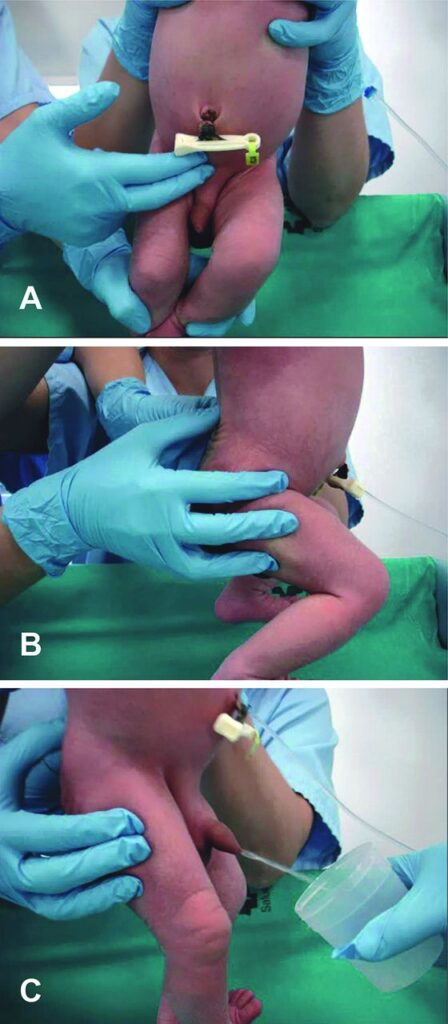
For babies, “Dangle-tap” urine collection method –

  • Feed first!
  • Then hold the baby under their armpits with their legs dangling (parent can do). Another person then starts bladder stimulation – gentle tapping in the suprapubic area at a frequency of 100 per minute for 30 s.
  • The third step is stimulation of the lumbar paravertebral zone in the lower back with a light circular massage for 30 s. Repeat as necessary.
  • Babies hate the suprapubic tapping, but often pee when you switch to back rub.

86% successful within 5 minutes, mean 57secs! Over 3 months hard as heavy and actively resisting.

Older babies – try Quick Wee – gentle suprapubic cutaneous stimulation using gauze soaked in cold fluid for 5 mins. 30% successful within 5 minutes.

[Madrid Infanta Sofia hospital, as reported in Arch Dis Child
2013;98:27-29 doi:10.1136/archdischild-2012-301872]]

Non-specific effects of childhood vaccines

Systematic review.

BCG and Measles vaccine appear to reduce all cause mortality, not just TB and Measles (relative risk 0.7 in trials, 0.5 in observational studies, roughly same for both vaccines).

That’s wonderful, until you see that DTP vaccine appears to increase mortality (in 7 of 9 observational studies).

So are live vaccines “immune boosting” in some general way, whereas inactivated vaccines are not, or actually deleterious?

Large proportion of data from studies in Guinea-Bissau so high risk of bias!

[BMJ 2016; 355]

Systematic review of immunological effects of BCG found evidence of changes in non-specific immunological variables (eg IFN-gamma prodution, enhanced lymphocyte proliferation in response to candida, HBsAg, staph etc) but inconsistent, dubious clinical relevance, and certainly not geographically generalisable.

Ultimately, better designed studies, linked to epidemiology, needed before policy changes can be justified.


Thalassaemia

Normal newborn has 90%+ HbF (alpha-gamma chains), dropping with age. In childhood, normal HbF is <2%. HbA2 (alpha-delta instead of alpha-beta) is normally <3.5%, and HbA:HbA2 ratio should be at least 40:1.

Alpha thalassaemia

4 genes for alpha chains. Africans, Afro-Caribbean (provided no Chinese ancestry), South Asians tend to carry the deletional α+ allele (“alpha plus” thalassaemia) which has no health consequences for person or their children (but causes endless confusion…). If both parents have alpha plus, child can just end up alpha plus.

Mediterranean, Middle Eastern, East Asian, SE Asian can have alpha plus or “–” (“zero”) defect, that is more serious.

  • If alpha zero, there is usually mild microcytic anaemia, easily confused with iron deficiency. No treatment required, though. Risk of “HbH” disease if other parent alpha plus – abnormal tetramers form viz Hb Barts (4 deltas) and HbH (4 betas). There is mild to moderate anaemia, Heinz bodies (accumulations of excess beta chains) and splenomegaly. Most people do not need any treatment, however.
  • If both parents alpha zero, risk of all 4 alpha genes being abnormal – “alpha zero major” – survival is not possible. The baby develops hydrops (as the unstable Hb forms do not deliver oxygen appropriately, so organ failure), and death occurs in utero or soon after birth.

Electrophoresis will show high quantities of Hb Barts in alpha zero thal major. In the trait form, there are often normal levels of HbA and HbA2 so need to do gene deletions.

Beta thalassaemia

Seen in the Mediterranean, Africa, SE Asia. Just 2 genes, so a heterozygote is a carrier, may have mild microcytic anaemia. In the Mediterranean form, the gene is usually a zero producer, so the disease is more severe than in Africa, where production is reduced but not absent.

Beta thal Major (homozygous) present after 6 months of age with anaemia, frontal bossing, growth failure, hepatosplenomegaly.

In Beta-thal trait, HbA2 is obviously increased eg 3.5-7%, and ratio reduced eg 20:1. The only exception is if there is co-existing severe iron deficiency. In beta-thal disease, you may not see such an increase if there’s lots of HbF around (about half the cases), and increased HbF is not specific; but the clinical picture doesn’t leave much doubt. Inclusions (alpha chains) seen esp post splenectomy. Retic count surprisingly normal due to severe intramedullary erythroblast destruction.

Treatment is with folate and regular blood transfusion, which then leads to cirrhosis, pigmentation, diabetes etc. Splenectomy reduces transfusion requirements but because of the increased vulnerability to pneumococcal infection this is usually deferred until later childhood.

Deferipone is oral chelating agent, used in Europe but not licensed in US. Acrimonious debate between lead researcher and drug company about research.

An intermediate beta thal exists, where transfusion is only required at times of increased stress.

Combined alpha thalassaemia and sickle cell disease tends to give less anaemia, but more vaso-occlusive crises.

Family support at https://ukts.org/
Sacral dimple

Typical sacral dimples are <5mm in diameter, within 25mm of anus and located in midline.  Rate of spinal  dysraphism (bifida occulta) less than 1%.

Higher risk if do not fulfill these criteria. Lipomas, deviated/bifurcated crease are the most likely to be associated with dysraphism.  Otherwise you expect at least 2 or more cutaneous markers (hair tuft, haemangioma, Mongolian spot, skin tag/tail).

Reports of high frequency of hair tufts in diastematomyelia probably refer to more striking lesions (“faun tails”).

Royal College of Radiology has policy  – ignore sacral dimples unless atypical, or in combination with other lesions.

USS if neonate, but MRI if US abnormal or equivocal, where neurological signs (bladder, bowel, lower limb) or lesion discharging.

[Arch Derm 2004]

Episodic autonomic symptoms

Antibiotic resistance

Penicillin resistance

Resistance to penicillin is usually due to Beta lactamase enzymes.  Therefore adding a  beta-lactamase inhibitor eg clavulanate (as found in co-amoxiclav) overcomes the resistance and extends the spectrum.

An alternative resistance mechanism however is production of defective Penicillin Binding Proteins – this is the mechanism of resistance in Pneumococci.  Beta lactamase inhibitors therefore do not help.

Macrolide resistance

Variable resistance seen; sometimes effective against penicillin resistant staphylococci including some MRSA, but poor activity against Haemophilus. Variable resistance seen in streptococcus, pneumococcus. Resistant mycoplasma are rare but do exist – try cipro, else tetracycline.

Using Azithromycin probably improves efficacy in Haemophilus (more active) but pneumococci that are resistant to erythromycin (approximately 5 to 20% of strains currently) will also be resistant to azithro, and no difference in in vitro activity between the newer and old macolides against other common respiratory pathogens.

Multiresistant organisms

In theory, you should use a combination of antibiotics (if possible) to treat a multiresistant organism, to prevent resistance developing (as in TB).  However there is no good clinical data to support this, beyond TB treatment (which is slow growing, so probably different).  On the contrary, meta-analyses demonstrate no difference in clinical outcomes between the two treatment strategies (for infections with Gram-negative bacteria), but there are well-documented increased toxicities with combination therapy.

Having said that, given the greater mortality associated with delays in appropriate and effective antimicrobial treatment, starting with combination therapy in critically ill patients seems sensible.

If there is poor response to treatment, rather than simply adding a second agent, consider:

  • dose, frequency – are you achieving adequate time above MIC?  Consider prolonged antibiotic infusion strategy
  • route – give IV if not already
  • duration – extended treatment course?

[doi: 10.1128/CMR.05041-11 Clin. Microbiol. Rev. July 2012 vol. 25 no. 3 450-470]

ESBL – extended spectrum beta lactamase

Scenario 1: lower renal tract infection with ESBL producing Gram negative

Bacteriuria with urinary symptoms but minimal systemic symptoms and no fever

  • Treatment duration 3 days
  • First line – trimethoprim / nitrofurantoin  (not used in under 3 months)
  • Depending on sensitivities and age alternative options include ciprofloxacin, single dose aminoglycoside, pivmecillinam or fosfomycin

Scenario 2: upper renal tract infection with ESBL producing Gram negative

Bacteriuria with urinary symptoms and associated systems symptoms including fever

  • Treatment duration 7-10 days (as per NICE)
  • Always consult with infection management specialist
  • First line – if seriously unwell or under 3 months carbapenem  + consider one dose of aminoglycoside
  • Alternative: tazocin and consider one dose of aminoglycoside (if sensitive and not seriously unwell and after discussion with local microbiologist)
  • OPAT : Ertapenem
  • Daily IVOST review required
  • Potential IVOST options when afebrile, clinically improving, falling CRP and able to take and absorb oral medicines: ciprofloxacin, trimethoprim
  • There was less consensus on the role of pivmecillinam and its ability to penetrate renal tissue. It should be considered only to offer an oral option to finish a course of antibiotics in a clinically improving child

Scenario 3 – infection with ESBL producing Gram negative outside the renal tract (except for meningitis)

  • As per IDSA – carbapenem, meropenem (especially if child unwell)
  • Stepdown co-trimoxazole or ciprofloxacin (would consider fosfomycin on rare occasion)
  • Temocillin not empirical therapy until we understand PK/PD profile better plus expensive and difficult to obtain – consider not including
  • Recommendation would need caveat, how unwell, age of child.  Not experienced discuss with infection specialist. BNFC reference
  • Ertapenem OPAT

Scenario 4 – meningitis complicating ESBL producing Gram negative

  • Carbapenem, limited ability to step down
  • Treatment duration – 3 weeks
  • Lumbar puncture to ensure infection cleared.

[Conor Docherty]