All posts by admin

Non-accidental injury – fractures

Abuse should be considered if:

  • multiple fractures
  • rib fractures (7 in 10 NAI)
  • femoral fracture (see below)
  • Under 3 with humeral fracture (1 in 2 NAI)
  • Mid shaft humeral fracture more frequently NAI, supracondylar less frequently
  • Infant/toddler skull fracture (1 in 3 NAI).  Type and location not helpful

Formerly known as CORE Info, the RCPCH Child Protection Portal hosted on the RCPCH website provides evidence-based guidance for health professionals concerned about non-accidental injury 

  • Fractures in the abuse group occurred predominantly in children less than 1 year of age.
  • Femoral fractures under 1 year of age are significantly associated with abuse.
  • One-third of isolated femoral fractures under 3 years of age were abusive.
  • Abusive femoral fractures occur predominantly in infants (evidence level IIb) [3].
  • Significantly more abusive femoral fractures arise in children who are not yet walking (evidence level IIb) [3].
  • Mid-shaft fractures are the most common fracture in both abuse and non-abuse groups (analysed for all age groups) (evidence level IIa) [3].
  • Under 15 months of age, a spiral fracture is the most common type of abusive femoral fracture p=0.05 (evidence level IIb) 

2014 Systematic review on bites has been withdrawn pending new review – interim advice on RCPCH child protection portal but need to be member.

Rib fractures with callus are at least 2 weeks old.  Other than that, unable to date.

Systematic reviews of various NAI issues at https://childprotection.rcpch.ac.uk/child-protection-evidence/

Rickets

Acquired bone disease, due to vitamin D deficiency. In UK, mostly black and Asian children, due to dark skin and low levels of sun exposure, also diets often rich in phytates and oxalates.

More common in boys, perhaps due to higher bone mineral density.

Safeguarding concerns note uncommon.  2 deaths reported in BPSU study, multiple risk factors, rickets only diagnosed post mortem

Clinically:

  • Leg deformity (bowing or knock-knees)/Swollen wrists or knees or ankles or ribs (rachitic rosary), AND
  • 25OH vitamin D <25nmol/L PLUS one or more abnormalities of serum calcium, alkaline phosphatase, phosphate, parathyroid hormone

Else radiological Rickets:

  • Widening, cupping, splaying of metaphysis (of any long bone) AND
  • 25OH vitamin D <25nmol/L

Other clinical features:

  • Delayed motor development 
  • Pain, limp

These are strict research definitions – some cases seen with abnormal PTH and radiological features but have dietary calcium deficiency and less severe vitamin D insufficiency (between 25 and 50), these would be called nutritional rather than Vit D deficiency rickets.  There is no clear cut off below which rickets occurs!

Incidence seemed to be rising but not borne out in most recent BPSU study (2020).

Differential

  • Vitamin D dependent rickets e.g. 1α hydroxylase deficiency
  • Vitamin D resistant rickets e.g. familial or X-linked hypophosphataemic rickets
  • Rickets associated with other chronic diseases e.g. malabsorption, liver disease, chronic renal disease
  • Metabolic Bone Disease of Prematurity (infants whose corrected age is < 3 months at presentation, who were born < 36 weeks gestation and weighing <1.5kg

Complications

  • Often cow’s milk allergy seen, else these are usually breast fed babies.
  • Fractures (usually femoral) can be a clue.
  • Hypocalcaemic seizures
  • Dilated cardiomyopathy can be seen, usually in older children where bone growth is more advanced already. Worth an echo!

Evidence from BPSU study that DOH guidance on Vitamin D supplementation not being followed, either in mothers or children themselves.

Wide variation in Vitamin D treatment prescriptions. Alfa-calcidol is potentially toxic and should be avoided.

Venom immunotherapy

Pharmalgen® no longer available. Alutard is an option (but no SMC submission) for the treatment of IgE-mediated bee and wasp venom allergy in those who have had [www.nice.org.uk/TA246]:

  • a severe systemic reaction to bee or wasp venom;
  • a moderate systemic reaction to bee or wasp venom PLUS:
    • a raised baseline serum tryptase concentration,
    • a high risk of future stings,
    • or anxiety about future stings.

Comes as an initial treatment set, with graded doses, plus a maintenance set.  For treatment, start with subcut at 1000th of SPT threshold dose or 10th of intradermal threshold, increase every 3-7 days until a threshold is reached.  Rush or modified rush regimens also available.  Then maintain maximum tolerable dose (typically 100mcg)  at 4 weekly intervals initially, gradually extending, for at least 3 years.

If symptoms or signs of hypersensitivity to therapy develop (e.g. rash, urticaria, bronchospasm, faintness), even if mild, the child should be observed until these have resolved completely. [BNFc] High baseline tryptase may make reactions to immunotherapy more likely – but still appropriate to do.

Asthma is not a contraindication but severe asthma (specified as FEV persistently below 70% despite treatment) is.

No age cut off, but data “sparse” for children under 5.

Some patients tolerate venom immunotherapy well but still have systemic reactions! So challenge tests with subcut venom not reliable – use live insect! Done sometimes to identify candidates for immunotherapy, or to identify those on maintenance immunotherapy to see who is not yet protected esp at high risk of sting or high risk of fatal reaction.

Efficacy of immunotherapy is related to adherence to treatment!  High adherence at 5 years to subcut immunotherapy.  Recent contraindications more flexible than previous ones.  [Pitsios, Allergy 2015;70:897]

Venom immunotherapy is 95% effective against wasp, 80% against bee.  Consider VIT if mild reaction but high tryptase, high risk of sting or major QOL issue.  But kids have better prognosis so only VIT for most severe.  Don’t do VIT without positive test.  Usual duration of VIT in UK is 3 yrs.

Intraosseous needle technique

Proximal humerus preferred in adults! Less pain, nearer heart. Lay elbow across abdomen. Half way between axilla and lateral aspect, feel for neck. 45 deg angle.

All sizes are same gauge, just length different. Judge soft tissue depth with thumb. If you can’t see first black line then prob too short for safety!  Don’t put patient into MRI!

Contra indications: local infection, previous attempt, fracture. Osteoporosis is less of an issue with EZIO driver, cf Cook’s needle.

Hard flush initially to help flow. Pain of infusion is severe – often worse than pain of insertion.  Consider lidocaine (without adrenaline) 0.5mg/kg IO over 2 mins, then allow 1 min dwell time, BEFORE flush.

Compartment syndrome is major complication (due to extravasation) – diproportionate pain, esp on passive stretching.  Later pallor, paraesthesiae, pulseless.

72hr life.  Removal can be tricky – secret is to remove extension tube and attach syringe directly to hub, for better grip.

Renal investigations

Ultrasound

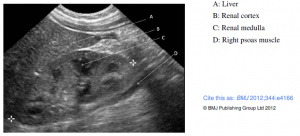
Renal uss image anotated

Incomplete bladder emptying cannot be diagnosed on a single post-void residual urine on ultrasound, due to significant intra-individual variability. Two post-void residual urine tests are recommended; larger volumes are seen if the bladder has been over distended (eg initial volume greater than 115% of expected), and in younger children. Greater than 20 ml is more specific than 10% bladder capacity. [J urology 2009 (182):1933]

Bladder capacity is = (Age +1) x 30 (ml) max 390ml.


Hair loss

  • Tinea capitis – “ringworm”, actually fungal.  Scalp abnormal.
  • Telogen effluvium – lots of hair shed all at the same time following some sort of trigger esp birth (both baby and mother can be affected!), infection.  Trigger usually 2-3 months preceding.  Clumps or general thinning, underlying scalp healthy.
  • Alopecia areata
  • Trichotillomania

On Examination

Exclamation mark hairs (thin proximally, at scalp, normal distally) suggest alopecia areata, but may be seen in trichotillomania, so not very predictive.

Pull test – gentle traction on about 20 (some people say 60) hairs in 3 different locations.  Positive if more than 3-5 hairs extracted – confirms active hair loss but not very specific. Usually telogen effluvium but can be early alopecia areata. 

Dyspraxia, or Developmental Coordination Disorder (DCD)

Developmental Co- ordination Disorder (DCD), as outlined in DSM IV (American Psychiatric Association 1994):

  • Performance in daily living activities that required motor co-ordination is substantially below that expected given the person’s chronological age and measured intelligence. This may be manifested in delays in achieving motor milestones (i.e. walking, crawling, sitting) dropping things, ‘clumsiness’.  Significantly interferes with academic achievement or activities of daily living.
  • The disturbance is not due to a general medical condition (e.g. Cerebral Palsy, Hemiplegia or Muscular Dystrophy), and does not meet the criteria for a pervasive Developmental disorder.
  • If Global Learning Difficulties are present the motor difficulties are in excess of those associated with it.

It is essential that early referral is made in order that children do not develop behavioural difficulties due to their frustration at not being able to carry out the same tasks as their peers.

Clues are:

  • Does the child’s motor skill appear to be behind their cognitive skills?
  • Dose the child appear to move generally in an uncoordinated way i.e. walking, running, manoeuvring around objects?
  • Does the child fall over constantly, bump into things, and /or knock thing over?
  • Has the child developed a dominant hand i.e. does he/she prefer to use one hand for more tasks?
  • Does the child have difficulties with dressing especially organising themselves? Do they find laces, small fastening and cutlery difficult?
  • What is their attention span like? Are they always fidgeting or squirming?
  • Are they having significant difficulties in the classroom in relation to their peer e.g. poor behaviour, avoidance of tasks, poor handwriting, dislikes gym?

N.B  Most children in their early school years will demonstrate one (or more) of these areas of difficulty but this does not mean they all have DCD!  Children with DCD will present with many of the difficulties above for a prolonged period.

Cow’s milk protein/allergy intolerance

A common issue for babies and infants.  But not that common – in EAT study, symptoms (vomiting, colic, eczema) related to milk reported by 13% of parents, but only found in 0.7%!

“Intolerance” suggests that cow’s milk causes adverse effects (generally gastrointestinal) but without committing to an underlying mechanism. 

If there is reason to think the adverse effects are immune mediated (because there are signs/symptoms outside the GI tract, for example) then it is preferable to use “cow’s milk allergy” (which then divides into type 1, non type 1, or mixed). 

Can even affect exclusively breast fed infants if sufficient milk proteins transmitted in breast milk, but probably over diagnosed (as challenge after 2-4 weeks not done).

Not the same as lactose intolerance – lactose is a sugar, intolerance to it is due to malabsorption and effects of undigested sugar in colon eg bloating, diarrhoea.  NOT rash, vomiting.  Usually post-gastroenteritis, transient.  No useful test other than lactose restriction for 2 weeks then rechallenge.

Some parents feel milk leads to more respiratory problems – there is some evidence that milk allergy is associated with more respiratory/GI infections and that an elimination diet (although supplemented by pre/probiotics) lead to reduced infections and less antibiotic use.

Cow’s milk allergy

Can be IgE mediated (immediate, histamine release, potentially anaphylaxis), else non-IgE mediated (typically more chronic, delayed symptoms, predominantly gastrointestinal, possibly a threshold level below which a patient is asymptomatic) but can be both. Non-IgE mediated symptoms include:

  • Eczema
  • Colic
  • Gastro-oesophageal reflux
  • Constipation [NOT green or mucuous stools]
  • Eosinophilic oesophagitis
  • Allergic Proctocolitis (FPIAP – see below)
  • Growth failure
  • Enterocolitis (FPIES)
  • Enteropathy – no blood, and longer recovery time (weeks)

Note that the first 4 problems are very common and cow’s milk protein intolerance may only be a factor in a small proportion of such patients. Best predictor of whether symptoms are due to milk allergy appears to be the background of the health care professional, not the history, age or family history of atopy! See Imperial College review of evidence (Munblit and Perkins 2020).

ESPGHAN 2023 guidance does detail trial of exclusion for reflux. For colic, very strict – only when Rome IV research criteria satisfied (3hrs per day, without obvious cause, cannot be prevented or resolved by care givers, 3 days a week, confirmed with prospective diary) AND suspected on basis of additional symptoms.

In patients with eczema, a mixture of IgE mediated and non-IgE mediated reactions can be seen (and immediate reactions may be seen on re-introduction even when only delayed reactions seen initially).

Food protein induced allergic proctocolitis

Well baby with blood +/- mucus in stool, usually in first few weeks of life. Associated with eczema and family history of food allergies. Mixed feeding appears to protect. Benign – in exclusively breast fed infants, ESPGHAN says no dietary intervention for first month. Even for formula fed babies controversial, as large study in Boston found elimination increased risk of later type 1 milk allergy by factor of 5!

DRACMA 2022 guidelines from WAO quote small Brazilian study showing 80% tolerant by 6 months so earlier reintroduction presumably possible if you do exclude. Calls for more research.

So depends on severity/frequency – and if you eliminate, definitely challenge early.

Diagnosis

Prescriptions for specialist formulas increased massively in early part of century – 10-12x higher than expected in England, for example. Estimated prevalence is 1% in the UK, less than 0.3% in Germany and Greece.

With delayed reactions, diagnosis depends on history, and then dietary exclusion followed by re-challenge after 2-4 weeks. In the case of FPIES, re-challenge may need to be done in hospital. Sometimes the diagnosis is only made at endoscopy.

Dietary exclusion has been shown to affect long term taste preferences. Also significantly restricts diet, with potential impact on calcium intake (and also riboflavin, niacin, zinc).

For immediate reactions, skin prick testing (SPT) more specific than IgE blood testing. 3mm SPT wheal considered positive in infants, but low specificity; when doing IgE/SPT tests, also check egg allergy (high cross-reactivity) and soy (for formula substitution). If IgE/SPT negative, needs challenge (ideally double blind).

Substitute Formulas

  • Breast feeding mothers may need to exclude dairy in their own diet.  Daily requirement of calcium (1250mg) and Vitamin D (10mcg), so supplement and fortified alternative dairy products needed.
  • Because of theoretical risk from phyto-oestrogens in soya, use extensively hydrolysed formula (EHF) instead of soya formula if under 6 months. Soya cross reactivity is reported in up to 25% of young infants with non IgE allergy but this varies widely. Soya milk usage is also associated with increased risk of subsequent peanut allergy (RR=2.6)!
  • ESPGHAN says you can also use hydrolysed rice formula – available in UK? Reported arsenic values are within WHO limits.
  • About 10% of infants will not tolerate even extensively hydrolysed formula (eHF) and may require an amino acid based formula; anaphylaxis has been described even with hydrolysed formula.  AA formula should be used first line if:
    • anaphylaxis,
    • severe non IgE (eg PR bleeding leading to haematological disturbance, severe skin disease, FPIES),
    • faltering growth (says ESPGHAN but controversial).
  • eHF potentially better than other types of formula, and potentially added benefit from probiotics – in trial of N=260 (42% IgE mediated, non-randomised) tolerance after 12 months 79% for EHF & Lactobacillus rhamnosus GG (LGG), cf 43% for EHF. 23% soya, 18% AA. Associated with IgE mechanism (negatively, OR 0.12), and EHF (4.41) or EHF & LGG (29) [Canani, European lab for food induced diseases, Naples. PMID 23582142].

Challenge

Cow’s milk must be tried again to prove it is the causal agent, unless type 1 symptoms, or severe non-type 1 (FPIES).  If symptoms return then continue elimination diet for at least 6 months, else 1yr of age, then re-introduce gradually. ESPGHAN says do IgE for milk first if type 1! Highlights that boiling more likely to hydrolyse proteins than baking, but ignores matrix idea. No evidence for further challenges but suggests every 6 months.

Prognosis

Exposure does encourage tolerance. In studies, after 6 months of oral desensitization, 11% had had positive food challenges cf 40% for abstainers. And in the abstainers, the threshold of sensitivity tended to be lower, and symptoms more severe [Eur Ann Allergy Clin Immunol. 2007 39:12-9. PMID 17375736].

Almost all non IgE milk allergy and most type 1 resolves by 1yr after diagnosis.

Reintroduction is typically done according to a “ladder” of 4 or more steps – baked milk, then boiled milk, then yogurt, then fresh raw milk. Baked milk is less allergenic due to the matrix of wheat – if wheat allergic, then gluten free cheese oatcakes (Nairns) or shortbread (Walkers/Asda).

IgE disease less likely to resolve if asthma, rhinitis, severe reactions or strongly positive results.  Median age of tolerance 5yrs.  According to Thermofisher, positive IgE Casein (Bos d 8) means less likely to tolerate baked milk or outgrow, as protein (casein) more heat stable (no consensus on component testing in ESPGHAN 2023).

You could argue for early introduction of weaning foods but this is only briefly mentioned in ESPGHAN 2023 and not yet recommended.

Final adult height has been shown to be reduced in milk allergy – this could be related to co-morbidities (asthma, eczema, steroid use, sleep disruption etc) or feeding difficulties (associated with elimination diets).

Prevention

EAACI task force recommends against use of milk formula top ups in first week of life in breast fed babies. Low certainty, though. Also recommends avoidance of allergens (including milk but not limited to) in pregnancy and during breast feeding!

ESPGHAN discusses too. In a multivariate model, independent factors associated with milk allergy were family history of allergy (OR = 2.83), avoidance of dairy products during pregnancy or breastfeeding (OR = 5.62), and formula given at the maternity hospital (OR = 1.81). In an RCT of daily 10ml formula supplementation (n=504 breast fed) cf only soya formula if required, performed between 1 and 2 months of age, daily formula ingestion prevented nearly 90% of later milk allergy confirmed by OFC at 6 months (RR: 0.12). EAACI neutral on this – and regular top ups would never be supported by breast friendly clinicians. Overall however, ESPGHAN group decided there was insufficient evidence for any of these things.

See also EAT study, and GINI study.

Treatment

66% of kids grow out cow’s milk allergy, even if they completely avoid it. But rate rises to nearly 90% if baked milk introduced. And less restrictive diet good for everyone, of course.

Salmivesi RCT from Finland 2012 – n=28, age 6-14. 81% using daily milk 6400mg protein at 12 months. First dose milk 0.06mg – 8 further observed doses (0.12mg day 8; 0.24mg day 15; 2.0mg day 36 [big jump!]; 4.0mg day 38 [2 days later!?]; 8.0mg day 42; 40mg [big jump again!] day 57; 80mg day 64; and 160mg on day 78) with other dose increases done at home. Monitored for 2hr in clinic. Final dose of 6400mg (=200ml) was given at home (!) on day 162.

Oral immunotherapy (OIT) for severe milk allergy (IgE >85 or low eliciting dose):  at 1yr 36% tolerated 150ml, 54% 5-150ml (good enough for accidental exposure). 10% could not complete protocol. [reference?]

DRACMA update on milk immunotherapy (2021) mostly fresh milk used in research. Randomized trials looked at kids aged 2-14, mean 8. Non randomized had wider range. 67% tolerated 150ml (cf 2.2% of controls), 78% tolerated 5-150ml (=swig protection) (cf 3.3% of controls). Anaphylaxis rate of 5.5 per person-years (although not always defined, and not always usual definition). 63% used IM adrenaline!?

6.9% developed EOE but rarely biopsy confirmed. No deaths.

2–8 weeks after discontinuation of successful OIT, tolerance of cow’s milk persisted in only 36% (20%–91%). So you have to persevere life long, probably.

Quality of life badly reported – only 5 studies. 1 study found parents reported better QOL in 37%, worse in 26%, and unchanged in 38%! 2 conference abstracts reported improved QOL or at least reduced anxiety in general and reduced fear of unexpected reaction. Some studies found worse QOL! Certainty of evidence overall v low…

Only 1 trial and 2 non randomized studies of baked milk OIT! In the 1 RCT of baked milk, 73% achieved tolerance at 12 months (cf none of control group) – other studies did not find evidence of effectiveness however (meta-analysis of Anagnostou. Tolerance to heated or baked milk may be temporary and diminish within a few years. Dantzer. 20% required adrenaline! Only some children assessed for QOL, with evidence of benefit – of the parents studied, no improvement in QOL! [Dantzer and Dunlop 2021]. Low desensitization rate for unheated milk means persisting concern about exposure in real life despite less frequent adverse reactions (8%–33%).

Other studies did not find this relationship, which is consistent with the meta-analysis results of Anagnostou et al. (41). Tolerance to heated or baked milk may be temporary and diminish within a few years. Dantzer et al. found that a protocol involving gradually increasing doses of baked milk was effective in promoting desensitization (73% achieved end dose of 4000mg cf 0% of controls).  Mean age 11. “This suggests that the initial dose [and then building] may influence the efficacy of desensitization.” 

[Yan Wang, China – Front. Immunol., 04 June 2025]

4% rate of biopsy proven EOE – note EoE typically emerges approximately 2.8 years after initiating the maintenance phase so many studies will miss…

Longer duration better. None of the studies reported on sustained unresponsiveness.

Only Dantzer study reported quality of life! 

Highlights “a dire need for a standardization in outcome assessment and reporting,” and that successful completion of OFC needs to be validated as a predictor of “real world” success. [Natasha trial will hopefully clarify further…]

Separate article on OIT recommendations – apart from balancing risks and benefits, recommends using omalizumab (monoclonal anti-IgE) in advance and in initial stages of oral immunotherapy with unheated cow’s milk. Inferring from limited evidence (use in other food allergies, mostly) that risk of anaphylaxis reduced (RR0.34 but not significant!). Not really any downside? (But costs at least £256 per dose, maybe double? Lasts a month?). Plus, does not recommend baked milk OIT as very low certainty of benefit. More evidence on effect, risks, QOL benefit obviously required.  

Sublingual/epicutaneous immunotherapy (SLIT) for milk? Not much evidence – low rate of success and high rate of relapse.

[EGPHAN 2023, Frontiers in Pediatrics 2019; BMJ cmpa article sept 2013]

Rush study from Japan used microwaved milk – microwaved for 100s at 550W (!). Dosing was 2–4 times a day in hospital for several days (frequent adverse events) aiming for 200 mL dose (total daily, I assume). If not achieved, dose increases changed to 1ml per day. At 200ml, dosing changed to once a day. After 2 months of maintenance, length of time in the microwave gradually reduced.

Another Japanese study looked at using heated milk powder (3 mins at 125degC) vs unheated milk. Rush protocol (5 days in hospital) up to maintenance of just 3ml daily. At 1 year, 35% and 18% in the HM group and 50% and 31% in UM group passed the 3 and 25 mL OFCs, respectively, so not great efficacy. Rates of moderate or severe symptoms significantly lower (halved) in the heated milk group however.

Natasha Trial is looking at Peanut or cow’s milk OIT in UK – groups are Peanut age 6-23yrs, Peanut age 2-3yrs, Cow’s milk age 3-23yrs. Using everyday food products. Final results expected 2027.
Tic Disorders and Tourette Syndrome

Tics are recurrent, sudden, non-rhythmic twitches. Can be in 1 muscle or muscle group, but can also be a more complex semi-purposeful movement, or even present as a bizarre gait. Typically affect face (eg blinking, grimacing), neck, shoulder.  Can be more complex sequences of movements. Characteristics are:

  • Tend to be situational, with stress making them worse.
  • Initially they are suppressible, although depending on the situation this suppression can be virtually effortless! Usually though, suppression leads to rising anxiety and then a rebound in frequency.
  • There is often a premonitory feeling.
  • They can be suggestible.

Differential includes stereotypy, spasms, chorea.

Although tics can wax and wane over time, there is a general tendency to improve, and they are very unusual in adulthood.

Tics occur most commonly in boys. Usually they are transient, lasting for between 4 weeks and 1 year. A chronic tic disorder does exist distinct from Tourettes.

Vocal tics (clearing throat, yelps, coughs, sniffs, grunts) can occur in isolation, but a combination of vocal and motor tics suggests Tourette’s syndrome.

Tourette’s syndrome

Thought to affect 1% of children, so probably a lot subclinical! An inherited neuropsychiatric condition, it starts at a mean age of 7 but can be as young as 2yrs. Motor tics come first, about a year before vocal tics. Complex vocal tics may be seen but contrary to public understanding, most kids do not swear (coprolalia)!

Definition requires that motor and vocal/phonic tics are present (at some point) for at least a year, on a daily basis, with onset prior to 18yrs, in absence of substance misuse, medical condition or medication.  The characteristic features of Tourette’s are:

  • Echolalia – repeating phrases
  • Palilalia – repeating other people’s words
  • Coprolalia – swearing or abusive language. Involuntary, and causes distress to the patient, who will often try to conceal the outburst by coughing, etc.
  • Copropraxia – making obscene gestures
  • Palipraxia – imitating other people’s gestures

Tics wax and wane, evolve over months.  Can be self harming eg scratching, rubbing, head banging, punching, poking, stabbing oneself (see also obsessive compulsive co-morbidity below).

In some patients, there is a non-obscene compulsion to shout socially inappropriate things (NOSI).  Often worsens around puberty. 50% abate after puberty, but mostly just better self-management?

Differential is basal ganglia or cerebellar abnormality eg post-encephalitis, Huntingtons.  Investigations only necessary where unusual deterioration or progression of symptoms.

Co-morbidity

Pure tic disorder is unusual in Tourettes. 85% have comorbidity, most commonly:

  • Obsessive Compulsive Disorder/Behaviour – less to do with cleanliness, more sexual/religious/violent themes, orderliness, symmetry, checking, counting, forced touching.
  • Self-injurious behaviour is well described (see above)
  • ADHD
  • Conduct disorder, affective disorders more rarely.

The comorbidities are often more significant on school performance than the tics.  Comorbidities are common in relatives, even if tics are not.

Treatment

Counselling is useful for self-esteem, anger management, and social functioning. Habit Reversal Training is effective but not widely available – officially 12 weekly hour sessions, need to recognize premonitory urges and then replace tic with controlled movement, or position self to prevent tic (eg chin on chest to prevent shouting).

Drug treatment may be considered eg self harming, but not much evidence for effectiveness.  Traditional or atypical neuroleptics, or clonidine (esp where behaviour or sleep problems) used.

Deep brain stimulation being researched.

Prognosis

Tic frequency and severity decline with age in a large proportion of patients (59–85%).

Predictors of NOT improving include higher childhood tic severity, smaller caudate volumes and poorer fine motor control.

The presence of untreated comorbid psychopathology, such as ADHD and OCD, can adversely affect the long-term outcome of patients with TS.[Funct Neurol. 2012 Jan-Mar; 27(1): 23–27. ]

Tourettes Action parent support group.

[Stern, Curr Peds 2006:16:459]

Fabricated and induced illness

Five possible causes for discrepancy between reported and observed symptoms/signs suggested in the RCPCH guidelines:

  1. Exaggeration due to anxiety, poor understanding, lack of knowledge
  2. Carer misperception of child’s illness leading to genuine belief that child is ill
  3. Carer actively promotes sick role by non-treatment or fabrication/falsification or induction of illness (‘true’ FII)
  4. Carer suffers from psychiatric condition which leads them to believe the child is ill
  5. True medical condition

It is important to keep an open mind and to carefully plan appropriate assessments for both medical causes and evidence of maltreatment, without putting the child at further risk of harm.

RCPCH National guidance supports the clinician and team in withholding concerns about FII from the parents at early stage of investiagion. This highlights the main difference in dealing with suspected FII compared to other forms of abuse. Documentation and information sharing need to be handled carefully, as alerting the parents to your concerns may put the child at greater risk of harm – concerns should not be recorded in case notes, parents should not be informed.  Important that team is united.

Gather information about the parents’ background and any known health problems, including some assessment of parenting capacity and risk factors such as domestic violence, mental health issues or drug abuse. This is essential not optional.

Chronology – given multiple attendances for multiple children with different services, helps see overall picture for a family.  Should also include significant events eg moves, bereavements etc.

It is important to feed back your findings to the parents that there appear to be no medical problems and that this is good news.  How family responds to initial assessments and management plans is key to making the diagnosis.

In-patient: clarify nursing ability to supervise 24hrs a day.  Can child leave ward with/without nurse escort?  Who gives medication/food/drink?  Where should notes be kept?

If parents demand a new consultant, you can agree to involve another consultant for a specific medical issue eg asthma/epilepsy.  You should definitely discuss with named doctor.  CAMHS could also be useful for discussing case (and supporting staff, esp if conflicting views)

Disclose to parents – if decision is made to disclose concerns, keep it positive (health of child, etc).  Bring in dad, gran etc if potentially useful.  Don’t confront or challenge, acknowledge how parents and professionals can have different perceptions and responses to a child’s problems.  Present united front, and unambiguous plan.