All posts by admin

Sleep

Poor sleep associated with hyperactivity, obesity, poor school performance, depression.  And affects parents, of course!  Caffeine and Propranolol (as used for migraine prophylaxis) affect sleep!

Normal sleep

REM (rapid eye movement) phase is light sleep. Usually in later part of night after deep sleep.  Slow wave (deep) sleep is associated with increased anabolic hormone release, mitotic repair. Higher proportion of sleep in adolescence is slow wave.  60% of newborn sleep is REM.

Recommended sleep duration: [National Sleep Foundation]

  • Newborn 0-3 months: 14-17 hours
  • Infants 4-12 months: 12-15 hours
  • 1-2yrs: 11-14 hours
  • Preschool 3-5yrs: 10-13 hours
  • School age 6-13yrs: 9-11 hours
  • Teenagers 14+: 8-10 hours

Some sources suggest adolescents have increased sleep requirements.

Late insomnia (early morning waking) in depression. Cf early – mood disorders, anxiety (cortisol vs melatonin).

30 mins high intensity exercise is as good as melatonin. But ideally 3hrs before bed time!?

Sleep latency 19 min under 2yrs, 17-19 mins thereafter.

Night wakenings are normal! But parental response varies!

Excessive sweating seen in 11% of children, so considered normal. But beware weight loss, lethargy!  Can also be associated with obstructive sleep apnoea.

Sleep problems

For infants not going to sleep, options are extinction vs gradual retreat. Not appropriate for under 6/12 of age as may affect bonding. No adverse effects otherwise.

Melatonin does not increase total sleep time! Helps prepare brain for sleep – does not induce sleep, as such.  Earlier waking as well!

Nocturnal seizures – stereotyped, multiple in one night, sudden stop and start, mostly after first third of sleep.  Seen in BECTS.

Restless legs associated with iron deficiency!

Benign nocturnal leg pain common in children.

Teenagers generally do have different body clock, but not helped by major changes in bed/wake times at the weekend. Blue light from screens suppresses natural melatonin production besides distraction.

For autism – Hope for autism do not need diagnosis, others do. Waiting times? National Autistic Society page. Arch, Reach websites.

CAMHS won’t prescribe melatonin but do prescribe methylphenidate!?

Bio melatonin 3x the price, not approved by SMC. Modified release melatonin may be useful with or without standard if early waking in night.

Parasomnias

In early part of night, likely to be non REM, cf later in night.

Classic non REM =

  • Confusional arousal – can appear fully awake but don’t make much sense, no recollection in morning.
  • Sleep walking – quite complex behaviours possible (riding a motorcycle!)
  • Sleep terror – worse for partner/parents, as rarely remembered

REM related =

  • REM sleep behaviour disorder – typically violent, dream can often be remembered, can escalate. Can be sexual.
  • Sleep paralysis – up to several minutes, usually terrifying (“like being dead”), often with hallucinations.

Sleep hygiene, then consider melatonin and CBT (stress often provokes non-REM). Benzodiazepines can help non REM but can worsen REM.

Beware Narcolepsy – poor sleep quality at night, then daytime somnolence, plus hypnagogic/hypnapompic hallucinations, sleep paralysis, cataplexy (laughing causes collapse). Genetic, treatable with stimulants.

Support

Posterior urethral valves

1 in 5000 births.  Mostly failure of Wolffian duct development, rarely failure of urethral canalisation.

2/3 detected antenatally, with distended bladder. If missed, then present with urinary tract infection, abnormal voiding (dribble rather than fountain!) else incontinence (if toilet trained, of course).

Later detrusor failure, tubular dysfunction, renal failure.

Fussy eating

Hard to define – picky, restricted, faddy? Neophobia important – refusal to try new things. Only really a problem of the developed world… Refusal to eat unhealthy foods is obviously no bad thing…

Actually not much evidence about long term consequences – such studies are hard – poor fibre intake associated with constipation, persistent fussy eating may lead to being underweight, becoming a fussy adult or possibly an eating disorder. Avon longitudinal study (where most of the data comes from) found calorie intake maintained (some studies have found higher calorie intake in fussy eaters) but lower levels of iron, zinc, fibre and vitamin A. Intake of all but Vitamin A were below recommended levels for a substantial proportion of fussy children.

Peak age seems to be around 3yrs. Twin studies suggest highly heritable (due to heritability of sensitivity to bitterness) – associated with having fussy parents too. From an evolutionary perspective, non-mobile infants are only likely to be offered safe foods by their mother; once mobile however, risk of eating poisonous plants or contaminated foods. Hence probably why preference among fussy eaters is for bland flavours and colours, and non slimy textures.

Other risk factors are older mothers, higher maternal educational attainment, lower parity and lower birthweight. More precious children??

Avon longitudinal study found maternal worry about fussy eating at 15 months predicted fussy eating at age 3 (RR=3). Fresh fruit and eating the same meal as a family protective, ready meals increased risk of fussy eating.

Early introduction of vegetables before 6 months helps but goes against WHO guidance…

Australian study showed maternal healthy (adventurous) eating helps.

Parents get very emotional about the lack of variety in their child’s diet or perceived disinterest or refusal to eat. The often “internalise the child’s food intake as a reflection of their own parenting“, whereas choices of what and how much to eat are actually an expression of the child’s emerging autonomy.

Parental pressure to eat (usually fuelled by concerns the child is underweight, which is rarely the case) is associated with fussy eating, not surprisingly, but is potentially a vicious circle. Maternal negative affectivity, internalising problems, sensitivity (ie low tolerance) predicts fussy eating; authoritative parenting style protects [Norwegian studies]. The combination of modelling health eating (which means eating the same food together and not offering alternatives) and not pressuring definitely seems best.

[Caroline Taylor and Pauline Emmet, Bristol 2018]

For extreme refusal

Things to avoid

  • Do not refuse to give high-energy foods, like ice cream, cakes, biscuits and chocolate, in the hope that your child will eat ‘proper’ meals and ‘healthy’ foods.
    Reason:This is not a good way to get your child to eat new foods, and your child might lose weight if you withhold their ‘safe’ foods.
  • Do not try to force your child to eat food.
    Reason:This will make your child even more anxious at mealtimes, and may cause your child to vomit the food back up.
  • Leave long gaps between meals to try to make your child more hungry or hide new foods inside foods that your child already likes.
    Reason: This will make your child less hungry over time, and may lead to weight loss. Some children can very easily detect new tastes and smells, even when hidden in other foods. Your toddler may just stop eating the liked foods.

Things that help

  • Encourage your child to experience different textures through ‘messy’ play every day. Your toddler may find some textures (like Play-Doh) very difficult, so start with textures that they are happy to touch. This may need to be drier consistencies initially, such as rice or lentils. Gradually progress to more messy/wet substances, allowing your toddler to gain confidence. Have plenty of fun and get messy. If you don’t like touching certain textures yourself, or don’t feel comfortable allowing your toddler to make a mess, then why not take them to a playgroup in your area?
    Reason: Many children who are extreme food refusers are very sensitive to touch on the hands and mouth, and so will not even pick up new foods. Messy play helps them to get used to new textures.
  • Give small frequent meals of foods that your child accepts.
    Reason: Some children become very anxious at mealtimes and are sometimes very slow eaters. Small frequent meals will help them to take in the calories that they need.
  • Remember, even children who are extremely faddy eaters usually grow and develop normally, if they are given the foods that they will accept.
    Reason:It is important to keep your child growing well, and these extreme food refusers do grow as we would expect them to if they have enough of the food that they will eat.

Growth Charts

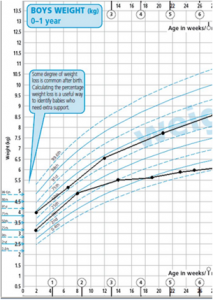
Current charts are UK-WHO, which is to say a combination of UK growth cohorts with world wide cohorts.  This is to correct for the low prevalence of breast feeding and high prevalence of obesity in the UK, and assumes that there is little genetic differences in growth.

Downloads and online growth tool at RCPCH.

Usage Tips

Between 37 and 42 get plotted as term.  No centiles for first 2 weeks as dip expected.  One in 5 still below birth weight at 2 weeks, only one in 50 will be 10% below or more.  Still mainly well, but suggests feeding problem worthy of further assessment, and in a few there will be an otherwise occult pathological condition eg cardiac or metabolic disorder.

Preterms get plotted on both Preterm section of chart AND day 0!  Because assessing early growth works best on day 0 centile, whereas later growth more likely to be related to preterm centile.  Plot after birth on preterm section until you hit the end (42 weeks) then continue on to main 0-1yr chart, plotting a point for calendar age but adding arrow indicating gestational age.   Otherwise unclear whether corrected or not.

Children up to age 2 get weighed without clothes or nappy.  From 2, minimal clothing and no shoes.  Height is hard! Only act on several measurements that appear consistent!

Growth Faltering and Failure to Thrive

Infants are at high risk of undernutrition – high requirements for growth, frequent infections affecting appetite and increasing requirements, inefficient metabolism, dependence on adults for food!

Faltering on growth chart

See Growth charts for details on different centile charts available.

There are various ways of defining or looking for undernutrition:

  • Wasting – ie low BMI or weight for height.  Pushed by WHO as way of identifying most vulnerable, but in affluent societies seems to mostly identify tall children
  • Stunting – low height for age, indicating chronic poor growth.  But in affluent societies, more likely to be constitutional or organic disease?  Social gradients in height in UK persisted until 1990s, but socially deprived short children had shorter parents and were smaller at birth, so not all nutritional.
  • Low weight centile – usually just selects out low birth weight babies.
  • Falling through weight centiles (“growth faltering”) selects for relatively large infants regressing to mean.

“Failure to thrive” has gone out of fashion.  “Thrive” seems to suggest something more than growth, but really we are just talking weight and height.  “Failure” suggests not only that there is a definite problem, but also that it’s somebody’s fault! Variability in definition and use.

The main issue here is poor sensitivity and specificity for a genuine problem.  27% of Danish cohort infants met one or more of 7 different growth criteria in at least one of the two age groups (2–6 and 6–11 months of life). The concurrence among the criteria was generally poor, with most children identified by only one criterion. Positive predictive values of different criteria ranged from 1% to 58%. Most single criteria identified either less than half the cases of significant undernutrition (found in 3%) or included far too many, thus having a low positive predictive value. [Olsen, Arch Dis Child 2007;92:109-114 doi:10.1136/adc.2005.080333 ]

Things get even less consistent in older kids, where you can have low fat but apparently normal growth except at the extreme end of range.

Combination of weight faltering and low BMI is perhaps best.  These kids subsequently have growth and body composition patterns suggestive of previous undernutrition.  Overall, about 2/3 of kids with either weight faltering or low BMI probably adequate nutrition but variant growth pattern.  Weight faltering kids are relatively short at follow up, but not more so than parents, so probably “catching down”. [Proceedings of the Nutrition Society. 71(4):545-55, 2012 Nov. PMID: 22954067]

Causes

Deprivation

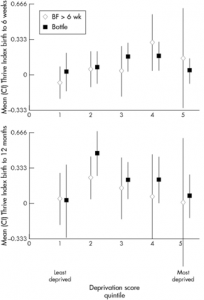
Undernutrition is NOT associated with deprivation in UK, presumably as welfare focuses on families with young children. In the Gateshead Millennium Baby Study, both the highest and the lowest levels of deprivation were associated with weight faltering; this was independent of the type of milk feeding. No relation was found with maternal educational status.

Thrive index by deprivation quintile, under 6 weeks and up to 1 yr

Abuse and neglect are a factor in only a minority of cases.

Some evidence of differences in maternal feeding behaviour and appetite, eating behaviour. In Gateshead study maternal eating restraint (“I need to control how much I eat”) was unrelated to weight gain.  Response to food refusal seems important.

In Gateshead study, infants of mothers with high depression symptom scores (EPDS >12) had significantly slower weight gain and increased rates of weight faltering up to 4 months (relative risk 2.5), especially if they came from deprived families, but by 12 months they were no different from the remainder of the cohort. [Arch Dis Child 2006;91:312-317 doi:10.1136/adc.2005.077750]

Either low appetite or actually not undernourished in strict sense!

Fussy eating

Being faddy was only weakly associated with poor growth, and simply eating a limited variety was unrelated to growth [cf high eating restriction scores]. High milk consumption was associated with lower appetite but not with poor growth.[ Pediatrics. 120(4):e1069-75, 2007 Oct. UI: 17908727]

See Fussy eating

Outcome

In Newcastle, There was a significant positive relationship between weight gain in infancy and picture vocabulary at age 10, adjusted for economic deprivation, gestational age and birthweight, but not with any of the other outcomes. There was a statistically significant association between birthweight and all four outcomes, where best outcome is at or just above average birthweight. In this population, the association between early growth and cognitive outcomes is stronger for growth before birth, postnatal weight gain having a relatively minor impact.[ Paediatr Perinat Epidemiol. 2007 Jan;21(1):57-64.]

Management

Being able to see what happens in the house at mealtimes is the most useful thing! Interventions that include home visits work best.  So Health Visitor is key.

Speech and Language, Dietician advice may be appropriate in some cases.

Identifying children with underlying medical problem important, even if these are a minority.  Similarly those with social concerns. But proportionate response to symptoms and signs important, rather than long lists of investigations.

Although tempting, high energy oral supplements eg Pedisure suppress appetite for normal food.  In series of 48 kids referred to a tertiary feeding clinic who were taking predominantly supplements (half neurodevelopmentally abnormal), most were successfully weaned off and had improved feeding behaviour a year later.  Average weight Z score unchanged, 17% had significant catch up growth. [Archives of Disease in Childhood. 100(11):1024-7, 2015 Nov. UI: 25809349]


Chronic Granulomatous Disease

A neutrophil defect, prediposes to certain characteristic organisms. Frustrated neutrophils cause granulomas, hence the name: these are responsible for some other characteristic features of the disease.

Due to NADPH oxidase mutations, causing reduced oxidative burst (needed by neutrophils to kill pathogens after phagocytosis). Various types depending on which subunit affected. X linked gp91phox def (ie NADPH OXidase, due to CYBB gene defect) is severe, p47phox is autosomal and milder (NCF1 gene, partial activity retained). Other gene defects are CYBA and NCF2, funnily enough, and RAC2. Phenotype varies even between mono twins (factors?). Since non-oxidative killing is then the only remaining immune mechanism, the most important pathogens are catalase positive (an enzyme to make bugs resistant to the peroxide and superoxide produced by neutrophils or by the bacteria themselves as a toxic byproduct). Register exists in UK.

Usually present by 2 yrs but occ not until adulthood. Most commonly lymphadenitis (often culture negative), skin infections (esp perianal), pneumonia. Hepatomegaly is a clue. Other sites of infection are osteomyelitis, liver abscesses (distinctive, fibrous capsule, septated, thick contents – vague presentation, blood cultures usually negative so low index of suspicion).

Probably not the superoxides themselves that are important; MPO deficiency does not tend to present with infections! Critical step is probably degranulation of primary granules, with release of elastases etc. Superoxides probably deal with toxic metabolites rather than doing the killing.

Chronic inflammatory problems occur (due to having intact upregulated phagocytic activity with reduced apoptosis):

  • BCG causes lymphadenitis in CGD, but does not disseminate.
  • colitis (characterized by pigment laden macrophages, quite specific for CGD but not very sensitive). Seen in 45% of X-linked, 10% of autosomal recessive. Tends to present with abdo pain rather than frank bleeding, often subclinical, may account for FTT.
  • lupus like rash and illness
  • Poor wound healing (classically dehiscence at 10/7 post op, non-purulent)
  • cystitis
  • pericarditis
  • chorioretinitis
  • Hollow organs may become obstructed by granulomas esp oesophagus, gastric outlet, bladder.
  • pulmonary fibrosis

Mums who are carriers of CGD can be symptomatic even with fairly decent percentages of functional neutrophils incl aspergillus! Due to lyonization.  Onset variable.

Diagnosis

Nitroblue tetrazolium (NBT) test now replaced by Dihydrorhodamine test on flow cytometer (false positive esp in preterm so always check with reference lab). Only takes 15 mins!

The organisms found are also characteristic:

  • Staphylococcus aureus – found in most liver abscesses as well as in skin
  • Enterobacteria – Enterobacter, E coli, Salmonella, Klebsiella, Aerobacter, Serratia, Yersinia, Proteus
  • Aspergillus – mostly fumigatus but A. nidulans is emerging in US, and Candida albicans, Scedosporium apiospernum and Chyrosporium zonatum reported. Can be acute, esp after inhalation eg digging in garden. Biopsy may be needed to make diagnosis. Steroids useful for severe inflammatory disease!!!
  • Burkholderia cepacia – looks identical to Pseudomonas, so any Ps not specified as aeruginosa should be considered suspect! (Pseudomonas itself is catalase positive but susceptible to non-oxidative killing so is not a problem).
  • Septicaemia is v rare ! – but may be seen with B. cepacia.
  • Nocardia common in US, rare in Europe – gram positive soil organism, forms filaments like a fungus. Usually pneumonia but also skin, CNS. Sensitive to co-trimoxazole.
  • Actinomycosis – even though catalase negative!

Note that you do NOT see PCP, strep, onychomycosis (despite susceptibility to fungus) or lymphomas (cf granulomas).

Patients are often anaemic with an iron-deficient pattern but resistant to iron supplementation (except in bowel disease, ?vitamin B12 def). ESR is often raised even when well. Less of a problem with CRP.

Management

Co-trimoxazole prophylaxis (daily dosing, not 3x weekly as in PCP prophylaxis) good because active against typical bugs, and intracellular. Itraconazole is prophylactic vs Aspergillus.

Avoid BCG because of tendency to form abscess.

Cipro and Fluclox good for first line – effective against typical organisms, and cipro acts intracellularly. In serious pneumonia, empirical treatment should consist of Ceftazidime/Meropenem, Fluclox and Amphotericin. Because of the range of possible organisms, bacteriological diagnosis should not be delayed and tissue biopsy sought if non-invasive methods unsuccessful.

Steroids for colitis, cystitis and obstructive granulomatous disease. Also for poor wound healing!

Other adjuncts:

  • Voriconazole is an effective oral antifungal, so useful when no tissue diagnosis (beware accumulation of amphotericin with long term use, causing permanent renal damage).
  • Interferon (IFN) gamma – effective as prophylaxis in large Multicentre study, but strong centre effect with less benefit in Europe (in fact the lowest incidence seen with antibiotic prophylaxis) so not universally used (but safe). Less evidence in established infection but that’s when it tends to get used! Increases NO production by neutrophils, by improved RNA splicing efficiency(?). Give three times a week by subcut injection; side effect is fever and flu-like symptoms. Better antifungals mean it is used less now.
  • Granulocyte infusions (apheresed from donors after GCSF priming) can be done every 1-2 days (or instilled directly into lesions) but rarely needed now with better antifungals. Increases risk of reaction to Ambisome, plus you become sensitized, which will hinder transplant prospects. Can support infected kids through BMT.
  • Surgery may be necessary to remove infected tissue, may help get positive culture.
  • BMT is indicated at diagnosis if a matched donor is available.
  • Gene therapy has produced transient improvements only.

Median survival 30 years – NB compliance with prophylaxis by adolescents. So consider transplant.

[Clin Exp Imm 122(1); October 2000 pp 1-9 GOLDBLATT, D; THRASHER, AJ]

Recurrent boils

Potentially symptom of diabetes, chronic granulomatous disease, Hyper IgE syndrome – but more usually just an individual thing, or a nasty strain of staphlycoccus aureus.

GOS says if otherwise well (no other abscesses, no colitis, no weird organisms eg Serratia) then consider eradication with:

  • Naseptin – a medication taken four times a day for a period of 10 day.s
  • Chlorhexidine shower or bath and hairwash every day for a period of 14 days.
  • Keep a separate towel for each member of the family, change for a clean towel every two days and wash the dirty towels on a hot wash cycle.

[http://www.gosh.nhs.uk/medical-information-0/search-medical-conditions/recurrent-boils]

Fatty Acid Oxidation Disorders

Various eg CoA disorders eg MCAD, LCAD, VLCAD; Carnitine disorders (transports fatty acids into mitochondria). Present with severe hypoglycaemia.

There are related lipid storage disorders eg Fabry, Niemann Pick, MCLD where hypoglycaemia is not a feature.

AST/ALT raised, due to protein breakdown for gluconeogenesis. Acylcarnitines, organic acids abnormal.

MCAD

=Medium Chain Acyl CoA Dehydrogenase deficiency. Can be asymptomatic eg parents of newly diagnosed child, even with same gene defect! Crisis – vomiting, hypoglycaemia, hyperammonaemia, sudden death.

Diagnosis: Octanoyl- acylcarnitine increased.

Management is by avoidance of fasting , plus carnitine! Newborn screening started in UK in 2009.  

Carnitine deficiency

In primary deficiency, there is non ketotic hypoglycaemia and cardiomyopathy, hepatomegaly, hyperammonaemia.

Various other abnormalities. Usually acylcarnitine, organic and amino acid analysis will clarify.

Glycogen Storage Disorders

Various. Not a problem of storing it, a problem of breaking it down! Classic type 1 is Glucose -6-phosphatase deficiency. Depending on the type, gluconeogenesis as well as glycogenolysis may be impaired – some of the enzymes are involved in both – so hypoglycaemia with ketones, lactate and triglycerides high. Liver becomes enlarged with excessive glycogen, Glucagon has no effect.

Managed by regular meals and extra complex carbohydrate eg cornstarch, as for ketotic hypoglycaemia.

Glycogen synthase deficiency is sometimes included. If you can’t make glycogen then you get an immediate glucose dip post prandially, you don’t get a big liver (obviously) but other mechanisms work ok so lactate is normal (cf typical Glycogen storage disorder).

Pompe disease is a lysosomal disorder, infantile form affects heart, neurodevelopment (enzyme treatment available).

McArdle syndrome is myophosphorylase defect – pain/weakness/cramps on exertion, myoglobinuria, second wind phenomenon (rapid recovery with rest).