Category Archives: Nutrition

Galactosaemia

Actually 3 different gene defects possible, most commonly Galactose-1-Phosphate uridyl transferase deficiency (GALT, or Gal-1-PUT). The others have different phenotypes.

Presents in the newborn period after initiation of milk feeding, most commonly with jaundice, which can be unconjugated in first week but becomes conjugated thereafter. The other features listed below are seen in only a minority:

  • Vomiting,
  • poor feeding
  • Hypotonia
  • Hepatomegaly
  • Encephalopathy
  • Cataract – can be present at birth, but more usually after a week or two.
  • Sepsis – esp E coli septicaemia

Lab findings include hypoglycaemia, deranged LFTs, coagulopathy, metabolic acidosis, abnormal urine aminoacid excretion. Urine for reducing substances is not sensitive or specific. The definitive test is RBC Gal-1-PUT activity, but if a transfusion has been given alternatives are genotyping or testing the parents for carrier status.

Management is by diet. Nonetheless, neuropsych problems usually develop in adolescence and ovarian failure often occurs. Some debate about whether galactose can be tolerated from age 2-3yr.

Pica

Can be due to mineral deficiency or toxicity. But can become habitual, in which case motives/consequences should be explored – attention? Escape? Sensory feedback?

Usually iron deficiency, but potentially calcium, zinc. Beware vitamin deficiencies esp C. 

Lead exposure can come from toys sourced from outside EU.
Houses in area built before 1950? Water companies generally screen for this, houses are occasionally notified of a hazard. But lead poisoning can also be a consequence of pica.

Complications are rare but potential for bezoar formation, gastrointestinal side effects. Toxocariasis if faeces is ingested.

Management

  • Ignore or avoid negative attention (eye contact, facial expression, speech)
  • Other oral stimulation eg. chew wristbands
  • Reward keeping hands in pockets?
  • Teach edible vs. Non-edible
  • Alternative communications methods
  • Provide similar smells, textures, colours to play with or eat

Egg allergy

Common.  Associated with eczema.  Can be prevented by early introduction as part of weaning – see EAT study, where 75% of cases prevented where families could stick to protocol.

Mostly mild reaction, 7% anaphylaxis quoted before diagnosis made.  Moderate to severe reactions can occur just from contact, if raw egg has been applied to inflamed nappy rash.

Diagnosis is made clinically.  No investigations are required if reactions mild (not really defined!).  Testing “useful” in “mod-severe” reactions (not specified really but does say hospital challenge if “severe vomiting or diarrhoea”).  No cut off given for SPT or IgE although historically 95% PPV at 4mm or 4ku/l under age 2, 7mm or 7ku/l over the age of 2. 

Encourage early introduction of peanut (do peanut test at the same time, if you are going to test), as per EAT study. 

Children referred to dieticians have half the rate of accidental reactions! Referral to dietician if multiple food allergies, or nutritional concerns, or difficulty following ladder; or if severe allergy. 

1/3 of children grow out of their egg allergy by age 3, 2/3 by age 6.  Predictors of tolerance are ability to have baked egg, mild reactions only, isolated egg allergy, IgE level (and presumably SPT but not mentioned).

Predicting tolerance of cooked egg tricky – Gal d1 (ovomucoid component – OVM – heat stable) >=11 indicated high risk of reacting to cooked, and persistence of allergy. In 1 study, none of the blood tests predicted tolerance of baked egg; Gal d1 had PPV of 58.33% for cut off of 1.73 kU/L, with a specificity of 93.15% . If isolated Gal d2 (ovalbumin, OVA) positive then likely transient. Better predictive value than regular IgE for egg anaphylaxis. Can be useful for assessment of resolution in adults.

Ovomucoid sIgE ≤1.2 kUA/L considered safe for home introduction.

In study of raw egg tolerance at age 5+, ovalbumin IgE/total IgE ratio was best predictor.

Since most children do grow out of this allergy, step by step, cautious reintroduction should be encouraged from 12 months of age, or 6 months after the last reaction.  This can be safely done at home unless:

  • history of severe reaction
  • severe or poorly controlled asthma

Mild asthma, and reaction to trace amount (or contact only) are relative indications.

For severe allergy, or allergy beyond age 6-7yrs, check history of reactions and repeat tests – but no specific IgE levels to indicate when to challenge! “Reasonable” if no recent reaction and reduction in IgE or SPT.

Egg “ladder” for step by step reintroduction simply baked egg (eg sponge cake), followed by less well cooked egg (French toast), followed by raw or nearly raw (mayonnaise). 

Where stage 1 achieved but difficultly moving further, regular ingestion should promote tolerance

Although can be frightening to challenge at home, prolonged total exclusion more likely to lead to persistent allergy, and of course increases dietary plus social exclusion. 

If there is a reaction at any stage, the previously tolerated diet should be continued and further escalation considered after 3-6 months.

Taste can be an issue – try egg fried rice, or sweet muffin, egg noodles, Quorn, sponge fingers, egg custard.

Remember vaccines – MMR made using egg but no identifiable egg protein remains so egg allergy not given as possible contraindication.  Out of the scheduled vaccines, only influenza vaccines is a potential issue, and even then nasal flu vaccine (or low egg or egg free injectable version) can be given with standard precautions unless anaphylaxis to egg requiring intensive care. Just specialist travel vaccines eg Yellow fever that might be an issue. For latter, should be “referred to specialist with access to designated YF vaccination centre” (3 in Lanarkshire, including Monklands hospital travel clinic and Calderlea centre at Alison Lea!).  No mention of JE, TBE??

[BSACI guidance 2021]

Egg allergy in adulthood has significant impact on quality of life, particularly around dietary restrictions and emotional impact. “Bird-egg syndrome” is allergy to both egg, feathers and chicken, due to Gal d5 (alpha livetin) sensitisation – can develop in adulthood, usually where exposed to feathers.

Treatment

No standard immunotherapy regime for egg. EAACI do not recommend OIT for persistent egg allergy.

One regimen is with raw egg white powder (!), aiming for target maintenance dose of 1g of egg white protein (approximately 1/3rd of an egg white). If no success, switch to cooked egg and try again. 3 months after reaching target dose, oral egg challenge with half a boiled egg white – if passed, allow up to one-half of an egg in heated form, but do not increase amount of raw egg. Aim for continuous daily consumption and add well cooked egg (eg meatballs, egg pasta, brioche bread, pancakes, pastries) into the diet.

Cochrane review 2018 (10 RCTs, ages 1-18), 82% achieved 10g egg protein (1 egg) cf 10% of control. 50% achieved sustained unresponsiveness by the fourth year. Small studies, low quality evidence.

In 2021 Helsinki study, after 8 months of OIT, 44% of the children were desensitized, 46% partially desensitized; at 18 months, over 80% eating egg regularly, 72% able to eat target dose. More than half not restricting at all. 

Early discontinuation is associated with underlying asthma, higher specific IgE and lower threshold during challenge.

Ovomucoid (Gal d1) IgE 8.85 kU/L indicated a 95% probability of early discontinuation or ongoing reactions over time. Ovalbumin (Gal d2) is heat labile so if this is the only one you are sensitised to, you should be ok with baked.

Low pre-treatment levels of egg white and ovomucoid IgE predict sustained unresponsiveness following egg immunotherapy. Decrease in size of SPT and increase in egg-specific IgG4 over time predicts tolerance in children being treated with egg OIT. Ovalbumin IgG4 and Ovalbumin IgE/IgG4 ratio may be useful to predict the development of tolerance to egg in oral immunotherapy.

High egg IgE levels and sensitization to all four components (Gal d 1-4) predicted failure or impaired response, but Helsinki authors still felt OIT worth trying.

Another way would be to start with egg yolk (carefully separated and the sac disposed of, since it has been in contact with the white) – discussed in a Japanese paper looking at a single adult female – or even quail egg followed by duck egg (TIP style programme).
Hydrolysed Formulas

Alternatives and variations on cow’s milk based formulas:

  • Extensively hydrolysed – protein is broken down so good for cow’s milk protein allergy.  Not very nice tasting!  Can be whey-based eg Pepti (which includes lactose, so more palatable but no good for lactose intolerance), else casein-based eg Nutramigen (lactose free).
  • Partially hydrolysed – better tasting but symptoms may persist if true allergy
  • Anti-reflux “stay down”
  • Soya – good for cow’s milk protein allergy but cross reactivity can occur, plus theoretical phyto-oestrogen effect so avoid if under 6 months.  But the only one you can use if you are vegan or have galactosaemia.

Aptamil Pepti is made by Milupa (which is where GP’s will find it on electronic prescribing system). Not suitable for vegetarians and not Halal!

Some are lactose free, others not. Some have medium chain triglycerides as main fat source, eg Pepti Junior, Pregestimil, Peptisorb.

Nutramigen contains prebiotics – should therefore not be given to preterm babies (theoretical risk of gut translocation), and should be made up at room temperature (so not suitable for prep machines).

For those who require a vegetarian or halal diet, the only suitable extensively hydrolysed infant milk is SMA Althéra. Of the amino acid formulas, all are halal, and Neocate/Alfamino are vegetarian. None are vegan friendly.

SMA Alfamino does not have coconut oil, unlike some of the others.  No evidence that there is sufficient coconut protein in formula to cause an allergic reaction but it often gets accused of suspected reactions.

Vitamins

A -orange or red foods.  Apricots, carrots, peppers, sweet potato, squash.  Also dairy, eggs, oily fish, (famously) liver.

B1 (thiamine) – deficiency causes several different syndromes including Wernicke’s encephalopathy (confusion, ataxia, ocular) and dry (peripheral neuropathy) or wet (cardiac failure) beri-beri. Depends on chronicity.  Classically alcoholism or diet dependent on polished rice. Bread has it!

B6 – fish, potatoes, fruit, fortified breakfast cereal.

C – citrus, blackcurrant, kiwi, berries.  Also peppers, broccoli, Brussel sprouts, potatoes.

B12 – see Vitamin B12.  Found in fish, meat, eggs, milk, fortified breakfast cereal, yeast extract (Marmite).  So a major issue for vegans.  Deficiency classically causes macrocytic anaemia.

Curiously, teenagers often seem to have high levels in my experience.  Apparently this can be a flag for some nasties, namely malignancies, liver and kidney diseases, and can then be accompanied by symptoms of deficiency, due to disrupted pathways…  [QJM 2013]

E – nuts and seeds.

K – green leafy veg.

Folate (folic acid) – green leafy vegetables, broccoli, brussel sprouts.  Oranges, wholegrain cereals, nuts and pulses (peas, chickpeas, kidney beans)

Treatment

If vision loss or other neurological complications of malnutrition, can use IV or IM Pabrinex – vitamins B1,B2, B6, C, nicotinamide and glucose for intravenous or intramuscular administration.

Additionally, vitamins A and B12 may be replaced using high-dose intramuscular injections but may need unlicensed imported product.

The GINI study

German study from 1998.

Some potential benefit from using hydrolyzed formula in terms of preventing allergy.  The relative risk for the cumulative incidence of any allergic disease in the intention-to-treat analysis (n = 2252) was:

  • 0.87 (95% CI, 0.77-0.99) for partially hydrolysed whey-based formula (pHF-W),
  • 0.94 (95% CI, 0.83-1.07) for extensively hydrolysed whey-based formula (eHF-W) eg Pepti, and
  • 0.83 (95% CI, 0.72-0.95) for extensively hydrolysed casein-based formula (eHF-C) eg Nutramigen compared with standard cow’s milk formula.

The corresponding figures for atopic eczema/dermatits (AD) were 0.82 (95% CI, 0.68-1.00), 0.91 (95% CI, 0.76-1.10), and 0.72 (95% CI, 0.58-0.88), respectively.

In the per-protocol analysis (ie where patients stuck to protocol) effects were stronger (0.49 for eczema at 1yr). The period prevalence of AD at 7 to 10 years was significantly reduced with eHF-C in this analysis, but there was no preventive effect on asthma or allergic rhinitis.

[J Allergy Clin Immunol. 2013 Jun;131(6):1565-73. doi: 10.1016/j.jaci.2013.01.006. ]

Cochrane review 2009 biased towards GINI data.  Since then big Melbourne study (MACS) not in favour; per protocol analysis for eczema at age 1 yr did not show any benefit (0.55-1.93).

Even with GINI, NNT could be as high as 80!

[http://onlinelibrary.wiley.com/doi/10.1111/pai.12138/full]

15 yr follow up of GINI study – between 11 and 15 years,

  • prevalence of asthma was reduced in the eHF‐C group compared to CMF (OR 0.49, 95% CI 0.26–0.89)
  • cumulative incidence of atopic rhinitis was lower in eHF‐C (risk ratio (RR) 0.77, 95% CI 0.59–0.99]) and the AR prevalence lower in pHF‐W (OR 0.67, 95% CI 0.47–0.95) and eHF‐C (OR 0.59, 95% CI 0.41–0.84).
  • cumulative incidence of eczema was reduced in pHF‐W (RR 0.75, 95% CI 0.59–0.96) and eHF‐C (RR 0.60, 95% CI 0.46–0.77), as was the eczema prevalence between 11 and 15 years in eHF‐C (OR 0.42, 95% CI0.23–0.79).
  • No significant effects were found in the eHF‐W group on any manifestation,nor was there an effect on sensitization with any formula.

[Allergy 2016; 71: 210–219. http://onlinelibrary.wiley.com/doi/10.1111/all.12790/abstract]

Fussy eating

Hard to define – picky, restricted, faddy? Neophobia important – refusal to try new things. Only really a problem of the developed world… Refusal to eat unhealthy foods is obviously no bad thing…

Actually not much evidence about long term consequences – such studies are hard – poor fibre intake associated with constipation, persistent fussy eating may lead to being underweight, becoming a fussy adult or possibly an eating disorder. Avon longitudinal study (where most of the data comes from) found calorie intake maintained (some studies have found higher calorie intake in fussy eaters) but lower levels of iron, zinc, fibre and vitamin A. Intake of all but Vitamin A were below recommended levels for a substantial proportion of fussy children.

Peak age seems to be around 3yrs. Twin studies suggest highly heritable (due to heritability of sensitivity to bitterness) – associated with having fussy parents too. From an evolutionary perspective, non-mobile infants are only likely to be offered safe foods by their mother; once mobile however, risk of eating poisonous plants or contaminated foods. Hence probably why preference among fussy eaters is for bland flavours and colours, and non slimy textures.

Other risk factors are older mothers, higher maternal educational attainment, lower parity and lower birthweight. More precious children??

Avon longitudinal study found maternal worry about fussy eating at 15 months predicted fussy eating at age 3 (RR=3). Fresh fruit and eating the same meal as a family protective, ready meals increased risk of fussy eating.

Early introduction of vegetables before 6 months helps but goes against WHO guidance…

Australian study showed maternal healthy (adventurous) eating helps.

Parents get very emotional about the lack of variety in their child’s diet or perceived disinterest or refusal to eat. The often “internalise the child’s food intake as a reflection of their own parenting“, whereas choices of what and how much to eat are actually an expression of the child’s emerging autonomy.

Parental pressure to eat (usually fuelled by concerns the child is underweight, which is rarely the case) is associated with fussy eating, not surprisingly, but is potentially a vicious circle. Maternal negative affectivity, internalising problems, sensitivity (ie low tolerance) predicts fussy eating; authoritative parenting style protects [Norwegian studies]. The combination of modelling health eating (which means eating the same food together and not offering alternatives) and not pressuring definitely seems best.

[Caroline Taylor and Pauline Emmet, Bristol 2018]

For extreme refusal

Things to avoid

  • Do not refuse to give high-energy foods, like ice cream, cakes, biscuits and chocolate, in the hope that your child will eat ‘proper’ meals and ‘healthy’ foods.
    Reason:This is not a good way to get your child to eat new foods, and your child might lose weight if you withhold their ‘safe’ foods.
  • Do not try to force your child to eat food.
    Reason:This will make your child even more anxious at mealtimes, and may cause your child to vomit the food back up.
  • Leave long gaps between meals to try to make your child more hungry or hide new foods inside foods that your child already likes.
    Reason: This will make your child less hungry over time, and may lead to weight loss. Some children can very easily detect new tastes and smells, even when hidden in other foods. Your toddler may just stop eating the liked foods.

Things that help

  • Encourage your child to experience different textures through ‘messy’ play every day. Your toddler may find some textures (like Play-Doh) very difficult, so start with textures that they are happy to touch. This may need to be drier consistencies initially, such as rice or lentils. Gradually progress to more messy/wet substances, allowing your toddler to gain confidence. Have plenty of fun and get messy. If you don’t like touching certain textures yourself, or don’t feel comfortable allowing your toddler to make a mess, then why not take them to a playgroup in your area?
    Reason: Many children who are extreme food refusers are very sensitive to touch on the hands and mouth, and so will not even pick up new foods. Messy play helps them to get used to new textures.
  • Give small frequent meals of foods that your child accepts.
    Reason: Some children become very anxious at mealtimes and are sometimes very slow eaters. Small frequent meals will help them to take in the calories that they need.
  • Remember, even children who are extremely faddy eaters usually grow and develop normally, if they are given the foods that they will accept.
    Reason:It is important to keep your child growing well, and these extreme food refusers do grow as we would expect them to if they have enough of the food that they will eat.

Growth Charts

Current charts are UK-WHO, which is to say a combination of UK growth cohorts with world wide cohorts.  This is to correct for the low prevalence of breast feeding and high prevalence of obesity in the UK, and assumes that there is little genetic differences in growth.

Downloads and online growth tool at RCPCH.

Usage Tips

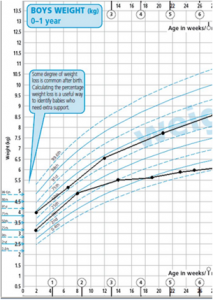
Between 37 and 42 get plotted as term.  No centiles for first 2 weeks as dip expected.  One in 5 still below birth weight at 2 weeks, only one in 50 will be 10% below or more.  Still mainly well, but suggests feeding problem worthy of further assessment, and in a few there will be an otherwise occult pathological condition eg cardiac or metabolic disorder.

Preterms get plotted on both Preterm section of chart AND day 0!  Because assessing early growth works best on day 0 centile, whereas later growth more likely to be related to preterm centile.  Plot after birth on preterm section until you hit the end (42 weeks) then continue on to main 0-1yr chart, plotting a point for calendar age but adding arrow indicating gestational age.   Otherwise unclear whether corrected or not.

Children up to age 2 get weighed without clothes or nappy.  From 2, minimal clothing and no shoes.  Height is hard! Only act on several measurements that appear consistent!

Growth Faltering and Failure to Thrive

Infants are at high risk of undernutrition – high requirements for growth, frequent infections affecting appetite and increasing requirements, inefficient metabolism, dependence on adults for food!

Faltering on growth chart

See Growth charts for details on different centile charts available.

There are various ways of defining or looking for undernutrition:

  • Wasting – ie low BMI or weight for height.  Pushed by WHO as way of identifying most vulnerable, but in affluent societies seems to mostly identify tall children
  • Stunting – low height for age, indicating chronic poor growth.  But in affluent societies, more likely to be constitutional or organic disease?  Social gradients in height in UK persisted until 1990s, but socially deprived short children had shorter parents and were smaller at birth, so not all nutritional.
  • Low weight centile – usually just selects out low birth weight babies.
  • Falling through weight centiles (“growth faltering”) selects for relatively large infants regressing to mean.

“Failure to thrive” has gone out of fashion.  “Thrive” seems to suggest something more than growth, but really we are just talking weight and height.  “Failure” suggests not only that there is a definite problem, but also that it’s somebody’s fault! Variability in definition and use.

The main issue here is poor sensitivity and specificity for a genuine problem.  27% of Danish cohort infants met one or more of 7 different growth criteria in at least one of the two age groups (2–6 and 6–11 months of life). The concurrence among the criteria was generally poor, with most children identified by only one criterion. Positive predictive values of different criteria ranged from 1% to 58%. Most single criteria identified either less than half the cases of significant undernutrition (found in 3%) or included far too many, thus having a low positive predictive value. [Olsen, Arch Dis Child 2007;92:109-114 doi:10.1136/adc.2005.080333 ]

Things get even less consistent in older kids, where you can have low fat but apparently normal growth except at the extreme end of range.

Combination of weight faltering and low BMI is perhaps best.  These kids subsequently have growth and body composition patterns suggestive of previous undernutrition.  Overall, about 2/3 of kids with either weight faltering or low BMI probably adequate nutrition but variant growth pattern.  Weight faltering kids are relatively short at follow up, but not more so than parents, so probably “catching down”. [Proceedings of the Nutrition Society. 71(4):545-55, 2012 Nov. PMID: 22954067]

Causes

Deprivation

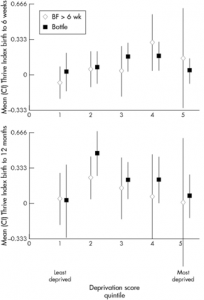
Undernutrition is NOT associated with deprivation in UK, presumably as welfare focuses on families with young children. In the Gateshead Millennium Baby Study, both the highest and the lowest levels of deprivation were associated with weight faltering; this was independent of the type of milk feeding. No relation was found with maternal educational status.

Thrive index by deprivation quintile, under 6 weeks and up to 1 yr

Abuse and neglect are a factor in only a minority of cases.

Some evidence of differences in maternal feeding behaviour and appetite, eating behaviour. In Gateshead study maternal eating restraint (“I need to control how much I eat”) was unrelated to weight gain.  Response to food refusal seems important.

In Gateshead study, infants of mothers with high depression symptom scores (EPDS >12) had significantly slower weight gain and increased rates of weight faltering up to 4 months (relative risk 2.5), especially if they came from deprived families, but by 12 months they were no different from the remainder of the cohort. [Arch Dis Child 2006;91:312-317 doi:10.1136/adc.2005.077750]

Either low appetite or actually not undernourished in strict sense!

Fussy eating

Being faddy was only weakly associated with poor growth, and simply eating a limited variety was unrelated to growth [cf high eating restriction scores]. High milk consumption was associated with lower appetite but not with poor growth.[ Pediatrics. 120(4):e1069-75, 2007 Oct. UI: 17908727]

See Fussy eating

Outcome

In Newcastle, There was a significant positive relationship between weight gain in infancy and picture vocabulary at age 10, adjusted for economic deprivation, gestational age and birthweight, but not with any of the other outcomes. There was a statistically significant association between birthweight and all four outcomes, where best outcome is at or just above average birthweight. In this population, the association between early growth and cognitive outcomes is stronger for growth before birth, postnatal weight gain having a relatively minor impact.[ Paediatr Perinat Epidemiol. 2007 Jan;21(1):57-64.]

Management

Being able to see what happens in the house at mealtimes is the most useful thing! Interventions that include home visits work best.  So Health Visitor is key.

Speech and Language, Dietician advice may be appropriate in some cases.

Identifying children with underlying medical problem important, even if these are a minority.  Similarly those with social concerns. But proportionate response to symptoms and signs important, rather than long lists of investigations.

Although tempting, high energy oral supplements eg Pedisure suppress appetite for normal food.  In series of 48 kids referred to a tertiary feeding clinic who were taking predominantly supplements (half neurodevelopmentally abnormal), most were successfully weaned off and had improved feeding behaviour a year later.  Average weight Z score unchanged, 17% had significant catch up growth. [Archives of Disease in Childhood. 100(11):1024-7, 2015 Nov. UI: 25809349]


Rickets

Acquired bone disease, due to vitamin D deficiency. In UK, mostly black and Asian children, due to dark skin and low levels of sun exposure, also diets often rich in phytates and oxalates.

More common in boys, perhaps due to higher bone mineral density.

Safeguarding concerns note uncommon.  2 deaths reported in BPSU study, multiple risk factors, rickets only diagnosed post mortem

Clinically:

  • Leg deformity (bowing or knock-knees)/Swollen wrists or knees or ankles or ribs (rachitic rosary), AND
  • 25OH vitamin D <25nmol/L PLUS one or more abnormalities of serum calcium, alkaline phosphatase, phosphate, parathyroid hormone

Else radiological Rickets:

  • Widening, cupping, splaying of metaphysis (of any long bone) AND
  • 25OH vitamin D <25nmol/L

Other clinical features:

  • Delayed motor development 
  • Pain, limp

These are strict research definitions – some cases seen with abnormal PTH and radiological features but have dietary calcium deficiency and less severe vitamin D insufficiency (between 25 and 50), these would be called nutritional rather than Vit D deficiency rickets.  There is no clear cut off below which rickets occurs!

Incidence seemed to be rising but not borne out in most recent BPSU study (2020).

Differential

  • Vitamin D dependent rickets e.g. 1α hydroxylase deficiency
  • Vitamin D resistant rickets e.g. familial or X-linked hypophosphataemic rickets
  • Rickets associated with other chronic diseases e.g. malabsorption, liver disease, chronic renal disease
  • Metabolic Bone Disease of Prematurity (infants whose corrected age is < 3 months at presentation, who were born < 36 weeks gestation and weighing <1.5kg

Complications

  • Often cow’s milk allergy seen, else these are usually breast fed babies.
  • Fractures (usually femoral) can be a clue.
  • Hypocalcaemic seizures
  • Dilated cardiomyopathy can be seen, usually in older children where bone growth is more advanced already. Worth an echo!

Evidence from BPSU study that DOH guidance on Vitamin D supplementation not being followed, either in mothers or children themselves.

Wide variation in Vitamin D treatment prescriptions. Alfa-calcidol is potentially toxic and should be avoided.