Category Archives: General paediatrics

Hypokalaemia

Could be reduced intake but usually excessive losses –

RenalNon-renal
Renal tubular acidosis (type 1 or 2)Vomiting eg pyloric stenosis
Bartters or Gitelmans syndromeDiarrhoea
DiureticsLaxative overuse
Hyperaldosteronism (CAH, tumour)Thyrotoxicosis
Salbutamol
Familial periodic paralysis
Pseudo-Bartter’s
Trauma
Diabetic ketoacidosis

Symptoms depend on severity and how rapidly decrease has happened. Chronic low levels are better tolerated. Since potassium important for membrane potentials, effects are mostly neuromuscular.

  • Cramps, weakness, paralysis
  • Ileus
  • Metabolic acidosis (although underlying cause often produces alkalosis)
  • Arrhythmia, heart failure
  • Rhabdomyolysis

ECG classically shows U waves, T wave flattening, and ST-segment changes. Can be tall wide P waves, can look like long QT if T and U waves merge.

Do urine and blood electrolytes to look at fractional excretion.

[Endocrine connections 2018][Current Treatment Options in Peds 2022]

Fragile X

Cause of developmental delay.

FMR1 gene is on X chromosome, obviously, and is a trinucleotide repeat disorder (along with Friedrich’s ataxia, myotonic dystrophy, Huntington disease etc), so inheritance is interesting.

Dads can carry gene, but only pass it on to their daughters (who will all get it).

Mums will carry gene on 1 chromosome, so sons and daughters can both get it, but 50:50 chance.

As with other trinucleotide repeat disorders, gene expands with each generation, so risk of disease increases from 1 generation to the next, and this is somewhat predictable: intermediate gene (so 45-54 copies) won’t expand to cause disease (200+ copies) in 1 generation, but premutation gene (55-199) copies probably will.

Features:

  • Moderately severe learning disability
  • Facial features – long face, midface hypoplasia, large lips and jaw, small ears
  • Macro-orchidism

Females less severely affected, of course.

Neuroblastoma

Neural crest tumours – cells that migrate to form sympathetic chain, including adrenal glands. 

Usually young children, usually already metastases at presentation – that’s because mostly vague symptoms until an abdominal mass or lymphadenopathy obvious.

Several eye related symptoms possible –

  • Dancing eyes (opsoclonus-myoclonus) a famous association – only seen in 1% of neuroblastoma but 1/3 of opsoclonus-myclonus syndrome (includes ataxia too!) have it.
  • Horner’s syndrome associated, as sympathetics (dilated pupil) run with oculomotor nerve.
  • “Panda eyes” are a rare clinical finding – proptosis, bruising – from orbital mets. 

Catecholamines are a marker but only rarely do you get symptoms eg hypertension, sweating, diarrhoea. 

Bone pain and fever are not uncommon. Otherwise depends were the mass effects are eg obstructive jaundice, dysphagia.

Investigations

GD-2 marker. Catecholamines as above.

MRI full body else MIBG scintigraphy. 

“Metastatic special” risk category – under 18 months, only skin, liver, marrow. Resolve spontaneously even when extensive!

Screening programmes in Germany and US doubled pick up rate but no change in mortality… Probably because detected more of these Metastatic special cases.

Arrhythmia

See SVT.

Adenosine 150mcg/kg? 12yr 3mg

Broad complex SVT – just treat as VT.

Cardioversion

Remove oxygen tubing for shocks unless closed circuit.

Stand clear – look at top/middle/bottom!

IM/IN ketamine plus sedation for synchronised shock.

Synchronised shocks are 1 then 2 J/kg.

Sync button needs pressed for each shock – most machines immediately reset. Press and hold – needs time to sync and give shock.

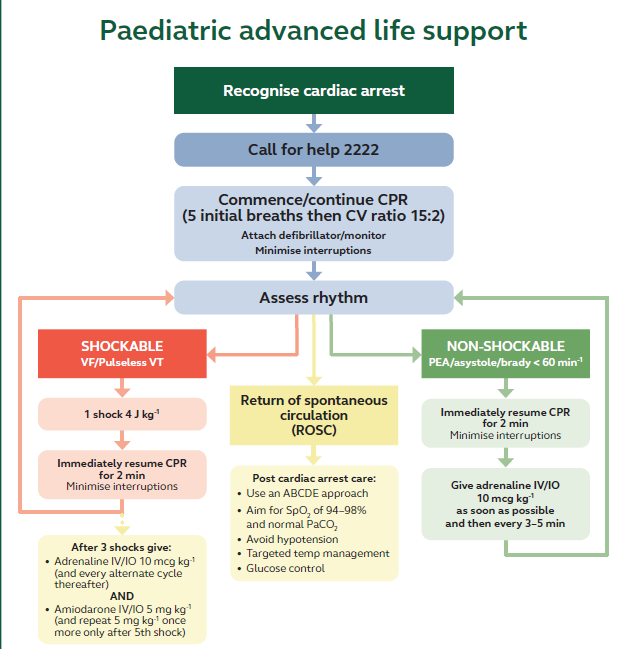
Resuscitation

UK Resuscitation council updates guidelines from time to time.

See also anaphylaxis (now 2 guidelines, basic and refractory) and arrhythmia.

Atropine not part of guideline – neonates 10mcg/kg (no minimum). Else 20mcg/kg min 100mcg. 

Out of hospital – Shout for help AND ask for an AED.  Sudden OOH collapse likely to be cardiac, even in a child – don’t wait till after rescuer breaths!

Compressions 100-120.min for both infants and children. One third depth of chest – 4cm infant, 5 child (6 adult). 1 finger breadth above xiphisternum to avoid organs. 

40% blood volume might be lost before hypotension appears…

5th centile for systolic BP is 70 at 1yr, 80 at 10, 90 at 15yr. 

Haemothorax might be picked up in B but don’t manage until C!

C – compartments of body incl long bones. 1:1 RCC:FFP

TXA – bolus, remember 2nd dose (or double bolus). 

Log roll can be missed if suspected spinal unless penetrating back wound suspected (or found on absorbent surface…)

ATMIST – age, time, 

Parents need a senior person who understands!

CT head might be better done at trauma centre…

Team Dynamics

Higher scores on teamwork were associated with faster patient defibrillation. 50% of errors in trauma resuscitation were directly related to teamwork and leadership failures. A study looking at barriers to teamwork in pediatric resuscitation highlighted leadership and communication within the resuscitation team. Integrative review (2022) highlighted the following as important for effective teamwork –

  • Interactions between team members – shared mental models, communication, co-operation, coordination, prioritization, and cognitive aids
  • Skills of the leader and team members – role allocation, information needs, situational awareness, adaptability
  • Environmental elements – Family presence, team climate, clinical standards, scene organization, and training

Allergies and School/Nursery

First do no harm – parents tend to overestimate risk of anaphylaxis, whereas there are clear consequences to restricting the child’s ability to sit with other children at snack/meal times, or restricting the food choices of other children.

Probably better to increase allergy awareness (which varies widely) than rely on classroom or school-wide bans [Dave Stukus editorial]

George Raptis has shown how allergy training can improve allergy awareness, not just confidence in managing an allergic emergency.

Rhabdomyolysis

Muscle breakdown with release of products into blood stream that can cause acute renal failure. Can be associated with compartment syndrome, disseminated intravascular coagulation.

Typically occurs with crush injuries, sometimes seen with extreme endurance sports.

Can be infectious.

Recurrent seen with fatty acid oxidation disorders and Lipin 1 mutations.

Lipin 1 mutations

Autosomal recessive – heterozygotes may have exercise induced muscle symptoms or be prone to drug induced myopathy.

Basal CK high but spikes to over 100 000 with decompensation (infection, exercise, anaesthetic).

Treat crises with carbohydrates/intralipid.

Trauma

Children are small adults, when it comes to trauma!

Mortality jumps when airway management instituted more than 45 mins after 999 call. (NICE) Mortality actually rare with isolated head (7%) and abdominal (20%) trauma. But jumps to 50% for multiple sites.

Beware head impact apnoea.

Collars not required as part of immobilisation in children. Cx spine trauma v rare. Manual in line stabilisation best if necessary. Extrication maybe?

Triage tool highlights who needs to go to trauma centre eg mangled limbs, penetrating or open trauma, mechanisms eg ejection from vehicle.  But always clinical judgement.

If “hot critical” then decide on transfer to tertiary centre within 8 minutes. Airway, catastrophic haemorrhage and move.

C-ABC is catastrophic haemorrhage first.

Access above and below diaphragm if possible. Blood first line if bleeding. 10ml/kg aliquots. 1:1:1 packed cells, FFP and platelets as able.

Tranexamic acid dose 15ml/kg (same as paracetamol!). See major haemorrhage protocol. No role for permissive hypotension in children.

Avoid over resuscitation with crystalloid.

Pelvic binder problematic if moves. Fixes greater trochanters and public symphysis.

AVPU – but specify pain response!

Head injury: 3% saline preferred. Aim for high MAP, with inotropes if necessary. GGC has guideline. Adrenaline preferred.

Agitated kid – persevere with getting them into scanner without anaesthetic! In Wishaw, induction best in theatre but would then need to go in lift!  Limited expertise with waking them up! Discuss with Scotstar, maybe move, maybe tube.

Log roll 90% out, 20% in? Conrad 2012

Traumatic cardiac arrest: in adults, evidence for aggressive treatment of reversible causes. Consensus is for bundle of simultaneous interventions (not all necessary for every case), prioritised ahead of CPR!

  • Haemorrhage control
  • ETT or equivalent
  • Bilat finger thoracostomies
  • Rapid volume replacement with warmed blood NOT thoracotomy or inotropes. Persistent low ETCO2 is poor prognostic sign.

Even if death declared out of hospital, should be admitted for after care.

NAI audit – 5.2% rate of suspected child abuse. 75% under 1 yr. Often major trauma, often severe brain injury.

Major Incident

Workload should be spread out. Over 12 should go to adults (unless lots of adults too). Walking wounded to non trauma centres. Try not to separate children from injured parents – who worst affected?

Circumcision

Still routine practice in many parts of the world, including the USA. Last figures I can find suggest 56% of US boys circumcised, with higher rates among non-Hispanic white boys, which is down from previous decades.

The Royal Dutch Medical Association declared in 2010 that male circumcision as routine practice or for religious reasons is medically unjustified and therefore an abuse of the rights of the child.

In 2013 the Children’s ombudsmen of the Nordic countries proposed a ban. In Sweden it is illegal in the first 2 months of life, following a death from complications in 2001 (an attempt at an outright ban was watered down).

In the UK there have been legal cases where parents have disagreed on their son having the procedure.

Trials in Africa suggested that circumcision might help prevent spread of HIV (38-66% reduced risk). South African president Jacob Zuma made a point of getting circumcised, to encourage others.

Risks are low in neonates cf adults.

Muslim and Jewish cultures see it as part of cultural identity, of course.