Category Archives: OPD

Sleep

Poor sleep associated with hyperactivity, obesity, poor school performance, depression.  And affects parents, of course!  Caffeine and Propranolol (as used for migraine prophylaxis) affect sleep!

Normal sleep

REM (rapid eye movement) phase is light sleep. Usually in later part of night after deep sleep.  Slow wave (deep) sleep is associated with increased anabolic hormone release, mitotic repair. Higher proportion of sleep in adolescence is slow wave.  60% of newborn sleep is REM.

Recommended sleep duration: [National Sleep Foundation]

  • Newborn 0-3 months: 14-17 hours
  • Infants 4-12 months: 12-15 hours
  • 1-2yrs: 11-14 hours
  • Preschool 3-5yrs: 10-13 hours
  • School age 6-13yrs: 9-11 hours
  • Teenagers 14+: 8-10 hours

Some sources suggest adolescents have increased sleep requirements.

Late insomnia (early morning waking) in depression. Cf early – mood disorders, anxiety (cortisol vs melatonin).

30 mins high intensity exercise is as good as melatonin. But ideally 3hrs before bed time!?

Sleep latency 19 min under 2yrs, 17-19 mins thereafter.

Night wakenings are normal! But parental response varies!

Excessive sweating seen in 11% of children, so considered normal. But beware weight loss, lethargy!  Can also be associated with obstructive sleep apnoea.

Sleep problems

For infants not going to sleep, options are extinction vs gradual retreat. Not appropriate for under 6/12 of age as may affect bonding. No adverse effects otherwise.

Melatonin does not increase total sleep time! Helps prepare brain for sleep – does not induce sleep, as such.  Earlier waking as well!

Nocturnal seizures – stereotyped, multiple in one night, sudden stop and start, mostly after first third of sleep.  Seen in BECTS.

Restless legs associated with iron deficiency!

Benign nocturnal leg pain common in children.

Teenagers generally do have different body clock, but not helped by major changes in bed/wake times at the weekend. Blue light from screens suppresses natural melatonin production besides distraction.

For autism – Hope for autism do not need diagnosis, others do. Waiting times? National Autistic Society page. Arch, Reach websites.

CAMHS won’t prescribe melatonin but do prescribe methylphenidate!?

Bio melatonin 3x the price, not approved by SMC. Modified release melatonin may be useful with or without standard if early waking in night.

Parasomnias

In early part of night, likely to be non REM, cf later in night.

Classic non REM =

  • Confusional arousal – can appear fully awake but don’t make much sense, no recollection in morning.
  • Sleep walking – quite complex behaviours possible (riding a motorcycle!)
  • Sleep terror – worse for partner/parents, as rarely remembered

REM related =

  • REM sleep behaviour disorder – typically violent, dream can often be remembered, can escalate. Can be sexual.
  • Sleep paralysis – up to several minutes, usually terrifying (“like being dead”), often with hallucinations.

Sleep hygiene, then consider melatonin and CBT (stress often provokes non-REM). Benzodiazepines can help non REM but can worsen REM.

Beware Narcolepsy – poor sleep quality at night, then daytime somnolence, plus hypnagogic/hypnapompic hallucinations, sleep paralysis, cataplexy (laughing causes collapse). Genetic, treatable with stimulants.

Support

Growth Charts

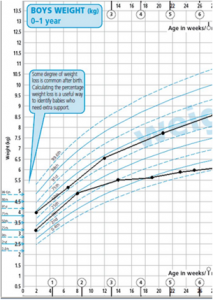
Current charts are UK-WHO, which is to say a combination of UK growth cohorts with world wide cohorts.  This is to correct for the low prevalence of breast feeding and high prevalence of obesity in the UK, and assumes that there is little genetic differences in growth.

Downloads and online growth tool at RCPCH.

Usage Tips

Between 37 and 42 get plotted as term.  No centiles for first 2 weeks as dip expected.  One in 5 still below birth weight at 2 weeks, only one in 50 will be 10% below or more.  Still mainly well, but suggests feeding problem worthy of further assessment, and in a few there will be an otherwise occult pathological condition eg cardiac or metabolic disorder.

Preterms get plotted on both Preterm section of chart AND day 0!  Because assessing early growth works best on day 0 centile, whereas later growth more likely to be related to preterm centile.  Plot after birth on preterm section until you hit the end (42 weeks) then continue on to main 0-1yr chart, plotting a point for calendar age but adding arrow indicating gestational age.   Otherwise unclear whether corrected or not.

Children up to age 2 get weighed without clothes or nappy.  From 2, minimal clothing and no shoes.  Height is hard! Only act on several measurements that appear consistent!

Growth Faltering and Failure to Thrive

Infants are at high risk of undernutrition – high requirements for growth, frequent infections affecting appetite and increasing requirements, inefficient metabolism, dependence on adults for food!

Faltering on growth chart

See Growth charts for details on different centile charts available.

There are various ways of defining or looking for undernutrition:

  • Wasting – ie low BMI or weight for height.  Pushed by WHO as way of identifying most vulnerable, but in affluent societies seems to mostly identify tall children
  • Stunting – low height for age, indicating chronic poor growth.  But in affluent societies, more likely to be constitutional or organic disease?  Social gradients in height in UK persisted until 1990s, but socially deprived short children had shorter parents and were smaller at birth, so not all nutritional.
  • Low weight centile – usually just selects out low birth weight babies.
  • Falling through weight centiles (“growth faltering”) selects for relatively large infants regressing to mean.

“Failure to thrive” has gone out of fashion.  “Thrive” seems to suggest something more than growth, but really we are just talking weight and height.  “Failure” suggests not only that there is a definite problem, but also that it’s somebody’s fault! Variability in definition and use.

The main issue here is poor sensitivity and specificity for a genuine problem.  27% of Danish cohort infants met one or more of 7 different growth criteria in at least one of the two age groups (2–6 and 6–11 months of life). The concurrence among the criteria was generally poor, with most children identified by only one criterion. Positive predictive values of different criteria ranged from 1% to 58%. Most single criteria identified either less than half the cases of significant undernutrition (found in 3%) or included far too many, thus having a low positive predictive value. [Olsen, Arch Dis Child 2007;92:109-114 doi:10.1136/adc.2005.080333 ]

Things get even less consistent in older kids, where you can have low fat but apparently normal growth except at the extreme end of range.

Combination of weight faltering and low BMI is perhaps best.  These kids subsequently have growth and body composition patterns suggestive of previous undernutrition.  Overall, about 2/3 of kids with either weight faltering or low BMI probably adequate nutrition but variant growth pattern.  Weight faltering kids are relatively short at follow up, but not more so than parents, so probably “catching down”. [Proceedings of the Nutrition Society. 71(4):545-55, 2012 Nov. PMID: 22954067]

Causes

Deprivation

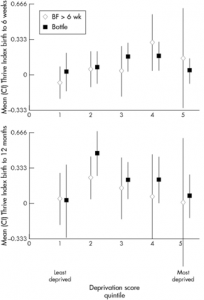
Undernutrition is NOT associated with deprivation in UK, presumably as welfare focuses on families with young children. In the Gateshead Millennium Baby Study, both the highest and the lowest levels of deprivation were associated with weight faltering; this was independent of the type of milk feeding. No relation was found with maternal educational status.

Thrive index by deprivation quintile, under 6 weeks and up to 1 yr

Abuse and neglect are a factor in only a minority of cases.

Some evidence of differences in maternal feeding behaviour and appetite, eating behaviour. In Gateshead study maternal eating restraint (“I need to control how much I eat”) was unrelated to weight gain.  Response to food refusal seems important.

In Gateshead study, infants of mothers with high depression symptom scores (EPDS >12) had significantly slower weight gain and increased rates of weight faltering up to 4 months (relative risk 2.5), especially if they came from deprived families, but by 12 months they were no different from the remainder of the cohort. [Arch Dis Child 2006;91:312-317 doi:10.1136/adc.2005.077750]

Either low appetite or actually not undernourished in strict sense!

Fussy eating

Being faddy was only weakly associated with poor growth, and simply eating a limited variety was unrelated to growth [cf high eating restriction scores]. High milk consumption was associated with lower appetite but not with poor growth.[ Pediatrics. 120(4):e1069-75, 2007 Oct. UI: 17908727]

See Fussy eating

Outcome

In Newcastle, There was a significant positive relationship between weight gain in infancy and picture vocabulary at age 10, adjusted for economic deprivation, gestational age and birthweight, but not with any of the other outcomes. There was a statistically significant association between birthweight and all four outcomes, where best outcome is at or just above average birthweight. In this population, the association between early growth and cognitive outcomes is stronger for growth before birth, postnatal weight gain having a relatively minor impact.[ Paediatr Perinat Epidemiol. 2007 Jan;21(1):57-64.]

Management

Being able to see what happens in the house at mealtimes is the most useful thing! Interventions that include home visits work best.  So Health Visitor is key.

Speech and Language, Dietician advice may be appropriate in some cases.

Identifying children with underlying medical problem important, even if these are a minority.  Similarly those with social concerns. But proportionate response to symptoms and signs important, rather than long lists of investigations.

Although tempting, high energy oral supplements eg Pedisure suppress appetite for normal food.  In series of 48 kids referred to a tertiary feeding clinic who were taking predominantly supplements (half neurodevelopmentally abnormal), most were successfully weaned off and had improved feeding behaviour a year later.  Average weight Z score unchanged, 17% had significant catch up growth. [Archives of Disease in Childhood. 100(11):1024-7, 2015 Nov. UI: 25809349]


Episodic autonomic symptoms

Renal investigations

Ultrasound

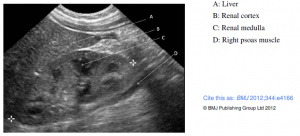
Renal uss image anotated

Incomplete bladder emptying cannot be diagnosed on a single post-void residual urine on ultrasound, due to significant intra-individual variability. Two post-void residual urine tests are recommended; larger volumes are seen if the bladder has been over distended (eg initial volume greater than 115% of expected), and in younger children. Greater than 20 ml is more specific than 10% bladder capacity. [J urology 2009 (182):1933]

Bladder capacity is = (Age +1) x 30 (ml) max 390ml.


Hair loss

  • Tinea capitis – “ringworm”, actually fungal.  Scalp abnormal.
  • Telogen effluvium – lots of hair shed all at the same time following some sort of trigger esp birth (both baby and mother can be affected!), infection.  Trigger usually 2-3 months preceding.  Clumps or general thinning, underlying scalp healthy.
  • Alopecia areata
  • Trichotillomania

On Examination

Exclamation mark hairs (thin proximally, at scalp, normal distally) suggest alopecia areata, but may be seen in trichotillomania, so not very predictive.

Pull test – gentle traction on about 20 (some people say 60) hairs in 3 different locations.  Positive if more than 3-5 hairs extracted – confirms active hair loss but not very specific. Usually telogen effluvium but can be early alopecia areata. 

Dyspraxia, or Developmental Coordination Disorder (DCD)

Developmental Co- ordination Disorder (DCD), as outlined in DSM IV (American Psychiatric Association 1994):

  • Performance in daily living activities that required motor co-ordination is substantially below that expected given the person’s chronological age and measured intelligence. This may be manifested in delays in achieving motor milestones (i.e. walking, crawling, sitting) dropping things, ‘clumsiness’.  Significantly interferes with academic achievement or activities of daily living.
  • The disturbance is not due to a general medical condition (e.g. Cerebral Palsy, Hemiplegia or Muscular Dystrophy), and does not meet the criteria for a pervasive Developmental disorder.
  • If Global Learning Difficulties are present the motor difficulties are in excess of those associated with it.

It is essential that early referral is made in order that children do not develop behavioural difficulties due to their frustration at not being able to carry out the same tasks as their peers.

Clues are:

  • Does the child’s motor skill appear to be behind their cognitive skills?
  • Dose the child appear to move generally in an uncoordinated way i.e. walking, running, manoeuvring around objects?
  • Does the child fall over constantly, bump into things, and /or knock thing over?
  • Has the child developed a dominant hand i.e. does he/she prefer to use one hand for more tasks?
  • Does the child have difficulties with dressing especially organising themselves? Do they find laces, small fastening and cutlery difficult?
  • What is their attention span like? Are they always fidgeting or squirming?
  • Are they having significant difficulties in the classroom in relation to their peer e.g. poor behaviour, avoidance of tasks, poor handwriting, dislikes gym?

N.B  Most children in their early school years will demonstrate one (or more) of these areas of difficulty but this does not mean they all have DCD!  Children with DCD will present with many of the difficulties above for a prolonged period.

Tic Disorders and Tourette Syndrome

Tics are recurrent, sudden, non-rhythmic twitches. Can be in 1 muscle or muscle group, but can also be a more complex semi-purposeful movement, or even present as a bizarre gait. Typically affect face (eg blinking, grimacing), neck, shoulder.  Can be more complex sequences of movements. Characteristics are:

  • Tend to be situational, with stress making them worse.
  • Initially they are suppressible, although depending on the situation this suppression can be virtually effortless! Usually though, suppression leads to rising anxiety and then a rebound in frequency.
  • There is often a premonitory feeling.
  • They can be suggestible.

Differential includes stereotypy, spasms, chorea.

Although tics can wax and wane over time, there is a general tendency to improve, and they are very unusual in adulthood.

Tics occur most commonly in boys. Usually they are transient, lasting for between 4 weeks and 1 year. A chronic tic disorder does exist distinct from Tourettes.

Vocal tics (clearing throat, yelps, coughs, sniffs, grunts) can occur in isolation, but a combination of vocal and motor tics suggests Tourette’s syndrome.

Tourette’s syndrome

Thought to affect 1% of children, so probably a lot subclinical! An inherited neuropsychiatric condition, it starts at a mean age of 7 but can be as young as 2yrs. Motor tics come first, about a year before vocal tics. Complex vocal tics may be seen but contrary to public understanding, most kids do not swear (coprolalia)!

Definition requires that motor and vocal/phonic tics are present (at some point) for at least a year, on a daily basis, with onset prior to 18yrs, in absence of substance misuse, medical condition or medication.  The characteristic features of Tourette’s are:

  • Echolalia – repeating phrases
  • Palilalia – repeating other people’s words
  • Coprolalia – swearing or abusive language. Involuntary, and causes distress to the patient, who will often try to conceal the outburst by coughing, etc.
  • Copropraxia – making obscene gestures
  • Palipraxia – imitating other people’s gestures

Tics wax and wane, evolve over months.  Can be self harming eg scratching, rubbing, head banging, punching, poking, stabbing oneself (see also obsessive compulsive co-morbidity below).

In some patients, there is a non-obscene compulsion to shout socially inappropriate things (NOSI).  Often worsens around puberty. 50% abate after puberty, but mostly just better self-management?

Differential is basal ganglia or cerebellar abnormality eg post-encephalitis, Huntingtons.  Investigations only necessary where unusual deterioration or progression of symptoms.

Co-morbidity

Pure tic disorder is unusual in Tourettes. 85% have comorbidity, most commonly:

  • Obsessive Compulsive Disorder/Behaviour – less to do with cleanliness, more sexual/religious/violent themes, orderliness, symmetry, checking, counting, forced touching.
  • Self-injurious behaviour is well described (see above)
  • ADHD
  • Conduct disorder, affective disorders more rarely.

The comorbidities are often more significant on school performance than the tics.  Comorbidities are common in relatives, even if tics are not.

Treatment

Counselling is useful for self-esteem, anger management, and social functioning. Habit Reversal Training is effective but not widely available – officially 12 weekly hour sessions, need to recognize premonitory urges and then replace tic with controlled movement, or position self to prevent tic (eg chin on chest to prevent shouting).

Drug treatment may be considered eg self harming, but not much evidence for effectiveness.  Traditional or atypical neuroleptics, or clonidine (esp where behaviour or sleep problems) used.

Deep brain stimulation being researched.

Prognosis

Tic frequency and severity decline with age in a large proportion of patients (59–85%).

Predictors of NOT improving include higher childhood tic severity, smaller caudate volumes and poorer fine motor control.

The presence of untreated comorbid psychopathology, such as ADHD and OCD, can adversely affect the long-term outcome of patients with TS.[Funct Neurol. 2012 Jan-Mar; 27(1): 23–27. ]

Tourettes Action parent support group.

[Stern, Curr Peds 2006:16:459]

Haematuria

In a study of 342 kids with asymptomatic microscopic haematuria, no cause was found in the large majority of patients. The most common cause discovered was hypercalciuria (16% of patients) followed by post–streptococcal glomerulonephritis (1%). No evidence for value of early detection of hypercalciuria (may be at long-term risk for nephrolithiasis and bone demineralization).  The children with asymptomatic post–streptococcal glomerulonephritis all improved spontaneously and without complication.  None had evidence of urinary tract infection! Clinically insignificant abnormalities in the upper urinary tracts of 5 children and grade 3 reflux in 1  [Arch Pediatr Adolesc Med. 2005;159(4):353-355. doi:10.1001/archpedi.159.4.353]

Asympt recurrent can be monitored for 5yr!

Beware:

  • frank blood,
  • protein,
  • hypertension,
  • other features (joints, rash, wt loss)

Haematuria defined as persistent dipstick positive on at least 3 occasions for at least 3 months. Else as >2rbc per HPF (not same as flow cytometry). Then consider:

  • Red cells or not?
    • myoglobinuria = haemolysis
    • beetroot!
    • Porphyrins, other unusual pigments
  • Proteinuria or not?

If spot urine abnormal, repeat on early morning urine and then proceed to 12-14hr collection. Urine calcium/creatinine has age specific normals, high at birth (up to 1.5 in toddlers) falling to adult max of 0.7 at age 7. High levels especially significant in the presence of a normal plasma calcium

Investigations – only do bloods if macroscopic or nephritis suspected:

  • Do urine culture and microscopy.
  • Do PCR if proteinuria.
  • If macroscopic, do FBC, U&Es, LFTs, Coag.
  • Renal USS
  • Screen family members with urinalysis
  • Spot urine calcium/creatinine
  • If acute nephritis, do C3/4, ASOT, immunoglobulins, ANCA, anti GBM as below.
  • If stones suspected, do 2 sets of spot urine Ca/creat, Oxalate/creat, Urate, amino & organic acids, pH, KUB.

Differential is:

  • Tumour – bladder (colour changes during voiding, dysuria with sterile culture) or kidney
  • IgA nephropathy – persistent, progressive in 30%, diagnosis on biopsy
  • Alports – usually X dominant, deafness in minority, cataracts in 10%
  • Sickle cell – 1% macroscopic, 16% microscopic. Papillary necrosis, usually painless, episodic. May progress to sickle nephropathy.
  • Venous thrombosis – esp neonates, nephrotics.
  • Vascular – AVM, Nutcracker syndrome (compression of the left renal vein between the abdominal aorta and SMA)
  • Nail-patella syndrome (BM disorder, like Alports)
  • Polycystic Kidney Disease

Biopsy if persistent high grade microscopic, or microscopic with proteinuria (>150 mg/24 hr)/hypertension/impaired renal function, or 2 episodes of gross haematuria. Cystoscopy for bladder problem.

Colic = Cry-Fuss Behaviour

Cry-fuss behaviour (=colic etc), mean is just short of 2hrs per day for first 6 weeks, reduces to 72 minutes by 10-12 weeks.

“Colic” suggests that there is a bowel issue, usually suspected due to drawing legs up, passing wind – but these could be considered normal for crying and distress, of any cause.  Reflux (GORD) is often blamed, yet international consensus states there is no evidence to support an empiric trial of acid suppression as a diagnostic test in infants and young children, even though symptoms tend to be less specific [Vandenplas, J Pediatr Gastroenterol Nutr. 2009 Oct;49(4):498-547. doi: 10.1097/MPG.0b013e3181b7f563]!

Cause

Mums with an anxiety disorder prior to pregnancy are at higher risk of having a child with excessive crying at 2, 4 or 16 months postpartum compared with mothers without an anxiety disorder.  Risk increased further for mothers who developed an anxiety disorder during pregnancy.

So does maternal anxiety lead to “intrusive” parenting, in turn increasing infant crying ?[Arch Dis Child 2014;99:800–6]. Else fetal programming?  Genetics?

What’s the influence of fathers!?

Surprisingly, maternal depressive disorders, cf anxiety, experienced before or during pregnancy, did not predict maternal report of excessive infant crying.  Is the difference withdrawal, rather than intrusiveness?

Reflux

Consider 2 week trial of anti-secretory eg ranitidine (but NOT PPI – increase risk of infection esp respiratory and GI, associated with parietal cell hyperplasia, and possibly food allergy!).  But don’t assume improvement due to response!  Or investigate with pH monitoring.  Or stick to supporting parents!   Even if arching and refusing to feed, no evidence of effectiveness.

Infection

5% have UTI retrospectively, but in absence of other signs, investigations not routinely required.

Associations

Crying that lasts more than 3 h per day, for more than 3 days per week and for more than 3 weeks in a row—is associated with child abuse and maternal depression!  Higher scores on PND scale persists at 6/12 even if crying resolves…

6% of parents retrospectively admit physically abusive behaviours towards baby when crying.

Predicts shorter duration of breast feeding.

Persistent problems with cry-fuss behaviour at 5/12 associated with later behavioural problems (metanalysis, but confounded by psychosocial risk factors).

Management

Reassure the parents/carers that infantile colic is a common problem that should resolve by 6 months of age.

RCTs of behavioural sleep intervention under 3/12 did not decrease crying.  So encourage parent-infant reciprocity (ie responding to crying) until old enough to suit Gina Ford type regimented sleep regimes.

Encourage the parents to try relaxed cue based care, sleeping in the same room as the baby (not the same bed – beware SUDI) , offering physical contact esp skin to skin contact, and ensuring the baby gets lots of rich sensory experiences during the day.  This,  combined with average 10 hours of physical contact per 24hr (even if asleep), associated with 50% less crying and fussing. Only 37% of 3/12 babies sleep 8hrs straight at night.

Night waking is associated with co-sleeping and breast feeding, but breast feeding does not equate with less total sleep for parents over the whole 24hr period (quality, however, may be inferior).

Over sensitive babies may benefit from OT/Physio, but beware removing sensory stimulus as associated with neurodevelopmental problems.  Massage, wrapping may help, little evidence for chiropractic, craniosacral, nutritional.  Offer diverse sensory stimulation (through parents’ own social life and activities).

If symptoms are severe (subjective, of course) or persist after 4 months, consider an alternative underlying cause for symptoms.

NICE says seek specialist advice from a paediatrician if infant is not thriving, or symptoms are not starting to improve or are worsening after 4 months of age.

Caveat for GPs is “Seek specialist advice if Parents/carers feel unable to cope with the infant’s symptoms despite reassurance and advice in primary care.”


Feeding

Feed refusal is often linked, often impaired mutual regulation of feeding that result in entrenched patterns of difficult feeding esp breast feeding issues.

The following suggest a feeding problem –

  • 4 heavy disposable nappies per day minimum
  • 3-4 yellow curdy stools if breast fed minimum
  • Nipple/breast pain, attachment problems
  • falling asleep within 10 minutes, feeding longer than 30 minutes (active feeding ie not including dozing, interacting) regularly
  • clicking sound, gurgly sounds, absence of swallowing sounds
  • Increased resp effort

Expect 125g per week growth average in first 3 months.  Tongue tie only really relevant to breast feeding babies.

Babies who have infrequent large feeds are not necessarily abnormal, and cue based feeding rather than scheduled 3-4hrly feeds often works better.

So offer feed calmly, unless already full blown crying, in which case calm holding eg skin to skin until more settled.  Cochrane review concluded that pacifier use does not interfere with breast feeding in mothers who are motivated.

Some evidence for trial of hydrolysed formula. RCT of 107 breast fed babies with colic excluded dairy, soy, wheat, nuts, fish and shortened duration of crying, but only CMPI really substantiated.  Probiotic has helped in RCT but roles of feed management, lactose overload etc need to be elucidated first?

Functional lactose overload? – as feed progresses, fat level usually increases so transit time slows.  If insufficient fat, rapid transit leads to lactose fermentation in colon (lower cholecystokinin levels seen).

Parent Support

The self-help support group Cry-sis for families with excessively crying or sleepless children, has a website and runs a national telephone helpline (0845 122 8669).

There’s also parent info including a video at http://www.nhs.uk/Conditions/Colic/Pages/Introduction.aspx


[https://cks.nice.org.uk/colic-infantile#!scenario]

[Clinical review BMJ 2011;343:d7772  doi: http://dx.doi.org/10.1136/bmj.d7772]