Category Archives: General paediatrics

Pyloric Stenosis

Pylorus is the name of the outflow tract of the stomach, the muscle in the wall controls how quickly the stomach empties.

For some reason, this muscle can become hypertrophied in the first month or two of life, to the point that the baby begins to vomit with feeds, become dehydrated and lose weight. Remains hungry of course, which may not be the case with some of the differentials.

The vomit is non-bilious of course, as the obstruction is above the bile duct.

4 male:1 female. Less common in black/Asian groups. Maternal history is more significant than paternal! NB Associated with TOF, other abnormalities. Associated with erythromycin use in infancy, particularly in first 14 days of life.

1st week to 5 months, but usually after 3 weeks. Only 6% present within 14 days of life – increasing proportion over time? (Even before US available) More likely to have family history?

Preterm babies make up only 3% of cases, and symptoms/signs tend to be less dramatic. Unclear whether USS criteria (below) are valid for preterms. [Arch Peds Adol Med 1996]

Diagnosis

Peristalsis may be visible through abdominal wall. Olive shaped mass (2 cm diameter) felt RUQ just lateral to midline, under liver (sit on left side), after vomit.

When well established vomiting, hypochloraemic, hypokalaemic alkalosis characteristic (but not 100% specific).

On ultrasound scan, muscle thickness more than 3mm, transverse pyloric diameter more than 14mm (length similarly) – ie 3.14 (Pi, the mathematical constant)! [radiopaedia]

Differential diagnosis = reflux, sepsis, cow’s milk intolerance, other surgical condition eg malrotation, raised intracranial pressure, Congenital Adrenal Hyperplasia, biochemical imbalance eg renal tubular acidosis, inborn error of metabolism etc.

Treatment

Surgical pyloromyotomy (Ramstedt’s)- usually laparascopic. Quite a minor procedure, since the muscle is incised and then left to heal without any need to enter bowel itself or repair anything.

Infantile spasms

Range of different shudders and twitches seen in babies and infants. Shudders and stereotypy can be dramatic, self stimulating behaviours, many kinds! Esp at 6-9/12, triggered by excitement but can also be boredom! So context important.  Can have a few together, but cluster would suggest epileptic.  Looks well. 

Differential is myoclonus, spasms (where at start may appear neurologically normal).

Infantile spasms are easy when classic, but are often atypical so can be difficult! 90% present before age 1, typically 3-7 months. Usually followed by upset so often confused with colic. Mostly when awake, arousal. Clusters of synchronous flexor spasms, usually of legs but possibly of head on torso. Definition is 0.5-2secs, so longer than jerk, some people think of an initial fast contraction followed by slower phase. Salaam attack is flexion of head and legs plus adduction of arms into midline. Rarely extensor, or mixed flexion of trunk and extension of limbs. Subtle presentations may just be chin. Can be unilateral.

Needs EEG to be sure, and even sleep EEG at that.  Low threshold since urgent treatment required.

Making diagnosis is urgent, as better initial control (in those without underlying aetiology) seem to have better developmental outcome). 

West syndrome – described by neurologist in his own son. Combination of spasms, developmental regression and hypsarrhythmia (see below). May initially be developmentally normal, become less visually attentive.  Flexion of head and trunk, arms extend/flex, abduct/adduct (can be asymmetrical if underlying hemiplegia).  Briefly upset or dazed, may be grimace.  On waking or falling asleep. Various Youtube videos available.

Rarely metabolic (consider PKU, Menkes, molybendum cofactors along with others). More often structural esp tuberosclerosis (TS – about 70% ) but also lissencephaly. Can be acquired eg post meningitis or congenital infection. Associated with Downs syndrome (actually more responsive to treatment).  Do Woods lamp and genetics. 20% cryptogenic.

Investigations

EEG by definition is abnormal, but in early phase standard awake EEG may be normal so consider sleep EEG.  Classical hypsarrhythmia in 50-70% = chaotic, high voltage.  But can be asymmetric.  If structural lesion, may be burst suppression (sudden high voltage then brief flattening) or focal features.

Treatment

ICISS (2016) showed combination of steroids and vigabatrin superior to either alone. High doses of both needed. ACTH or prednisolone at prescriber’s discretion (ACTH is alternate day injection, expensive). 

Visual field loss with vigabatrin is seen in adults on long term treatment.  Weaned as soon as possible. Side effects with both common, esp infection. 

Not yet clear if resolution of EEG findings important. Spasms settle by mid-childhood as neurodevelopmental delay evolves, most develop other epilepsy eg Lennox Gastaut. Treatment is often difficult, and most children do not have a good neurological outcome (with or without underlying brain disorder). [Cochrane Rev. PMID: 18843624]

Remember to avoid live vaccines after high dose steroids, varicella prophylaxis.

Mechanism for steroids not understood!

Hyper IgE Syndrome

This is a rare, autosomal dominant (sporadic) immunodeficiency characterized by:

  • recurrent staphylococcal skin infections (cold abscesses)
  • lung infections causing pneumatocoeles, which then invite aspergillomas
  • mucocutaneous candidiasis
  • eczema, eosinophilia and high IgE

PLUS bony abnormalities:

  • osteopenia and spontaneous bone fractures
  • dysmorphism: triangular jaw, wide nose, asymmetrical face
  • dental abnormalities eg retained primary
  • hyperflexibility and scoliosis

Also called Job’s (because of the Bible story, smitten by boils etc, but could equally have been CGD!) or Buckley syndrome.

Caused by STAT3 defect, part of IL6 receptor. Not actually an immunoglobulin problem! Not to be confused with Hyper IgM syndrome. But if antibiotic prophylaxis is ineffective, IVIG is sometimes used.

An autosomal recessive form without the bone abnormalities but with vasculitis esp CNS involvement described.

Short Stature

Are they really? Plot height and weight, and check figures if in doubt!

Investigate if:

  • Severe short stature = height below the 0.4th centile
  • Height more than 2 centile spaces below the mid-parental height
  • Downwards crossing of more than 1 height centile in 1 year, in a child aged 2 years or over

Is there evidence of chronic disease? Needs full history and examination, including urine dip. Common things would be renal failure, coeliac disease, IBD, hypothyroidism. Endocrine causes tend to produce relatively heavy children, other chronic diseases tend to produce relatively slight children.

Brain tumour symptoms?

Are they dysmorphic? Is one parent dysmorphic? Main syndromes to look out for:

  • Turners – besides short stature, webbed neck, characteristic facies, short metacarpals, broad chest with widely spaced nipples, hyperconvex fingernails and toenails (but can be missed); decreased growth velocity and delayed puberty
  • Short limbs – SHOX mutations eg Leri-Weill dyschrondeostosis but milder variants. Classically mesomelia (short proximal bones) and Madelung deformity (wrist) but these may only become obvious in later childhood.
  • Achondroplasia or hypochondroplasia (FGFR3 (Fibroblast Growth Factor Receptor 3) mutations)

Bone age will be delayed in all except familial and idiopathic. Progressively falls behind in endocrine disorders.

Causes

Constitutional delay – good weight at birth, then “catch down” growth, dropping through centiles in infancy. Growth velocity is then normal, but with delayed bone age and delayed puberty.

Small for gestational age babies tend to catch up in first few years of life with their genetic potential, but can take up 4 years or more. 10% however remain small (more than 2 SDs below MPH) through life. Consider other causes if no catch up in first 6 months of life or still small at 2 years.

Growth hormone deficiency – can be congenital or acquired (head injury, meningitis etc). Early growth tends to be normal (growth hormone doesn’t contribute much in first few years of life). Look for hypoglycaemia in neonatal period, microphallus, midline facial abnormalities.

Investigations

  • Karyotype if dysmorphic or if girl
  • TFTs
  • IGF1 – screening test for Growth hormone problems, but may need GH stimulation testing as limited reference ranges in under 2s
  • FBC, U&Es, LFTs, Vit D, Ferritin
  • TTG antibody
  • LH/FSH, testosterone, oestradiol if pubertal signs
  • Urinalysis
  • Bone age if thinking constitutional
[SPEG Guideline]

Rumination

A functional gastrointestinal problem, where food or other stomach contents effortlessly comes up into the mouth, where it is either then vomited, spat or swallowed. Odour may be a clue.

Diagnosis is on history, but often misdiagnosed as reflux (and resistant to reflux treatment). Typically no nausea, no nocturnal symptoms, no dysphagia but these do not necessarily exclude the diagnosis.

Treatment is diaphragmatic breathing! Baclofen has been used.

Rome IV criteria. Beware eating disorder.

Galactosaemia

Actually 3 different gene defects possible, most commonly Galactose-1-Phosphate uridyl transferase deficiency (GALT, or Gal-1-PUT). The others have different phenotypes.

Presents in the newborn period after initiation of milk feeding, most commonly with jaundice, which can be unconjugated in first week but becomes conjugated thereafter. The other features listed below are seen in only a minority:

  • Vomiting,
  • poor feeding
  • Hypotonia
  • Hepatomegaly
  • Encephalopathy
  • Cataract – can be present at birth, but more usually after a week or two.
  • Sepsis – esp E coli septicaemia

Lab findings include hypoglycaemia, deranged LFTs, coagulopathy, metabolic acidosis, abnormal urine aminoacid excretion. Urine for reducing substances is not sensitive or specific. The definitive test is RBC Gal-1-PUT activity, but if a transfusion has been given alternatives are genotyping or testing the parents for carrier status.

Management is by diet. Nonetheless, neuropsych problems usually develop in adolescence and ovarian failure often occurs. Some debate about whether galactose can be tolerated from age 2-3yr.

Prolonged Jaundice

Physiological is because Long chain FAs in breast milk compete with Glucuronyl transferase! Dehydration and poor feeding contribute (jaundice FOLLOWS, does not cause). But can also be seen in bottle fed babies.

Prolonged jaundice defined as 21/7 if well, term according to American Academy of Pediatrics. After that, investigation probably appropriate.

Unconjugated vs Conjugated bilirubin is important – do direct bilirubin. Conj bili >20 may indicate significant disease, esp if unconj not high. Low albumin suggests prenatal onset.

Unconjugated

  • Haemolysis (so liver function tests normal): eg rhesus disease (diagnosis: Direct Coombs Test Positive), ABO, irregular antibodies (Kell, Duffy; varying significance), hereditary sphero/elliptocytosis, G6PD deficiency, DIC. G6PD in baby can be precipitated by maternal drugs/infection. Enzyme assay false negative because of high retic count, so test mother for carrier status.
  • Crigler Najjar is unconjugated. Uridine Di Phos Glucuronyl transferase deficiency (Dubin Johson/Rotor only present >2 yr). Recessive form is severe, assoc with kernicterus; dominant can be treated with phenobarb.
  • Hypothyroidism
  • Galactosaemia – in the first week of life can be unconjugated but always features liver dysfunction cf Crigler Najjar so unlikely to be any confusion.

Conjugated

Suggests hepatitis. Note that Alk phos in normal neonates is often high in isolation. See BSPGHAN protocol.

  • Congenital Biliary Atresia
  • Choledochal cyst: assoc with East Asians, PKD (Caroli’s disease). Cystic mass below liver. Can rupture and cause ascites, cause obstruction +/or cholangitis. Late carcinoma risk.
  • Spont CBD perforation – discoloured umbilicus, paracentesis diagnostic. Rx Surg
  • Gallstones – possible!
  • Congenital viral infection (TORCH), enteroviruses (esp ECHO, assoc with fulminant hepatitis), sepsis (eg UTI, listeria assoc with hepatic abscesses).
  • Cystic fibrosis and bile plug syndrome
  • Inherited Metabolic Disorders: galactosaemia, Zellweger’s, haemochromatosis, etc.
  • Alpha -1 antitrypsin deficiency
  • Alagille’s syndrome
  • Endocrine disorders: congenital hypothyroidism (1 in 60 000), pituitary/adrenal underactivity.

Biliary atresia

Wasting of biliary tree +/- gall bladder in early months of life (LANDING’s theory). Premature babies get it less (as wasting hasn’t progressed as much) but can still get it!

Stool colour chart

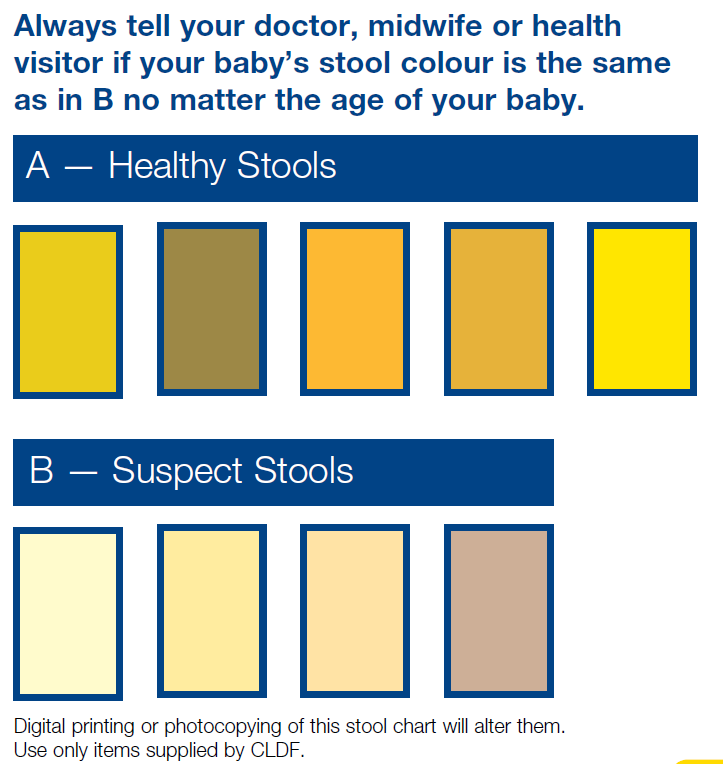
Presents with prolonged jaundice. Dark urine, pale (white!) stools distinguish it from common, benign breast feeding jaundice, but often missed. Parental reporting of stool/urine colour is unreliable! Stool colour chart available from Children’s Liver Disease Foundation.

Normally distal but 20% proximal.

Associated with SPLENIC MALFORMATION syndrome (poly or asplenia, situs inversus, malrotation, absent IVC).

Lanarkshire incidence 1.26 per 10 000, significantly higher than rest of Scotland!  NO evidence of genetic factors.  Pigweed in pregnant ewes in Australia – “biliatresone” toxin. Industrial waste…?

Investigations

Colour of stool!

Fasting (4hrs) USS essential, but sensitivity is operator dependent

Treat by Kasai Porto-enterostomy before 6 weeks ideally (16% normal LFTs, 18% portal hypertension, 94% survival @5yr +/- transplant), else liver transplant.

1yr phenobarb, urso, Vit K.  Long term Dalivit.

Consider varicella vaccination if likely for transplant!

Prognosis

Prognosis related to clearing of jaundice, established cirrhosis/fibrosis, cholangitis, biliary stricture, portal hypertension (degree of – most have).

60% clear jaundice, up to 60% require transplant in first 2yrs.  Of the rest, half need transplant in childhood, leaving just 20% getting to transition with native liver.Most mortality due to transplant complications.

New Japanese data suggests length of jaundice more important than age (traditionally 45-60 days low risk for liver failure)

Outcomes from Kasai operation are better in centres doing more than 5/yr, so only 3 supra-regional centres in England.  But outcomes in Scotland seem to have got worse, even though overall better!  Up to surgeon whether feasible or not for an individual patient.

Increased sepsis due to gut organisms from Roux-en-Y loop.

Cholangitis – features can be seen on USS.  Characteristically unwell, febrile with rise in bilirubin and LFTs (but not always).  Rx Tazocin.  Some require antibiotic prophylaxis.

Portal hypertension can develop early or late.  May present with variceal bleeding, low platelets, splenomegaly. Managed by banding of varices, TIPS shunt, transplant.

Strictures present with biliary stasis, itch, pain, coagulopathy. 

[Rachel Tayler]

SARS

Severe acute respiratory syndrome – caused by one of the coronavirus group, see also MERS and COVID19. The virus probably originated in bats (which commonly carry coronaviruses), then crossed into humans via masked palm civets at the live animal market in Guangdong, China.

The virus spread beyond its original outbreak in China when a businessman became unwell on his flight out of China and died in Vietnam in 2003. Further outbreaks appeared rapidly, as far afield as Toronto. Eventually led to 8000 cases globally, but rapid surveillance and isolation measured brought the epidemic to an abrupt end within 4 months.

Super shedders exist, who have much higher infectivity (1 case on a plane infected 120 others, whereas another plane had 4 cases on board, but no secondary cases occurred!). On the other hand, there is no documented transmission by asymptomatic cases, or between children.

Incubation period is 5-7 but up to 14 days. Spread is by respiratory, fomites, and faecal-oral routes. Peak shedding occurs at peak of clinical disease hence outbreaks were often among health care workers.

Symptoms are ‘flu-like, and non-specific. Fever is universal. Those who do badly have sudden deterioration on 10th day, with ARDS. Mortality is around 10%, but very age dependent, reaching over 50% in the over 65s. Children have lower viral loads, and generally have a benign course. Compared with adults, they perhaps get more gastrointestinal symptoms than respiratory.

Children under 5 yrs are hardly affected at all – perhaps because recent coronavirus infection protective, perhaps because of reduced immune reactivity.

No long term morbidity seen in children.

The diagnosis is suggested by the paucity of clinical signs (mild crepitations only, if anything) with an abnormal chest radiograph (non-specific), and laboratory evidence of leucopenia, lymphopenia, and thrombocytopenia. Raised AST/ALT also seen.

Definitive diagnosis is by ELISA or PCR, neither of which is very sensitive, or useful early on in disease.

Interferon alpha appears to be of benefit in vitro. Otherwise supportive.

Personal Protective Equipment effective if used properly – so buddy system.

Infection control – encourage self isolation, dedicated staff etc.

MERS

Middle East respiratory syndrome, caused by a coronavirus
(MERS-CoV) . See also COVID19 and SARS.

Reported 2012.  More than 2000 cases so far, mostly related to Arabian peninsula, but a single case of MERS-CoV in a returning traveller led to an outbreak involving 186 cases across 16 hospitals in the Republic of Korea.

36% mortality, mostly people with co-morbidities. More than 2000 cases so far. 

One of WHO blueprint priority diseases – potential for serious outbreak, no treatment or vaccine (6-7 others: SARS, Crimean-Congo HF, Ebola, Lassa etc).

Incubation time 2-5 days but up to 14. Median onset to hospitalisation 4 days.

Risk factor appears to be camel contact – milk, meat, urine.

Management

Management based on experience of SARS etc.

Infection control – negative pressure, dedicated staff, cleaning, PPE for suspected cases, self isolation for close contacts.