All posts by admin

Toxoplasmosis

Caught by ingesting oocysts from cat faeces (in soil or water) or infected meat (but cats are vector). Mother to child transmission occurs only in primary infection, which is usually asymptomatic. About a third of newly infected mothers will transmit infection, but very dependent on gestational age at time of seroconversion; risk rises by 12% per week of gestational age.

Only 4% of those congenitally infected will be symptomatic.

Introduction in the UK of prenatal or neonatal screening for congenital toxoplasmosis would not be justified by the currently available evidence. 1 in 10 000 children is congenitally infected but only five in a million have severe neurological disease in infancy and some 20 or 30 per million develop brain or eye lesions by the age of 3 years… Acquired toxoplasmosis is a bigger problem than congenital (meat and meat products, in some countries water supply). (Journal of Medical Screening 2002;9:135)

Untreated congenital toxoplasmosis with generalized or neurologic abnormalities at presentation almost always develop mental retardation, seizures, and spasticity. For untreated, initially asymptomatic infants studies have found that although the mean IQ was in the average range it was significantly lower (93 versus 110); furthermore, sequelae were common – at a mean age of 8.5 years, uni/bilateral blindness (65%), sensorineural hearing loss (26%), seizures (17%), severe mental retardation (13%), and hydrocephalus or microcephaly (13%).

Early treatment is very effective. A prospective study (n=36) using pyrimethamine and sulfadiazine for 1 year beginning in the first months of life in symptomatic patients had excellent outcomes with nearly 80% having a normal IQ. Seizures, deafness and motor problems resolved in most cases. Poor prognostic factors were hydrocephalus at birth, or high CSF protein (>1g/dl), or hydrocephalus unresponsive to shunting. Other risk factors for poor outcome include diabetes insipidus, apnoea and bradycardia. Microcephaly does not always mean a poor outcome, esp if hydrocephalus does not complicate it.

In pregnancy, IgM is not necessarily diagnostic of recent infection (can persist in adults). If IgG only, probably old infection unless third trimester, so use reference lab if in doubt – do battery of tests incl dye test, IgA, agglutination. Serology not reliable if HIV co-infection. Amnio PCR only 80% sensitive and varies with gestation. Monthly antenatal USS can assess ventricular dilatation, calcification, hepatosplenomegaly. Chorioretinitis in pregnancy thought to be reactivation so not a risk to fetus.

In newborn, IgM, IgA or Sabin Feldman Dye test > 300 IU suggests infection. Avoid using cord blood in case of contamination from maternal blood. If unsure, do PCR and culture from blood, urine, CSF. Characteristic findings (in symptomatic?) are:

Chorioretinitis usually present if clinical disease, seen in 40% if subclinical. Rare in acquired disease (ie lymphadenopathy), only 1.5%.

  • chorioretinitis (always),
  • cerebral calcifications (72%),
  • hydrocephalus (44%),
  • persistent IgG antibodies beyond first year,
  • and Toxoplasma antibodies in Western blot but not present in the mother.

Other initial manifestations include jaundice (64%); hepatomegaly (50%); splenomegaly (56%); abnormal tone (58%); microphthalmia (22%); CSF pleiocytosis (56%); and abnormal CSF protein (59%).

Trial ongoing in Chicago. Regimen (Feigin & Cherry) – First 6 months: pyrimethamine – 15mg/m2 or 1 mg/kg daily else alternate days if difficult to divide tablet). Sulfadiazine – 85mg/kg in 2 divided doses, with folinic acid 5mg every 3 days, IM in young infants, 10mg if bone marrow toxicity, more frequent in young infants. Next 6 months alternate pyri/sulfa with spiramycin 100mg/kg in 2 divided doses monthly. If active chorioretinitis, high CSF protein, jaundice add steroids (pred 1.5mg/kg in 2 divided doses!) until inflammation subsiding, then taper. FBC 2x/week.

Remington + Klein regimen – pyri 2mg/ml, 2mg/kg for 2 days loading then 1mg/kg/d, 3x/wk in second 6/12, sulfa 100mg/ml, 100mg/kg in 2 divided doses, crush 10mg folinic, add to formula M/W/F, pred 1mg/kg in 2 divided doses. Fansidar 1.25mg/kg used in Europe – prob less effective levels, risk of serious adverse reactions, but convenient 2wkly dosing…

Spiramycin is good for infected mums as long as baby is not thought to be infected, where pyrimethamine/sulphadiazine are required. Prenatal treatment using spiramycin or pyrimethamine with sulfadoxine or sulfadiazine from time of diagnosis until 1 year of age has been tried. No RCTs. Metanalysis (n-1745 mothers) showed that early (within 3 weeks of seroconversion) was slightly more effective than later treatment, but that the risk was very dependent on gestation at time of seroconversion. Clinical manifestations in infected children were just as frequent whether prenatally treated or not. But difficult data and very dependent on gestational age at seroconversion. [Lancet Volume 369, Issue 9556 , 13 January 2007-19 January 2007, Pages 115-122]

Differential diagnosis: CMV, Human LCMV (lymphocytic choriomeningitis virus, found in rodents esp hamsters).

[Clin Perinatol 2005;32:705-26. Pediatrics, January 1, 1995, 95:11-20]

Rumination

A functional gastrointestinal problem, where food or other stomach contents effortlessly comes up into the mouth, where it is either then vomited, spat or swallowed. Odour may be a clue.

Diagnosis is on history, but often misdiagnosed as reflux (and resistant to reflux treatment). Typically no nausea, no nocturnal symptoms, no dysphagia but these do not necessarily exclude the diagnosis.

Treatment is diaphragmatic breathing! Baclofen has been used.

Rome IV criteria. Beware eating disorder.

Galactosaemia

Actually 3 different gene defects possible, most commonly Galactose-1-Phosphate uridyl transferase deficiency (GALT, or Gal-1-PUT). The others have different phenotypes.

Presents in the newborn period after initiation of milk feeding, most commonly with jaundice, which can be unconjugated in first week but becomes conjugated thereafter. The other features listed below are seen in only a minority:

  • Vomiting,
  • poor feeding
  • Hypotonia
  • Hepatomegaly
  • Encephalopathy
  • Cataract – can be present at birth, but more usually after a week or two.
  • Sepsis – esp E coli septicaemia

Lab findings include hypoglycaemia, deranged LFTs, coagulopathy, metabolic acidosis, abnormal urine aminoacid excretion. Urine for reducing substances is not sensitive or specific. The definitive test is RBC Gal-1-PUT activity, but if a transfusion has been given alternatives are genotyping or testing the parents for carrier status.

Management is by diet. Nonetheless, neuropsych problems usually develop in adolescence and ovarian failure often occurs. Some debate about whether galactose can be tolerated from age 2-3yr.

Prolonged Jaundice

Physiological is because Long chain FAs in breast milk compete with Glucuronyl transferase! Dehydration and poor feeding contribute (jaundice FOLLOWS, does not cause). But can also be seen in bottle fed babies.

Prolonged jaundice defined as 21/7 if well, term according to American Academy of Pediatrics. After that, investigation probably appropriate.

Unconjugated vs Conjugated bilirubin is important – do direct bilirubin. Conj bili >20 may indicate significant disease, esp if unconj not high. Low albumin suggests prenatal onset.

Unconjugated

  • Haemolysis (so liver function tests normal): eg rhesus disease (diagnosis: Direct Coombs Test Positive), ABO, irregular antibodies (Kell, Duffy; varying significance), hereditary sphero/elliptocytosis, G6PD deficiency, DIC. G6PD in baby can be precipitated by maternal drugs/infection. Enzyme assay false negative because of high retic count, so test mother for carrier status.
  • Crigler Najjar is unconjugated. Uridine Di Phos Glucuronyl transferase deficiency (Dubin Johson/Rotor only present >2 yr). Recessive form is severe, assoc with kernicterus; dominant can be treated with phenobarb.
  • Hypothyroidism
  • Galactosaemia – in the first week of life can be unconjugated but always features liver dysfunction cf Crigler Najjar so unlikely to be any confusion.

Conjugated

Suggests hepatitis. Note that Alk phos in normal neonates is often high in isolation. See BSPGHAN protocol.

  • Congenital Biliary Atresia
  • Choledochal cyst: assoc with East Asians, PKD (Caroli’s disease). Cystic mass below liver. Can rupture and cause ascites, cause obstruction +/or cholangitis. Late carcinoma risk.
  • Spont CBD perforation – discoloured umbilicus, paracentesis diagnostic. Rx Surg
  • Gallstones – possible!
  • Congenital viral infection (TORCH), enteroviruses (esp ECHO, assoc with fulminant hepatitis), sepsis (eg UTI, listeria assoc with hepatic abscesses).
  • Cystic fibrosis and bile plug syndrome
  • Inherited Metabolic Disorders: galactosaemia, Zellweger’s, haemochromatosis, etc.
  • Alpha -1 antitrypsin deficiency
  • Alagille’s syndrome
  • Endocrine disorders: congenital hypothyroidism (1 in 60 000), pituitary/adrenal underactivity.

Biliary atresia

Wasting of biliary tree +/- gall bladder in early months of life (LANDING’s theory). Premature babies get it less (as wasting hasn’t progressed as much) but can still get it!

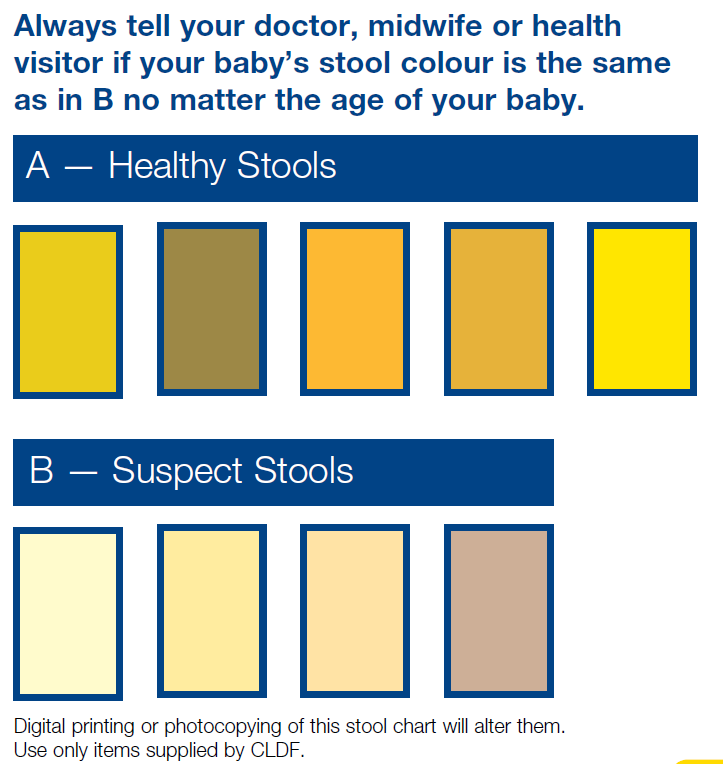
Stool colour chart

Presents with prolonged jaundice. Dark urine, pale (white!) stools distinguish it from common, benign breast feeding jaundice, but often missed. Parental reporting of stool/urine colour is unreliable! Stool colour chart available from Children’s Liver Disease Foundation.

Normally distal but 20% proximal.

Associated with SPLENIC MALFORMATION syndrome (poly or asplenia, situs inversus, malrotation, absent IVC).

Lanarkshire incidence 1.26 per 10 000, significantly higher than rest of Scotland!  NO evidence of genetic factors.  Pigweed in pregnant ewes in Australia – “biliatresone” toxin. Industrial waste…?

Investigations

Colour of stool!

Fasting (4hrs) USS essential, but sensitivity is operator dependent

Treat by Kasai Porto-enterostomy before 6 weeks ideally (16% normal LFTs, 18% portal hypertension, 94% survival @5yr +/- transplant), else liver transplant.

1yr phenobarb, urso, Vit K.  Long term Dalivit.

Consider varicella vaccination if likely for transplant!

Prognosis

Prognosis related to clearing of jaundice, established cirrhosis/fibrosis, cholangitis, biliary stricture, portal hypertension (degree of – most have).

60% clear jaundice, up to 60% require transplant in first 2yrs.  Of the rest, half need transplant in childhood, leaving just 20% getting to transition with native liver.Most mortality due to transplant complications.

New Japanese data suggests length of jaundice more important than age (traditionally 45-60 days low risk for liver failure)

Outcomes from Kasai operation are better in centres doing more than 5/yr, so only 3 supra-regional centres in England.  But outcomes in Scotland seem to have got worse, even though overall better!  Up to surgeon whether feasible or not for an individual patient.

Increased sepsis due to gut organisms from Roux-en-Y loop.

Cholangitis – features can be seen on USS.  Characteristically unwell, febrile with rise in bilirubin and LFTs (but not always).  Rx Tazocin.  Some require antibiotic prophylaxis.

Portal hypertension can develop early or late.  May present with variceal bleeding, low platelets, splenomegaly. Managed by banding of varices, TIPS shunt, transplant.

Strictures present with biliary stasis, itch, pain, coagulopathy. 

[Rachel Tayler]

SARS

Severe acute respiratory syndrome – caused by one of the coronavirus group, see also MERS and COVID19. The virus probably originated in bats (which commonly carry coronaviruses), then crossed into humans via masked palm civets at the live animal market in Guangdong, China.

The virus spread beyond its original outbreak in China when a businessman became unwell on his flight out of China and died in Vietnam in 2003. Further outbreaks appeared rapidly, as far afield as Toronto. Eventually led to 8000 cases globally, but rapid surveillance and isolation measured brought the epidemic to an abrupt end within 4 months.

Super shedders exist, who have much higher infectivity (1 case on a plane infected 120 others, whereas another plane had 4 cases on board, but no secondary cases occurred!). On the other hand, there is no documented transmission by asymptomatic cases, or between children.

Incubation period is 5-7 but up to 14 days. Spread is by respiratory, fomites, and faecal-oral routes. Peak shedding occurs at peak of clinical disease hence outbreaks were often among health care workers.

Symptoms are ‘flu-like, and non-specific. Fever is universal. Those who do badly have sudden deterioration on 10th day, with ARDS. Mortality is around 10%, but very age dependent, reaching over 50% in the over 65s. Children have lower viral loads, and generally have a benign course. Compared with adults, they perhaps get more gastrointestinal symptoms than respiratory.

Children under 5 yrs are hardly affected at all – perhaps because recent coronavirus infection protective, perhaps because of reduced immune reactivity.

No long term morbidity seen in children.

The diagnosis is suggested by the paucity of clinical signs (mild crepitations only, if anything) with an abnormal chest radiograph (non-specific), and laboratory evidence of leucopenia, lymphopenia, and thrombocytopenia. Raised AST/ALT also seen.

Definitive diagnosis is by ELISA or PCR, neither of which is very sensitive, or useful early on in disease.

Interferon alpha appears to be of benefit in vitro. Otherwise supportive.

Personal Protective Equipment effective if used properly – so buddy system.

Infection control – encourage self isolation, dedicated staff etc.

MERS

Middle East respiratory syndrome, caused by a coronavirus
(MERS-CoV) . See also COVID19 and SARS.

Reported 2012.  More than 2000 cases so far, mostly related to Arabian peninsula, but a single case of MERS-CoV in a returning traveller led to an outbreak involving 186 cases across 16 hospitals in the Republic of Korea.

36% mortality, mostly people with co-morbidities. More than 2000 cases so far. 

One of WHO blueprint priority diseases – potential for serious outbreak, no treatment or vaccine (6-7 others: SARS, Crimean-Congo HF, Ebola, Lassa etc).

Incubation time 2-5 days but up to 14. Median onset to hospitalisation 4 days.

Risk factor appears to be camel contact – milk, meat, urine.

Management

Management based on experience of SARS etc.

Infection control – negative pressure, dedicated staff, cleaning, PPE for suspected cases, self isolation for close contacts. 

COVID19

Hogmanay 2019, WHO were informed of cluster of cases of pneumonia of unknown cause in Wuhan city, Hubei province, China.

Novel coronavirus identified, named SARS-CoV-2. “COVID19” is associated disease. 75% genetically identical to SARS (severe acute respiratory syndrome) and 50% to MERS (Middle East respiratory syndrome) but of course these are both similarly capable of causing severe disease, whereas many coronaviruses pretty benign.

Most likely origin is from live animal markets in Wuhan, although intermediate animal (SARS was found eventually to have crossed over via civet cars). Evidence suggests that there were 2 different llineages in Wuhan, so presumably 2 different Patient Zeroes (which goes against lab leak theory).

By end of February 2020, more than 70 000 cases reported across China, 2500 fatalities. Pandemic was declared by WHO on 11th March.

Cruise ships including the Diamond Princess in Japan (over 700 cases) and the Zaandaam were particularly hard hit.

Lockdown declared in UK on 23rd March 2020.

5 variants of concern, most recently Omicron.

Risk factors

Spike (s) protein binds to ACE2 receptors, primary role of which is to convert AntiThrombin-II into AT-1,7, controlling heart rate, hypertension, vasoconstriction, sodium retention, oxidative stress, inflammation, and fibrosis, as well as enhancing baroreceptor sensitivity. ACE2 variability across populations potentially explaining particular susceptibility among people with hypertension and Africans (nearly double rate of whites) and Asians (although Indian rates lower than Bangladeshi/Pakistani). Rates among Chinese females actually lower than among Whites! [UK data]

At least 3% of severely affected people have known or previously unrecognised genetic defects in type 1 interferon production (especially TLR3 and IRF7 which amplify production).

Risk of “critical illness “ from COVID-19 RR 1.44 if overweight, 1.97 if obese. UK OpenSAFELY analysis. Death 1.27 if BMI 30-39, 2.27 if BMI>40. ACE-2 higher in obese. Plus different immune responses and challenges to ventilate.

London has double the age standardised mortality of any other part of the UK (Birmingham next), as high as 144 per 100 000 in Newham. Glasgow’s rate is about 80 [UK data].

Diabetes, cancer and poorly controlled asthma associated with death in primary care records study. Residential care homes, health care workers, social deprivation, Black/Asian groups also seem to be particularly at risk of death.

Bronx worse hit than Manhattan, despite similar population density. Higher attack and death rates among Afro-Americans. Role for air pollution too?

Plot of mortality rates by gender/race

Pregnancy increases risk slightly, not much risk to baby although elective preterm delivery may be part of management of sick mother.

Acute neurological presentations in adults, including stroke and Guillain Barre syndrome. Thrombosis risk.

Transmission from asymptomatic cases seems to be less important than symptomatic and pre-symptomatic (1-2 days).

In adults, low lymphocytes, high neutrophils and D-dimer predict mortality.

See Treatment.

COVID in Children

Probably more severe than SARS but still children tend to be less severely affected than adults. Cross protection from immunity from other coronaviruses? Differences in ACE2? Some asymptomatic.

16% of hospitalised children admitted to critical care. Age under 1 yr, or age 10-14 yrs, co-morbidities, black ethnicity are risk factors for critical care admission. Mortality rate less than 1% in hospitalised [Swann, ISARIC study]. 3 PIMS deaths in England, all 10-14yrs. 70% of all COVID related deaths in non-white groups. 24% of deaths had no co-morbidities, 60% had life limiting condition. No deaths in kids with asthma, diabetes, Trisomy 21.

Wheeze uncommon.

X-ray more often negative; CT more sensitive.

Can present with GI symptoms.

One baby born to an infected mother developed severe complications.

Neutrophil and LDH counts go up, lymphocytes go down.

A small series of children with COVID-19 has shown a greater prevalence of peripheral halo (halo-sign) lung consolidations on CT.

The criteria for the definition of Acute Respiratory Distress Syndrome (ARDS) and septic shock, the guidelines for the management of sepsis and septic shock and the use of non-invasive ventilation in children are different from those of adults.

Children desaturate more easily during intubation; therefore, it is important to pre-oxygenate with 100% O2 with a mask with a reservoir before intubating.

A rectal swab may be useful in children to determine the timing of the termination of quarantine.

[Chengdu and Italian experience, from PIPSQC]

WHO supports use of dexamethasone in patients with acute respiratory presentation and hypoxia (sats<90%), tachypnoea, or severe respiratory distress. RECOVERY trial continues to study dexamethasone in neonates, plus roles for azithromycin and toculizimab.

Sotrovimab is first line treatment, Remdesivir second line is licensed in hospitalised patients in oxygen, over 12 years and over 40kg and can be considered in this age group for patients with high-risk comorbidity for non-hospitalised patients also. Treatment should be commenced within 5 days of symptom onset (Sotrovimab), within 7 days of symptom onset (remdesivir). Paxlovid (Nirmatrelvir plus Ritonavir) is alternative first line option in adults.

Paediatric multi inflammatory syndrome associated with COVID19 (PIMS-TS)

See PIMS.

Autoimmune hypothyroidism

Associated with other autoimmune conditions, of course, especially diabetes , Addisons and coeliac disease.

If high TSH and low T4, goitre and positive TPO antibodies, then diagnosis clear.

Isolated high TSH is seen with some drugs and after acute illness. Persistently high TSH and normal T4 might be subclinical hypothyroidism. Treatment is recommended if symptoms/signs, especially if TPO positive as likely to become hypothyroid at some point anyway (pregnancy and infertility are other indications).

If TPO neg and no signs/symptoms, USS can be useful just to confirm evidence of thyroiditis.

Funny results are seen with TFT testing sometimes, appears to be interference of some kind – repeat with a different lab! Do T3 as well.

Management otherwise same as congenital hypothyroidism. Maintain TSH at any point within reference range unless symptomatic (RCT of aiming for lower limit did not show any benefit, plus risk of adverse effects). 

In adults, treat hypothyroidism if two TSH results over 10 – but consider also symptoms.  For lower levels, consider 6/12 trial of treatment.

Idiopathic thrombocytopaenic purpura

or ITP for short. Mostly primary school age children – rare under 2yrs.

80% of children with ITP will recover spontaneously within 6–8 weeks.

Diagnosis

Diagnosis by exclusion, because lots of causes of low platelets. Can occur at any age, but in neonates maternal ITP or alloimmune thrombocytopenia more likely.

In acute ITP:

  • Short history: purpura/bruising appear over 24–48 hr.
  • No patterning, and not tender. Often in mouth (cf trauma).
  • Platelet count usually less than 10–20/fl but may be 0 (with few symptoms or signs!)
  • Children with counts above 20 rarely show any symptoms cf other causes.

May follow an acute viral infection or within 6 weeks of immunisation esp MMR (1 in 24 000 risk).

(The CSM recommend that children who develop MMR associated ITP should have serology checked and a second dose given if not fully immune – rubella associated ITP is a bigger problem than MMR associated ITP!).

ITP associated with Varicella needs special caution: occasionally more complex coagulation disorders viz antibodies against proteins S +/or C.

Differential diagnosis

A chronic history, with symptoms developing over weeks or months, is possible in ITP but suggests something else. See bruising – beware non-accidental injury (NAI) and meningococcal disease: children with infection usually have other features and non-accidental injury does not present with generalized purpura.

Special diagnostic considerations in older children

  • Children over the age of 10 more likely to have a chronic course.
  • Consider other autoimmune diseases esp systemic lupus erythematosus (SLE) and antiphospholipid syndrome

Investigations

  • Full blood count and film.
  • Coagulation screening. Only necessary if there is a possibility of meningococcal infection, other features suggestive of an inherited bleeding disorder, or a suspicion of NAI.
  • Group and save in case needs treatment/transfusion later.
  • (Antiplatelet antibodies do not assist in the diagnosis)
  • Bone marrow aspiration. Normal bone marrow excludes some causes of thrombocytopenia but does not explain peripheral destruction. Consider if therapy is considered (esp steroids), in the presence of atypical clinical features or if no response to treatment.

Management: general measures

Classify clinically and not by platelet count, because even with severe thrombocytopenia (less than 10 /fl) clinical symptoms usually “mild”. Equally, pronounced skin purpura and bruising, however extensive, do not indicate a serious bleeding risk on their own and serious complications are probably rarer than sometimes quoted.

  • Two UK national surveys of children with ITP have demonstrated that only 4% of children with ITP have serious symptoms such as severe epistaxis or GI bleeding.
  • Several studies have confirmed that the incidence of intracranial haemorrhage (ICH) is 0.1–0.5% (cf 1- 3% as widely quoted) – only 2 UK cases, complete recovery in both.
  • Impossible to predict which children will develop an ICH – ?other predisposing factors eg underlying vascular anomaly. ICH has occurred in children who have been treated.
  • The severity of bleeding at any given time, esp at presentation, does not predict the risk of subsequent episodes of serious bleeding.
  • Children who continue to be severely thrombocytopenic with significant bleeding symptoms are very rare – refer to a specialist centre for management.

Treatment: Watch and Wait policy

  • More than 80% of children with acute ITP will not have significant bleeding symptoms (brief mucosal bleeding only) and will not need treatment to raise count. It is essential that the parents, and child where able, have an explanation that this is usually a self-limiting benign disorder.
  • Hospital admission should be reserved for children with clinically important bleeding (severe epistaxis, i.e. lasting more than 30 min with heavy bleeding, GI bleeding, etc.). Tranexamic acid can be useful.
  • Advise parents to watch for other signs of bleeding and give contact name and 24 h telephone number; as far as possible, avoid contact sports or activities with high risk of trauma or head injury. Hard with toddlers! Avoid immunisations. Helmet on bike/scooter!
  • Other activities can be continued as normal, and the child should be encouraged to continue schooling on the basis that ITP is a disorder that may last some weeks or months.
  • Repeat count within the first 7-10 d to check that there is no evidence of a serious marrow disorder emerging, eg aplasia.
  • Otherwise repeat platelet counts weekly or as clinically indicated by a change of symptoms (beware excessive family focus on numbers). While purpura still present, count is likely to be less than 20 /fl.
  • Minimise interference with schooling – deal with lifestyle limitation issues. “Most parents and patients can live quite comfortably with petechiae and low platelets awaiting spontaneous remission, providing their physician can!” (Dickerhoff, 1994).

Specific treatment to raise the platelet count

Several therapies raise the count faster than no treatment. However, all have significant side effects and none alters the underlying pathology nor increases the chance of complete remission. These strategies are appropriate for children with severe bleeding symptoms.

Recommendation: If a child has mucous membrane bleeding and more extensive cutaneous symptoms, high dose prednisolone 4 mg/kg/d is effective (Grade A recommendation, Level Ib evidence). It can be given as a very short course (maximum 4 d). There are no direct comparisons of low dose (1–2 mg/kg/d) with high dose therapy. If lower doses of 1–2 mg/kg/d are used the treatment should be given for no longer than 14 days, irrespective of response.

Other steroid regimens:

  • High dose methyl prednisolone (HDMP). This has been used as an alternative to IVIg because it is cheaper and effective.
  • Pulsed high dose dexamethasone. This treatment appears to be less effective in children than in adults in producing long-term remission, but may be useful as a temporary measure.

Intravenous immunoglobulin is effective and seems to work more quickly cf steroids (mean 2 days to achieve plt count of 50 cf 4 days). Works by binding to spleen receptors, reducing platelet destruction. Expensive and invasive, reserve for emergency treatment of patients who do not remit or respond to steroids and who have active bleeding. It is an appropriate treatment to enable essential surgery or dental extractions. IVIg is a pooled blood product, the risks of which must be explained to patients. It has significant side effects (75% of children, esp severe headache).

Recommendation: IVIg can raise the platelet count rapidly, but should be reserved for emergency treatment of serious bleeding symptoms or in children undergoing procedures likely to induce blood loss. It is effective given as a single dose of 0.8 g /kg (Evidence level Ib, Grade A recommendation). Lower doses are also effective, and fewer side effects are seen, in younger children; but usually it is used for emergencies where a higher dose eg 1g/kg may be more appropriate.

Anti-D immunoglobulin is less expensive than IVIg and can be given to Rh (D) positive individuals as a short infusion, and is therefore amenable to outpatient therapy. It is as effective as IVIg in children when given at sufficient dosage (45–50 lg /kg). The mechanism of action is not fully understood. Like IVIg, anti-D is a pooled blood product; some degree of haemolysis is commonly seen, occasionally severe and is associated with renal failure. Lower dose treatment is less effective at raising the platelet count than IVIg.

Tranexamic acid (oral) – not if macroscopic haematuria (risk of obstruction).

Use of platelet transfusions

Life-threatening haemorrhage is the only indication for platelet transfusion in ITP, a destructive platelet disorder where transfusions of normal doses are unlikely to be effective. In a life-threatening situation (such as the rare ICH) larger than normal doses are required with monitoring of the increment as a guide, and other modalities such as high dose IV steroids and IVIg should be given at the same time to maximise the chances of raising the count and stopping the haemorrhage.

Chronic ITP in childhood

The management of children with continuing thrombocytopenia (6 months) is essentially the same as for acute ITP. Many children settle with an adequate platelet count (i.e. more than 20 /fl) and have no symptoms unless injured. In children under 10 years of age at diagnosis spontaneous remission is likely to occur eventually eg within 15 years; expectant management can continue.

Children more than 10 years of age at diagnosis, esp girls, are more likely to sustain a chronic course but tends to attenuate over time.

Most children need no specific therapy to raise the count unless injured or requiring surgery or dental extraction. Particular problems may arise for girls at the onset of menstruation. It is advisable for the family to carry a card, letter or medical bracelet with details of the disorder in case of emergency eg trauma.

Children with counts persistently below 10 /fl are likely to have some symptoms, e.g. easy bruising or odd petechiae. Very rare, and are difficult to manage – refer such chronic severe ITP (CSITP) cases to paediatric haematologists with a special interest.

A significant group of children with ITP have counts of 10–30 /fl, and although they have no serious bleeding, are nevertheless troubled by purpura esp physical appearance, secondary school. Lifestyle issues and restrictions on sporting activities become more important and should be taken into account in considering therapy. Intermittent treatment with IVIg can be given to cover activity holidays after appropriate discussion of the risks.

Splenectomy is often considered, but it is ineffective in around 25% of cases, and most chronic cases remit spontaneously. It does bump the platelet count up with fewer symptoms but it is clear that the relapse rate with longer follow-up is high. Given that the risk of dying from ITP in childhood is extremely low (less than 1 in 500), that the mortality associated with splenectomy is 1.4 to 2.7% and that the risk of over-whelming sepsis probably persists for life, splenectomy is only justified in exceptional circumstances eg life-threatening bleeding.

The ITP Support Association