Category Archives: General paediatrics

Growth Faltering and Failure to Thrive

Infants are at high risk of undernutrition – high requirements for growth, frequent infections affecting appetite and increasing requirements, inefficient metabolism, dependence on adults for food!

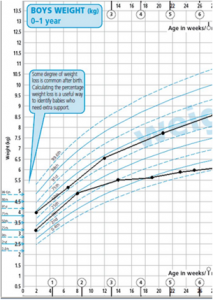
Faltering on growth chart

See Growth charts for details on different centile charts available.

There are various ways of defining or looking for undernutrition:

  • Wasting – ie low BMI or weight for height.  Pushed by WHO as way of identifying most vulnerable, but in affluent societies seems to mostly identify tall children
  • Stunting – low height for age, indicating chronic poor growth.  But in affluent societies, more likely to be constitutional or organic disease?  Social gradients in height in UK persisted until 1990s, but socially deprived short children had shorter parents and were smaller at birth, so not all nutritional.
  • Low weight centile – usually just selects out low birth weight babies.
  • Falling through weight centiles (“growth faltering”) selects for relatively large infants regressing to mean.

“Failure to thrive” has gone out of fashion.  “Thrive” seems to suggest something more than growth, but really we are just talking weight and height.  “Failure” suggests not only that there is a definite problem, but also that it’s somebody’s fault! Variability in definition and use.

The main issue here is poor sensitivity and specificity for a genuine problem.  27% of Danish cohort infants met one or more of 7 different growth criteria in at least one of the two age groups (2–6 and 6–11 months of life). The concurrence among the criteria was generally poor, with most children identified by only one criterion. Positive predictive values of different criteria ranged from 1% to 58%. Most single criteria identified either less than half the cases of significant undernutrition (found in 3%) or included far too many, thus having a low positive predictive value. [Olsen, Arch Dis Child 2007;92:109-114 doi:10.1136/adc.2005.080333 ]

Things get even less consistent in older kids, where you can have low fat but apparently normal growth except at the extreme end of range.

Combination of weight faltering and low BMI is perhaps best.  These kids subsequently have growth and body composition patterns suggestive of previous undernutrition.  Overall, about 2/3 of kids with either weight faltering or low BMI probably adequate nutrition but variant growth pattern.  Weight faltering kids are relatively short at follow up, but not more so than parents, so probably “catching down”. [Proceedings of the Nutrition Society. 71(4):545-55, 2012 Nov. PMID: 22954067]

Causes

Deprivation

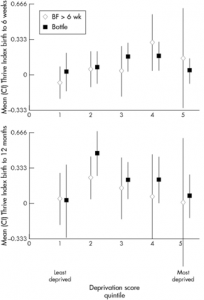
Undernutrition is NOT associated with deprivation in UK, presumably as welfare focuses on families with young children. In the Gateshead Millennium Baby Study, both the highest and the lowest levels of deprivation were associated with weight faltering; this was independent of the type of milk feeding. No relation was found with maternal educational status.

Thrive index by deprivation quintile, under 6 weeks and up to 1 yr

Abuse and neglect are a factor in only a minority of cases.

Some evidence of differences in maternal feeding behaviour and appetite, eating behaviour. In Gateshead study maternal eating restraint (“I need to control how much I eat”) was unrelated to weight gain.  Response to food refusal seems important.

In Gateshead study, infants of mothers with high depression symptom scores (EPDS >12) had significantly slower weight gain and increased rates of weight faltering up to 4 months (relative risk 2.5), especially if they came from deprived families, but by 12 months they were no different from the remainder of the cohort. [Arch Dis Child 2006;91:312-317 doi:10.1136/adc.2005.077750]

Either low appetite or actually not undernourished in strict sense!

Fussy eating

Being faddy was only weakly associated with poor growth, and simply eating a limited variety was unrelated to growth [cf high eating restriction scores]. High milk consumption was associated with lower appetite but not with poor growth.[ Pediatrics. 120(4):e1069-75, 2007 Oct. UI: 17908727]

See Fussy eating

Outcome

In Newcastle, There was a significant positive relationship between weight gain in infancy and picture vocabulary at age 10, adjusted for economic deprivation, gestational age and birthweight, but not with any of the other outcomes. There was a statistically significant association between birthweight and all four outcomes, where best outcome is at or just above average birthweight. In this population, the association between early growth and cognitive outcomes is stronger for growth before birth, postnatal weight gain having a relatively minor impact.[ Paediatr Perinat Epidemiol. 2007 Jan;21(1):57-64.]

Management

Being able to see what happens in the house at mealtimes is the most useful thing! Interventions that include home visits work best.  So Health Visitor is key.

Speech and Language, Dietician advice may be appropriate in some cases.

Identifying children with underlying medical problem important, even if these are a minority.  Similarly those with social concerns. But proportionate response to symptoms and signs important, rather than long lists of investigations.

Although tempting, high energy oral supplements eg Pedisure suppress appetite for normal food.  In series of 48 kids referred to a tertiary feeding clinic who were taking predominantly supplements (half neurodevelopmentally abnormal), most were successfully weaned off and had improved feeding behaviour a year later.  Average weight Z score unchanged, 17% had significant catch up growth. [Archives of Disease in Childhood. 100(11):1024-7, 2015 Nov. UI: 25809349]


Chronic Granulomatous Disease

A neutrophil defect, prediposes to certain characteristic organisms. Frustrated neutrophils cause granulomas, hence the name: these are responsible for some other characteristic features of the disease.

Due to NADPH oxidase mutations, causing reduced oxidative burst (needed by neutrophils to kill pathogens after phagocytosis). Various types depending on which subunit affected. X linked gp91phox def (ie NADPH OXidase, due to CYBB gene defect) is severe, p47phox is autosomal and milder (NCF1 gene, partial activity retained). Other gene defects are CYBA and NCF2, funnily enough, and RAC2. Phenotype varies even between mono twins (factors?). Since non-oxidative killing is then the only remaining immune mechanism, the most important pathogens are catalase positive (an enzyme to make bugs resistant to the peroxide and superoxide produced by neutrophils or by the bacteria themselves as a toxic byproduct). Register exists in UK.

Usually present by 2 yrs but occ not until adulthood. Most commonly lymphadenitis (often culture negative), skin infections (esp perianal), pneumonia. Hepatomegaly is a clue. Other sites of infection are osteomyelitis, liver abscesses (distinctive, fibrous capsule, septated, thick contents – vague presentation, blood cultures usually negative so low index of suspicion).

Probably not the superoxides themselves that are important; MPO deficiency does not tend to present with infections! Critical step is probably degranulation of primary granules, with release of elastases etc. Superoxides probably deal with toxic metabolites rather than doing the killing.

Chronic inflammatory problems occur (due to having intact upregulated phagocytic activity with reduced apoptosis):

  • BCG causes lymphadenitis in CGD, but does not disseminate.
  • colitis (characterized by pigment laden macrophages, quite specific for CGD but not very sensitive). Seen in 45% of X-linked, 10% of autosomal recessive. Tends to present with abdo pain rather than frank bleeding, often subclinical, may account for FTT.
  • lupus like rash and illness
  • Poor wound healing (classically dehiscence at 10/7 post op, non-purulent)
  • cystitis
  • pericarditis
  • chorioretinitis
  • Hollow organs may become obstructed by granulomas esp oesophagus, gastric outlet, bladder.
  • pulmonary fibrosis

Mums who are carriers of CGD can be symptomatic even with fairly decent percentages of functional neutrophils incl aspergillus! Due to lyonization.  Onset variable.

Diagnosis

Nitroblue tetrazolium (NBT) test now replaced by Dihydrorhodamine test on flow cytometer (false positive esp in preterm so always check with reference lab). Only takes 15 mins!

The organisms found are also characteristic:

  • Staphylococcus aureus – found in most liver abscesses as well as in skin
  • Enterobacteria – Enterobacter, E coli, Salmonella, Klebsiella, Aerobacter, Serratia, Yersinia, Proteus
  • Aspergillus – mostly fumigatus but A. nidulans is emerging in US, and Candida albicans, Scedosporium apiospernum and Chyrosporium zonatum reported. Can be acute, esp after inhalation eg digging in garden. Biopsy may be needed to make diagnosis. Steroids useful for severe inflammatory disease!!!
  • Burkholderia cepacia – looks identical to Pseudomonas, so any Ps not specified as aeruginosa should be considered suspect! (Pseudomonas itself is catalase positive but susceptible to non-oxidative killing so is not a problem).
  • Septicaemia is v rare ! – but may be seen with B. cepacia.
  • Nocardia common in US, rare in Europe – gram positive soil organism, forms filaments like a fungus. Usually pneumonia but also skin, CNS. Sensitive to co-trimoxazole.
  • Actinomycosis – even though catalase negative!

Note that you do NOT see PCP, strep, onychomycosis (despite susceptibility to fungus) or lymphomas (cf granulomas).

Patients are often anaemic with an iron-deficient pattern but resistant to iron supplementation (except in bowel disease, ?vitamin B12 def). ESR is often raised even when well. Less of a problem with CRP.

Management

Co-trimoxazole prophylaxis (daily dosing, not 3x weekly as in PCP prophylaxis) good because active against typical bugs, and intracellular. Itraconazole is prophylactic vs Aspergillus.

Avoid BCG because of tendency to form abscess.

Cipro and Fluclox good for first line – effective against typical organisms, and cipro acts intracellularly. In serious pneumonia, empirical treatment should consist of Ceftazidime/Meropenem, Fluclox and Amphotericin. Because of the range of possible organisms, bacteriological diagnosis should not be delayed and tissue biopsy sought if non-invasive methods unsuccessful.

Steroids for colitis, cystitis and obstructive granulomatous disease. Also for poor wound healing!

Other adjuncts:

  • Voriconazole is an effective oral antifungal, so useful when no tissue diagnosis (beware accumulation of amphotericin with long term use, causing permanent renal damage).
  • Interferon (IFN) gamma – effective as prophylaxis in large Multicentre study, but strong centre effect with less benefit in Europe (in fact the lowest incidence seen with antibiotic prophylaxis) so not universally used (but safe). Less evidence in established infection but that’s when it tends to get used! Increases NO production by neutrophils, by improved RNA splicing efficiency(?). Give three times a week by subcut injection; side effect is fever and flu-like symptoms. Better antifungals mean it is used less now.
  • Granulocyte infusions (apheresed from donors after GCSF priming) can be done every 1-2 days (or instilled directly into lesions) but rarely needed now with better antifungals. Increases risk of reaction to Ambisome, plus you become sensitized, which will hinder transplant prospects. Can support infected kids through BMT.
  • Surgery may be necessary to remove infected tissue, may help get positive culture.
  • BMT is indicated at diagnosis if a matched donor is available.
  • Gene therapy has produced transient improvements only.

Median survival 30 years – NB compliance with prophylaxis by adolescents. So consider transplant.

[Clin Exp Imm 122(1); October 2000 pp 1-9 GOLDBLATT, D; THRASHER, AJ]

Recurrent boils

Potentially symptom of diabetes, chronic granulomatous disease, Hyper IgE syndrome – but more usually just an individual thing, or a nasty strain of staphlycoccus aureus.

GOS says if otherwise well (no other abscesses, no colitis, no weird organisms eg Serratia) then consider eradication with:

  • Naseptin – a medication taken four times a day for a period of 10 day.s
  • Chlorhexidine shower or bath and hairwash every day for a period of 14 days.
  • Keep a separate towel for each member of the family, change for a clean towel every two days and wash the dirty towels on a hot wash cycle.

[http://www.gosh.nhs.uk/medical-information-0/search-medical-conditions/recurrent-boils]

Fatty Acid Oxidation Disorders

Various eg CoA disorders eg MCAD, LCAD, VLCAD; Carnitine disorders (transports fatty acids into mitochondria). Present with severe hypoglycaemia.

There are related lipid storage disorders eg Fabry, Niemann Pick, MCLD where hypoglycaemia is not a feature.

AST/ALT raised, due to protein breakdown for gluconeogenesis. Acylcarnitines, organic acids abnormal.

MCAD

=Medium Chain Acyl CoA Dehydrogenase deficiency. Can be asymptomatic eg parents of newly diagnosed child, even with same gene defect! Crisis – vomiting, hypoglycaemia, hyperammonaemia, sudden death.

Diagnosis: Octanoyl- acylcarnitine increased.

Management is by avoidance of fasting , plus carnitine! Newborn screening started in UK in 2009.  

Carnitine deficiency

In primary deficiency, there is non ketotic hypoglycaemia and cardiomyopathy, hepatomegaly, hyperammonaemia.

Various other abnormalities. Usually acylcarnitine, organic and amino acid analysis will clarify.

Glycogen Storage Disorders

Various. Not a problem of storing it, a problem of breaking it down! Classic type 1 is Glucose -6-phosphatase deficiency. Depending on the type, gluconeogenesis as well as glycogenolysis may be impaired – some of the enzymes are involved in both – so hypoglycaemia with ketones, lactate and triglycerides high. Liver becomes enlarged with excessive glycogen, Glucagon has no effect.

Managed by regular meals and extra complex carbohydrate eg cornstarch, as for ketotic hypoglycaemia.

Glycogen synthase deficiency is sometimes included. If you can’t make glycogen then you get an immediate glucose dip post prandially, you don’t get a big liver (obviously) but other mechanisms work ok so lactate is normal (cf typical Glycogen storage disorder).

Pompe disease is a lysosomal disorder, infantile form affects heart, neurodevelopment (enzyme treatment available).

McArdle syndrome is myophosphorylase defect – pain/weakness/cramps on exertion, myoglobinuria, second wind phenomenon (rapid recovery with rest).

Ketotic hypoglycaemia

What happens when you don’t eat enough and your carbohydrate stores run out!  Typically due to illness, especially with vomiting.

But  can be endocrine cause eg hypopituitarism, adrenal insufficiency. Growth hormone deficiency associated with recurrent hypoglycaemia even before growth failure apparent, associated with sudden death.

If you have excluded glycogen storage disorders (big liver, high lactate), glycogen synthase deficiency (normal liver, high lactate) and organic acidurias (acidosis, encephalopathy, usually high ammonia too), can be idiopathic (usually SGA at birth, thin, presents under 4yr, resolves by 7yr).

If ketones low and fatty acids high, then suggests fatty acid oxidation disorder (but usually just means hypoglycaemia was treated before sample was collected).

Regular meals + night time complex carbo snack, optimize nutrition, carbs if unwell eg Maxijul + Electrolade else Ribena/apple juice.

Childhood absence epilepsy

  • Age 3 to 10 yr
  • Abrupt onset and cessation
  • Most are complex ie clonic movements, minor changes in tone (eg head drops, or held object dropped),
    automatisms (repetitive movements of eyes, mouth).
  • No myoclonus (else likely to be juvenile myoclonic epilepsy). Some get generalised tonic-clonic seizures in adolescence but these are infrequent and respond well to treatment.
  • Precipitated by flashing lights, sleep deprivation, hyperventilation (90% detected after 3 minutes – get them to count aloud)
  • Atypical have more gradual onset, last longer, have more obvious changes in tone – but continuum
  • The SLC2A1 gene codes for the glucose transporter protein type 1 (GLUT1), involved in glucose transfer across blood-brain barrier. Heterozygous mutations are mostly de novo but may be inherited as AD trait. There may be mild learning and motor delay, but more often it presents with early absence seizures – GLUT1 mutations are present in up to 10% of early childhood absence epilepsy (ie under 5yrs). The importance of the diagnosis is that the seizure are often intractable to valproate and ethosuximide, whereas a ketogenic diet will be effective.
  • EEG shows sudden onset 3Hz spike and wave, esp with photic stimulation/hyperventilation. Interictal is often normal.
    Clinically apparent if more than 3 seconds of activity, but detailed neuropsych assessment suggests that non-clinical absences do cause functional impairment. Atypical have slower spike waves and rarely have normal interictal.
  • 60-80% full remission, usually during puberty; in most cases, absences disappear on monotherapy but there are resistant cases (unpredictable, other than SLC2A mutations).

Occipital lobe epilepsy

Early (PANAYIOTOPOULOS) or BECOP (Benign epilepsy of childhood with occipital paroxysms).

Panayiotopoulos

  • Or Self limiting epilepsy with autonomic symptoms (SeLEAS)
  • Usually 3-5yrs but can be 1 to 15
  • Mostly nocturnal
  • Characteristically autonomic – pallor/flushing/vomiting/coughing!
  • Head/eye deviation, then tonic-clonic (one sided or generalized)
  • Often status, but actually seizures infrequent
  • EEG can be normal – sleep EEG more sensitive
  • Good prognosis – most remit with a few years and have just a few seizures
  • Valproate or carbamazepine

BECOP

  • Usually middle childhood, cf above
  • Can be triggered by going from dark to light areas or vice versa
  • Visual  – partial or complete loss, flashing lights, multi-coloured circles, balls, rarely hallucinations
  • Headache during or after – cf migraine!
  • Often one side jerks; rarely generalized
  • Carbamazepine or Valproate
  • Usually benign, most remit by puberty

Urine collection

For culture, looking for urine infection, traditionally midstream urine, or at least clean catch.  Hard if not toilet trained.

Ideally, avoid first portion of sample (easier if toilet trained), more likely to be contaminated.

Need to be well hydrated, of course.

In/out catheter and suprapubic aspiration are quick but invasive and unpleasant.

For babies, “Dangle-tap” urine collection method –

  • Feed first!
  • Then hold the baby under their armpits with their legs dangling (parent can do). Another person then starts bladder stimulation – gentle tapping in the suprapubic area at a frequency of 100 per minute for 30 s.
  • The third step is stimulation of the lumbar paravertebral zone in the lower back with a light circular massage for 30 s. Repeat as necessary.
  • Babies hate the suprapubic tapping, but often pee when you switch to back rub.

86% successful within 5 minutes, mean 57secs! Over 3 months hard as heavy and actively resisting.

Older babies – try Quick Wee – gentle suprapubic cutaneous stimulation using gauze soaked in cold fluid for 5 mins. 30% successful within 5 minutes.

[Madrid Infanta Sofia hospital, as reported in Arch Dis Child
2013;98:27-29 doi:10.1136/archdischild-2012-301872]]